





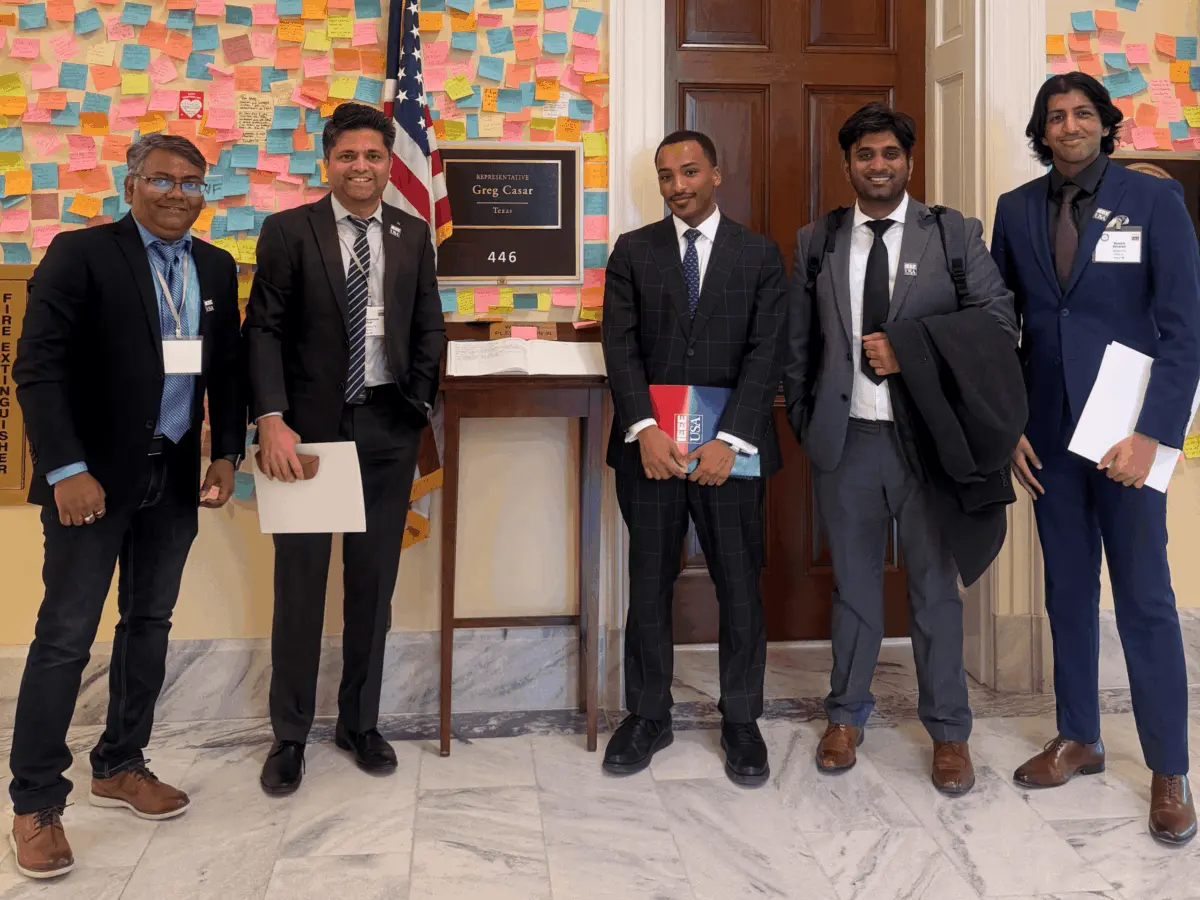
When San Antonio–based software engineer Nikhil Jathar first traveled to Washington, D.C., to advocate for federal support surrounding technology education and research funding, he found himself overwhelmed by a profound sense of awe. It was the spring of 2025, not long after Jathar had settled in the United States following his move from India. Newly established in his career and eager to engage with the broader civic landscape, he received an invitation to participate in the annual Congressional Visits Day organized by IEEE-USA, an event designed to bridge the gap between technical professionals and federal lawmakers.
“My first reaction was, ‘Wow, I get to visit Congress,’” recalls Jathar, who serves as the chief technology officer of AvanSaber, a business software company he cofounded in 2014. At the time of his initial invitation, he did not hold a specific lobbying agenda on behalf of his private enterprise. Instead, he was simply intrigued by the prospect—an opportunity extended broadly to all U.S. members of the Institute of Electrical and Electronics Engineers. As he began to read more about the history and impact of congressional visits, his motivation deepened considerably. He realized that this was an arena he needed to experience firsthand, driven by a simple curiosity to see where the journey might lead.
Congressional staffers note that they genuinely welcome the specialized knowledge and real-world perspectives that engineers like Jathar, along with other visitors traveling from outside the Washington beltway, bring to the table. However, these legislative aides emphasize that it is equally vital for visiting advocates to maintain clarity regarding their objectives and requests. A staffer for the House Committee on Science, Space, and Technology, who spoke on the condition of anonymity because of official office media policies, shed light on how federal policies take shape.
“Ideas for new policies come from multiple places. It could begin at the legislator or staff level, an ask from a constituent, or needs from industry. It’s up to us to figure out what would do the most good,” the staffer explained. “For instance, if you leave it to the lobbyists, they’re understandably going to do what’s in their clients’ interests.”
For engineers across the United States, direct dialogue with elected representatives remains an exceptionally effective method for shaping critical technological policies. Yet, as Jathar discovered over the course of two separate visits to Capitol Hill, maximizing this influence requires careful preparation, strategic alignment, and the right overall approach.
Mapping Your Way Into Washington
The constitutional responsibility of the United States Congress is to act on behalf of the populace, and the institution maintains strict guidelines governing how citizens and organizations may lobby its members. Federal regulations draw a clear legal distinction between broader grassroots advocacy—informal conversations between constituents and their federal representatives—and professional lobbying, which is carried out by paid agents and regulated strictly under the Lobbying Disclosure Act. Many professional societies, including IEEE and organizations such as the American Geophysical Union, the Massachusetts Institute of Technology Science Policy Initiative, and The Minerals, Metals & Materials Society, routinely organize specialized congressional visits for their members.
Because these organized visits can occasionally intersect with federal lobbying parameters, organizers provided Jathar with explicit instructions prior to his arrival. They reminded him that he was representing the broader organization rather than merely voicing his own individual opinions. Consequently, he needed to adhere closely to the standardized talking points that IEEE-USA had meticulously prepared for all its participants to promote across a wide array of congressional offices, regardless of each engineer’s specific industry specialization.
During Jathar’s inaugural visit to Washington, those organizational talking points focused on securing federal funding for smart grid infrastructure, authorizing robust research initiatives through the Department of Energy, and increasing sustained investments in science, technology, engineering, and math education. This dynamic highlights one of the inherent trade-offs associated with gaining direct access in Washington. The official priorities of IEEE-USA did not overlap perfectly with the day-to-day software development work that defined Jathar’s professional career at AvanSaber. Nevertheless, they represented broad, foundational enablers for the entire scientific and technological ecosystem. As Jathar notes, funding for STEM education remains a cause deeply close to his heart.
While any individual citizen is entirely free to approach their federal representatives in Washington to advocate for their own personal priorities, Jathar points out a practical reality of Capitol Hill. Given how intensely pressed for time congressional staffers consistently are, they are far more likely to prioritize scheduling meetings that reflect the shared views of large blocks of constituents.
“I could have gone outside the IEEE structure,” Jathar says, noting that congressional staff “are more likely to listen if you are part of a much bigger organization.”
For his first congressional visit, event organizers assigned Jathar to schedule meetings with the offices of several lawmakers from both major political parties, determined by his home district in Texas and national organizational strategy. He visited the offices of Representatives Greg Casar, a Democrat from Texas; Lloyd Doggett, a Democrat from Texas; and Barry Moore, a Republican from Alabama.
“Meeting a staffer or a senior member from their office is good. They tend to relate to these issues more than a representative, because a representative has 10 different high-level things they have to worry about whereas the staffer can be more focused on the policy details,” Jathar observes.
A typical congressional meeting of this nature generally lasts anywhere from fifteen minutes to a full hour. Recognizing the compressed nature of these appointments, Jathar quickly learned to keep his talking points remarkably concise and straightforward.
“First and foremost you’re gonna get a very small window,” he explains. “Make sure you’ve got everything ready to present in bullet points and not a lot of jargon. You can always bring that out later if they ask more questions.”
Furthermore, simple visual aids, such as concise one-page briefing handouts, can prove exceptionally helpful when communicating complex numerical figures or dense technical data to staffers.
The anonymous House Science Committee staffer strongly echoes this sentiment, emphasizing the value of targeted efficiency. “I prefer meetings where people know what they want and know what we’re doing in Congress,” the staffer notes.
In addition to presenting a clear, actionable request, the staffer advises that engineers and technical advocates must maintain a keen awareness of the congressional calendar. Advocates should ask themselves critical timing questions: Is Congress currently in the thick of appropriations season, and when is the next federal budget cycle scheduled to be finalized? How far along is a specific piece of legislation through the committee and floor process, and at what point is it actually realistic to effect meaningful changes?
During Jathar’s 2025 rounds on Capitol Hill, he experienced firsthand why thorough preparation is so critical. While visiting one congressional office, staff members politely pointed out that the legislator they worked for did not sit on the specific committee holding jurisdictional oversight over the particular IEEE-USA talking point the engineers were discussing.
“They explained that there are only certain things [the legislator] can do on that issue and that there are other people we need to talk to, to achieve more,” Jathar recalls of the educational exchange.
Shortcuts to Influence
Earlier this year, Jathar decided to return to Capitol Hill, armed with the hard-earned knowledge from his previous journey and operating once again within the structured framework of an IEEE-USA delegation. This time, however, he found himself uniquely positioned to provide something that legislative staffers actively crave from the engineering community: authoritative, firsthand technical expertise.
“When I introduced myself as a software developer to one staffer, his first question was, ‘Do you think AI will replace coders?’” Jathar says.
The conversation quickly evolved into an engaging dialogue, with the congressional staffer posing a series of probing questions to Jathar and his fellow engineering companions. Seizing the opportunity, Jathar explained that his company had developed an open-source business-management software suite known as ERPClaw, engineered specifically to operate seamlessly with artificial intelligence agents such as OpenClaw. This practical industry example led naturally into a broader, highly relevant discussion regarding the critical role of open-source software within the artificial intelligence landscape—a topic that directly aligns with one of IEEE-USA’s primary policy proposals aimed at democratizing artificial intelligence access. On this visit, Jathar successfully harmonized his organization’s formal advocacy agenda with his own deep technical expertise and the specific policy interests of the legislative staffer.
While it remains too early to predict the precise legislative impact that this particular round of advocacy might ultimately generate, these are precisely the types of informed, highly relevant proposals that congressional aides actively seek out.
“The people who build trust have more cachet with congressional staff because they’ve asked for something that’s reasonably thought out,” the House Science Committee staffer explains. In turn, empowered by credible information, congressional staffers are far better equipped to advocate internally within their offices for policies brought to them by individuals they trust.
Building that foundational trust often hinges on speaking candidly about the issues one genuinely cares about most. Interestingly, the House Science Committee staffer once walked the halls of Congress as an outside advocate before eventually transitioning to the other side of the legislative table. Reflecting on those early advocacy days, the staffer recalls relying heavily on prepared pitches provided by professional societies without possessing deep personal investments in every single talking point.
“I was making a pitch that was given to me without a lot of personal buy-in,” the staffer notes, adding that advocates “should feel emotionally connected to any issue you’re advocating for.”
Jathar’s passionate advocacy for the open-source software movement stems from precisely that kind of personal and professional conviction. The open-source paradigm provides smaller, growing enterprises with a sturdy technical foundation that they can readily adapt, modify, and build upon, while simultaneously empowering a global community of developers to extend and improve that work collectively.
“We can progress a lot faster,” Jathar concludes. “I’m not doing it only because it’s good for my business, but because I feel it’s good for any technological advancement.”