






For urban apartment dwellers, renters facing restrictive leases, or owners of tiny homes, mobile trailers, and RVs, the traditional built-in dishwasher is often an unattainable luxury. Limited kitchen square footage, absent water hook-ups, or landlords unwilling to invest in permanent kitchen renovations frequently leave residents with two less-than-ideal choices: endless hand-washing or going without. Fortunately, portable and countertop dishwashers have emerged as practical alternatives for households lacking the space for standard under-counter appliances.
Recent rigorous testing of these compact machines highlights how far the category has evolved, offering serious cleaning performance for spaces that traditionally forced residents to rely entirely on the kitchen sink. Yet, choosing the right machine requires understanding the distinct trade-offs between portable roll-around units and smaller countertop models, as well as evaluating whether a machine will genuinely save time and effort compared to efficient hand-washing.
Understanding the Landscape: Portable vs. Countertop Models
Navigating the market for small-space dishwashers begins with understanding the fundamental differences between portable and countertop configurations. A portable dishwasher shares most of its engineering with a traditional, built-in kitchen appliance. However, these models are mounted on wheels, allowing them to be rolled out of the way when not in use. During operation, they must be temporarily hooked up to a kitchen faucet using specialized adapter kits.
Testing reveals that hose-style extendable kitchen faucets frequently fail to form a secure connection with portable dishwashers, making standard, rigid spouts a requirement. Additionally, renters must always review their lease agreements before purchasing a portable unit, as some property managers explicitly prohibit them.
Countertop dishwashers target even tighter quarters, serving households of one or two people. Yet these compact appliances come with significant spatial and operational constraints. Most testing reveals persistent struggles fitting dinner plates larger than 10 inches in diameter, tall drinking glasses, or bulky pots and pans. Furthermore, these machines command a substantial footprint on kitchen counters.
For many single or dual-occupant households, traditional hand-washing remains a more economical and space-efficient option. Consumers concerned about water conservation can adopt simple habits—such as filling a basin or turning off the faucet while soaping a sponge—to drastically reduce water consumption. Because running a standard faucet consumes roughly 1.5 to 2 gallons per minute, letting water flow continuously for just three minutes uses nearly as much water as an efficient modern dishwasher.
Whether choosing a portable or countertop machine, buyers must weigh the reality of setting up water lines and managing internal tanks against the simplicity of washing dishes by hand.
Rigorous Testing Protocols for Compact Cleaners
To determine which machines truly deliver on their manufacturers’ promises, appliance experts adapted standard dishwasher testing protocols to evaluate cleaning performance, cycle lengths, ease of installation, and rack design.
Testing the cleaning power of these compact units involved simulating heavy household use. Portable models were loaded to match the demands of a four-person family, while countertop units handled two-person workloads. Technicians covered plates, glassware, and silverware with stubborn, hard-to-clean soils, including dried eggs, oatmeal, peanut butter, soy sauce, jam, creamed corn, pasta with tomato sauce, tomato juice, coffee, red wine, and lipstick. Inspectors observed how effectively each machine’s filters and built-in food grinders handled the debris, using a standardized amount of powder detergent across all tests.
Evaluations also focused heavily on normal and quick-wash cycles, while noting automatic sensor modes and eco-settings designed to conserve water. While manufacturers often load appliances with numerous specialized cycles, testers found that everyday cleaning rarely requires more than standard settings, making adjustable temperatures and wash boosts far more valuable for tailoring cycles to delicate wine glasses or heavily soiled cookware. Finally, researchers assessed how easily machines connected to water sources, how quietly they operated, and whether their rack designs could comfortably accommodate varied tableware without sacrificing cleaning efficiency.
Top Pick for Portable Cleaners: The GE GPT Series
For households that require the capacity of a larger machine but lack the space or plumbing for a built-in unit, the GE GPT series portable dishwashers emerge as the clear industry leader. Available in both 18-inch (GPT145SSLSS) and 24-inch (GPT225SSLSS) configurations, these machines combine prime performance, intuitive controls, and relatively straightforward setup procedures.
The GPT series simplifies installation by shipping with pre-attached input and output hoses, allowing users to connect the machine to a sink quickly once the correct faucet adapter is selected. Aside from minor lifting required to attach the bottom casters, the setup process can often be completed without tools. The control panel offers straightforward access to light, heavy, and auto-sense cycles, alongside temperature-boosting options like "wash boost" and "sanitize."
Performance testing demonstrates that the GE GPT series holds its own against full-size, built-in dishwashers. The 24-inch model accommodates up to 12 place settings, while the 18-inch variant handles up to eight, with lower racks spacious enough to manage average-sized pots, pans, and casserole dishes. Utilizing a standard powder detergent, the machine delivered exceptional results on sensor cycles, easily clearing away sticky residues, jams, coffee grounds, and heavy sauces, while occasionally requiring a bit of extra scrubbing for baked-on egg remnants—a challenge for nearly all compact dishwashers.
Notably, GE includes a built-in food grinder in the GPT series, a rare and welcome feature for a portable machine discharging wastewater into a sink. Furthermore, the thick, sturdy top of the appliance functions as a practical extension of kitchen counter space, capable of supporting cutting boards or fruit bowls once the casters are locked. While both sizes command a premium price point of around $850—putting them on par with or above standard built-in models—their best-in-class performance and ease of use justify the investment. Consumers seeking a budget alternative with a trickier setup and a lower price tag may consider the SPT SD-9263, though its installation hoses require significantly more plumbing expertise.
The Best Countertop Option: Loch Capsule
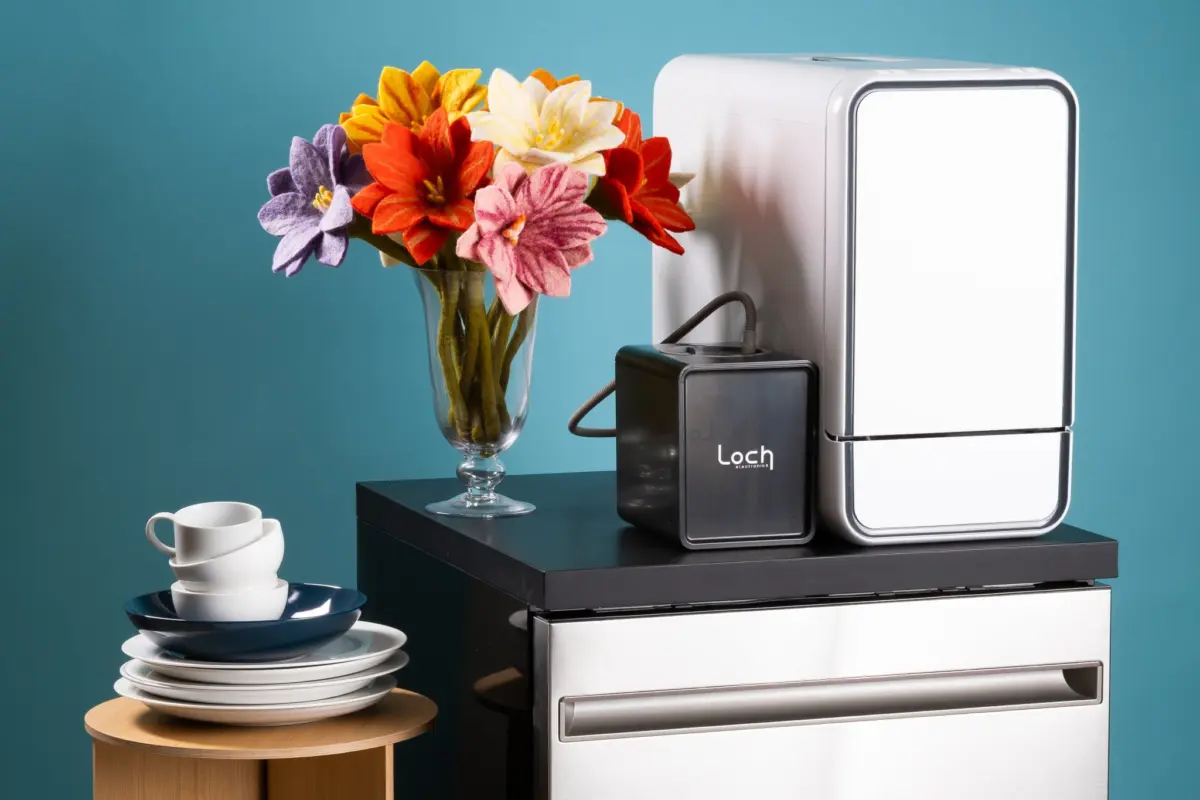
For consumers whose kitchens cannot accommodate a rolling portable unit, countertop dishwashers provide a smaller alternative. Among these, the Loch Capsule stands out as a strong cleaner with a remarkably slim profile, thanks in large part to its innovative external water tank.
Equipped with dual spray arms positioned at the front and back, the Capsule thoroughly attacks heavy messes across multiple cleaning modes. On longer cycles, the machine successfully eliminates baked-on egg, tomato sauce, yogurt, and starchy starches, while operating at a moderate hum comparable to an average vacuum cleaner. Its interior design accommodates larger plates and dishes better than many competing countertop models, featuring a thin gasket on the inner lip that allows taller tableware to fit securely without excessive leaning.
The Capsule offers flexible water-source options. While it can connect directly to a sink or water line with an optional hose, its most notable feature is an easy-to-fill external water tank that sits beside the machine during operation, automatically expelling dirty water back into the sink when the cycle concludes. Measuring roughly 20 inches tall, 10 inches wide, and 20 inches deep, the Capsule takes up less counter space than a traditional toaster oven, though buyers must carefully measure their kitchen real estate before purchasing.
Despite its high performance, the Capsule has minor drawbacks. Its rectangular, elongated shape requires loading from back to front, and the manufacturer advises against using detergent pods because they are too powerful for the machine’s efficient water usage. Additionally, the appliance features several gimmicky settings—such as fruit-washing and UV-sterilization modes—and lacks a viewing window to watch the wash cycle. Retailing for around $460, the Loch Capsule represents a significant financial commitment for a countertop appliance, but for buyers with severe space constraints, it provides a viable path away from the kitchen sink. Other alternatives, such as the scaled-down Loch Capsule Solo or the spacious GE Profile PZF560, cater to niche buyers depending on their exact plumbing setups and available counter space.