




While the global perception of Como is often anchored to its picturesque landscapes, historic villas, and storied traditions of silk-weaving and furniture craftsmanship, the region’s contemporary cultural footprint extends far beyond daily local production. For its eighth edition, the Lake Como Design Festival seeks to widen that field significantly. The event bridges the gap between historical heritage and modern experimentation, offering visitors a tangible dialogue between the past and present that unfolds room by room across historic spaces, curated exhibitions, and site-specific installations.
Framed by the overarching theme "Confine/Border," this year’s festival investigates boundaries not merely as rigid lines of division, but as dynamic zones of encounter, relation, and personal transformation. Emphasizing this conceptual boundary-crossing, the festival has expanded its geographic footprint this year, incorporating new exhibition venues in nearby Lecco alongside its traditional anchors in Como. Over the course of the multi-day event, visitors navigate a diverse array of installations that carefully balance the preservation of regional history with forward-thinking design trajectories.
The Contemporary Design Selection at Villa Saporiti
Serving as a central pillar of the festival, the Contemporary Design Selection returns under the curatorial vision of Giovanna Massoni and the direction of chief coordinator Francesca Prandelli. Hosted for the very first time within the stately rooms of Villa Saporiti, the exhibition serves as a testing ground for the fluid boundaries separating fine art from functional design, alongside the evolution of modern habits versus established traditions.
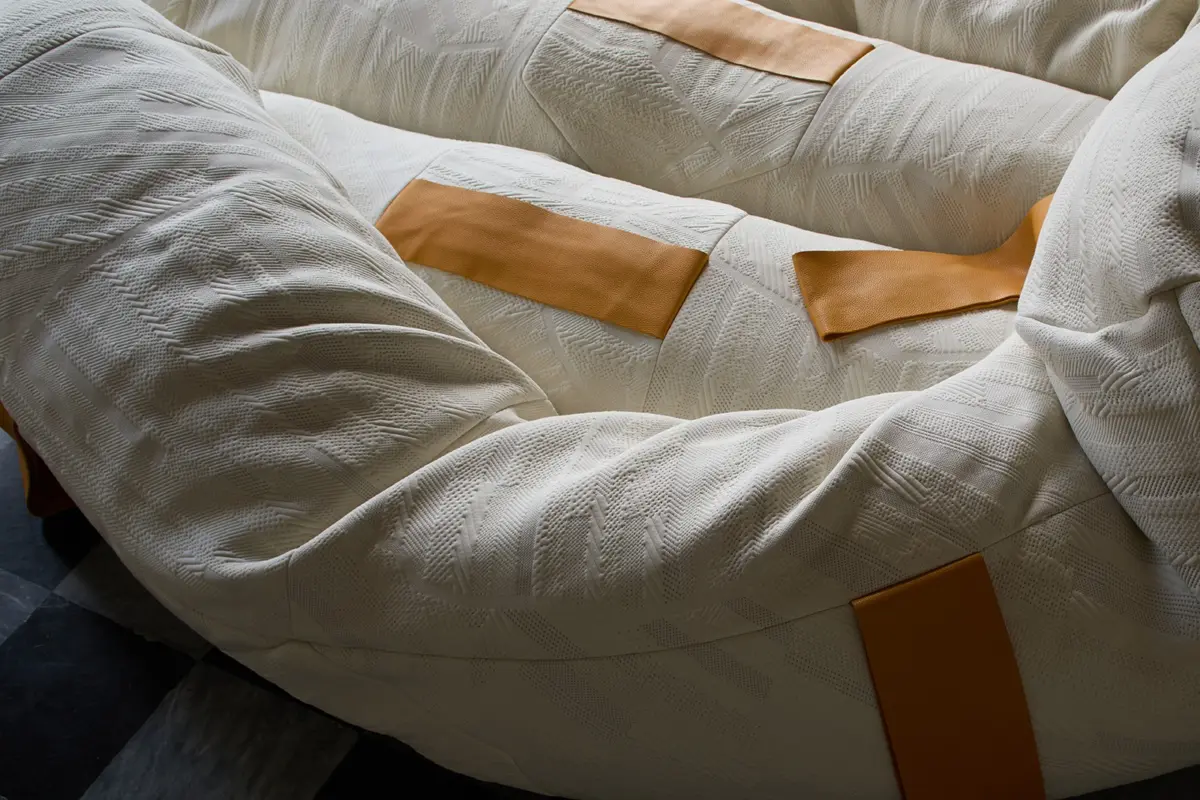
The exhibition brings together one hundred designers, makers, and artists representing approximately fifty countries. United by an inherent ease in operating across conventional disciplinary territories, these creators present works that challenge traditional categorization. Among the standout pieces occupying the historic halls is Soft Monuments by Rome-based studio Pastina. The installation features a monumental, malleable structure whose ambiguous geometry evokes human, animal, or bodily forms. Designed to be sat upon, reclined across, or reshaped entirely by the user, the piece deliberately blurs the physical border between the human body and domestic objects. The structure is upholstered in Groma, a novel textile developed by Pastina in collaboration with textile innovator BYBORRE.
Further exploring material research and immaterial design, French designer and artist Coco Brun presents Landscape Memories. Having previously exhibited in Como, Brun expands her exploratory practice into the realm of scent. The installation comprises three distinct 3D-printed ceramic sculptures, each thoughtfully paired with a bespoke perfume. By interweaving visual memory with olfactory perception, Brun translates intimate personal recollections into a universal experience. Just as individual memories evolve over time, physical landscapes—and the borders that define them—are shown to be perpetually shifting.
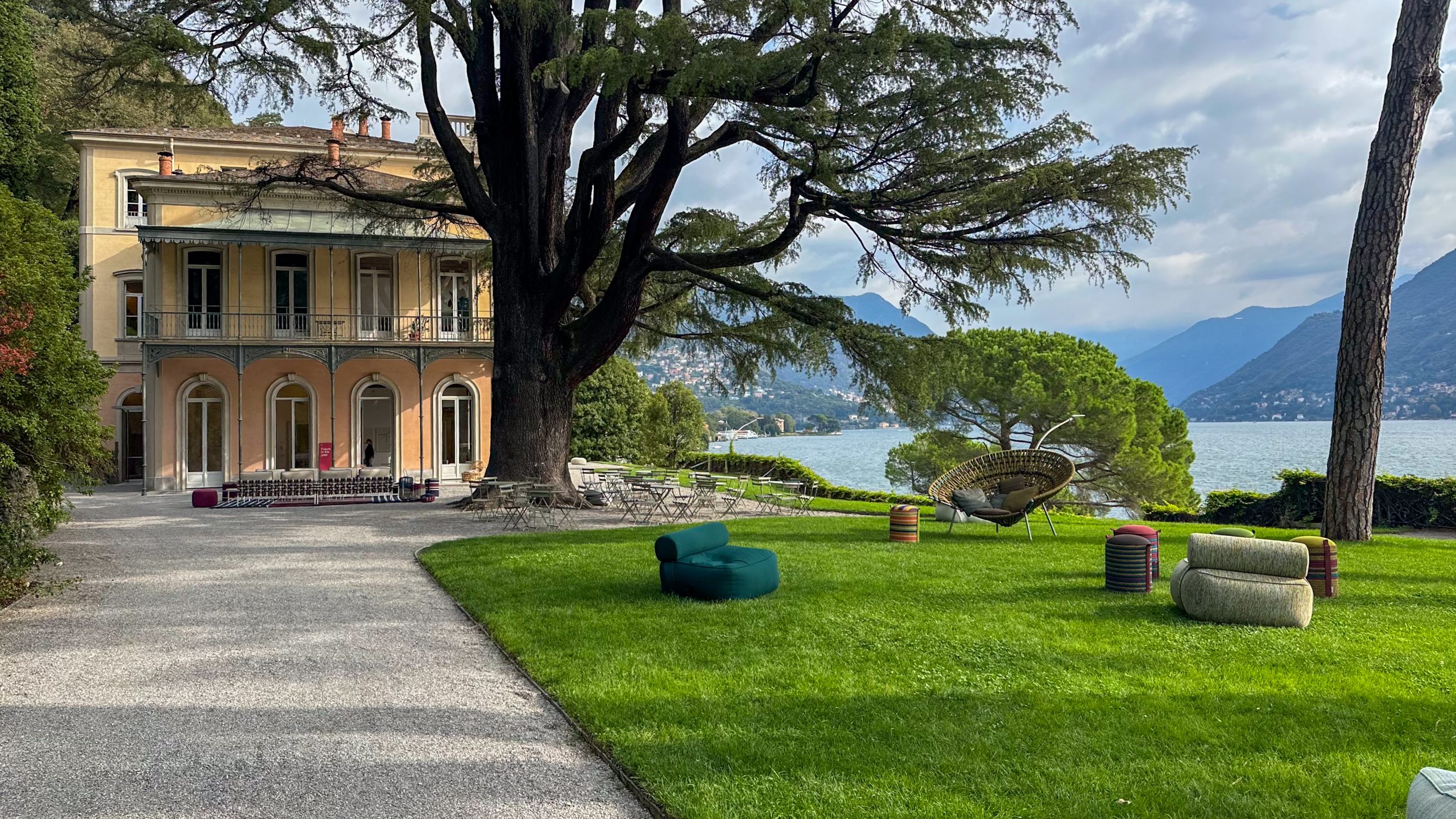
Meanwhile, the grand oval hall of Villa Saporiti houses The Long Take by Shanghai-based collective The Happy Few. Stretching ten meters across the floor, a bespoke carpet featuring irregular rectangular motifs dominates the space. The design draws inspiration from the unexpected geometry of urban sidewalk paving, prompting observers to trace the uneven grid visually or mentally chart alternative pathways across its surface. By translating a childlike, poetic impulse into a sophisticated textile design, the collective examines the duality of the street, which simultaneously divides and unites distinct spaces and communities.
Industrial Craftsmanship and Biomaterial Innovation
At the intersection of contrasting production methods, Belgium’s Studio Bjorn Verlinde presents Fur.001 and Fur.002, a companion seating element and side table. The pieces investigate the conceptual boundary formed when a traditional leather saddle meets a precision-engineered aluminum frame. Utilizing strict oil-polished aluminum structures alongside leather elements crafted through traditional saddlery techniques, the studio achieves high levels of ergonomic comfort within a compact scale. A specialized construction allows the stool to tilt backward and lock into a relaxed posture, while the side table echoes these precise forms to establish an industrial aesthetic underpinned by artisanal craftsmanship.
Material circularity and ecological storytelling take center stage in Burnt Wool by Sandra Battistel. Following her studies at Central Saint Martins and specialized research into biomaterials in Copenhagen, Battistel’s ongoing investigation focuses on the threshold between rural alpine traditions and contemporary urban design. Sourcing discarded wool scraps from the Alps that were otherwise designated for incineration, the designer subjects the waste material to controlled burning. This process yields a novel, highly textured material marked by rich tonal shading. The resulting objects occupy the nebulous space between art and design, functioning flexibly as protective elements, containment structures, or decorative installations.
Group Exhibitions and Studio Visits
The exploration of collective space continues inside the former church of Santa Caterina through the group exhibition Fine Comune. Featuring creative direction and exhibition design by Ultrapresent Studio, the show investigates communal limits and shared objectives. The narrative opens in an intimate side chamber showcasing works by Luca Monterastelli, presented in collaboration with Galleria Lia Rumma.
In the primary hall, Acerbis’s expansive and low-profile Free System sofa anchors the space, promoting a relaxed, Mediterranean-inspired model of nomadic conviviality. Surrounding the central seating arrangement are collectible design objects courtesy of Movimento Gallery, including reflective mirrored pieces by Costantino Gucci. Vertical surfaces are adorned with handmade rugs from cc-tapis, drawn from the Hypercode collection conceived by Roberto Sironi.
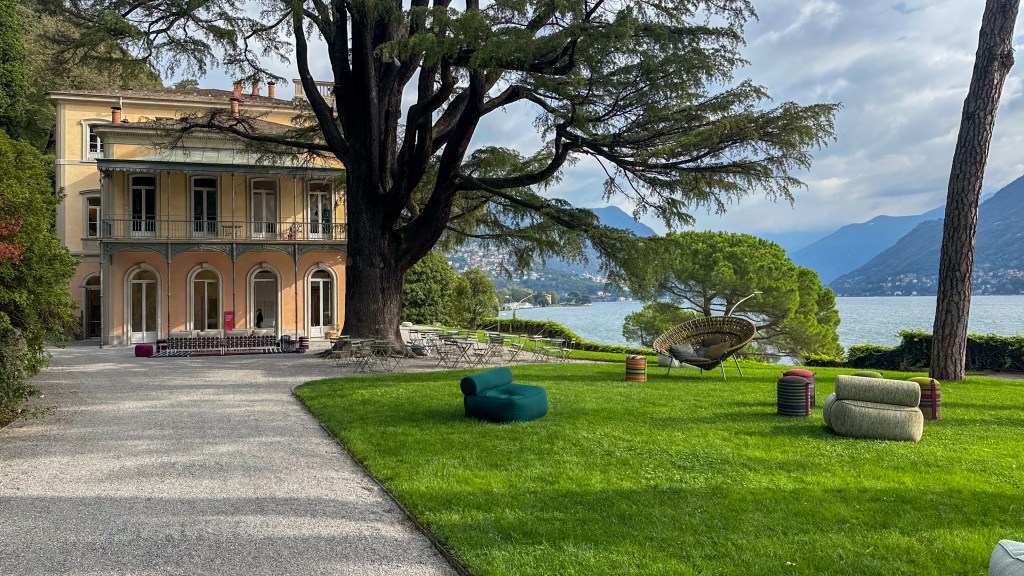
Beyond the temporary exhibitions, the festival’s established Studio Visit program opens local workshops, private galleries, and historical archives to the public. For the current edition, this initiative is complemented by a new Hospitality Visit program, inviting the public into five select hotels that have integrated contemporary art and design into their architectural spaces. Among these is the newly established Casabianca, a boutique hotel and house-museum comprising just three suites. The property houses a museum-quality contemporary art collection featuring works by prominent figures such as William Kentridge, Marina Abramović, Mimmo Paladino, and Francesco Vezzoli, all integrated within an interior scheme of vintage design pieces. The ground floor also hosts Cova Casabianca, a discreet pastry and aperitivo destination.
Archival Rediscoveries: Fronzoni, Bo Bardi, and Badiali
Set against the scenic backdrop of Villa Grumello’s park overlooking the lake, the Future in the Past exhibition explores the historical tension between archival memory and forward-looking design projects. Among the historical figures spotlighted is AG Fronzoni (1923–2002), a master of product and graphic design renowned for his radical minimalism. The display features his rigorously austere posters alongside archival objects and the Collezione 64 series produced by Cappellini. Comprising a chair, armchair, and table, the collection exemplifies a geometry where structural elements delineate spatial boundaries with absolute clarity.
Nearby, ETEL presents a dedicated exhibition honoring Italian-Brazilian designer Lina Bo Bardi, organized in collaboration with the Instituto Bardi. The presentation features authorized reissues of furniture originally conceived for her iconic 1951 residence, the Casa de Vidro, as well as the SESC Pompéia public cultural center in São Paulo. Bo Bardi’s furniture highlights a rigorous yet fluid approach to materials, balancing organic lines with structural integrity.
Rounding out the festival’s archival explorations is the presentation of the Carla Badiali Archive. Born in 1907, Badiali was an accomplished painter and textile designer who exhibited alongside the Futurists. Her sophisticated textile designs—characterized by intricate graphic motifs of ribbons, bows, and confections—were frequently incorporated into collections by major international fashion houses, including Givenchy, Balmain, Dior, and Chanel. Badiali’s body of work demonstrates a fluid boundary between decorative surface pattern and fine art painting, with patterns often demanding entirely novel manufacturing techniques to realize their complex geometry.
The Lake Como Design Festival remains open to the public through September 20, 2026.