






Financial markets have always relied on timely information, and the drive for timeliness has consistently adapted to the latest technological breakthroughs. From clipper ships transiting the oceans to telegraph wires connecting bustling cities to modern fiber-optic cables conducting high-speed trades in mere microseconds, traders have continuously embraced any possible advantage to secure the most up-to-date information available. Indeed, the overarching history of global finance is fundamentally a story about how fast information can move and who ultimately controls the interface between data and decision-maker.
It was only natural that enterprising individuals also figured out a way to build profitable enterprises by supplying that critical market intelligence. In 1841, for instance, the Mercantile Exchange, which served as a direct predecessor to Dun & Bradstreet, began selling proprietary business information to its growing roster of U.S. clients. During the following decade, Paul Julius Reuter began selling comprehensive news services alongside essential stock price information. To creatively supplement his company’s telegraph dispatches across challenging terrain, he famously deployed carrier pigeons between Aachen, Germany, and Brussels. Each bird carried a small cylinder containing slips of paper detailing that day’s exact stock prices. By 1867, an inventor named Edward Calahan introduced the very first telegraphic ticker-tape machine, which mechanically spooled out stock price information in near real time. Thomas Edison subsequently improved upon this foundational design with his own patented version in 1871.
The Dow Jones Industrial Average formally debuted in 1896 as a foundational index tracking 12 key businesses listed on prominent U.S. stock exchanges. It included gas, oil, coal, and electric companies, alongside diverse enterprises dealing in leather, rubber, and tobacco. During this era, human messengers physically delivered price quotes from the chaotic trading floor to quiet brokerage offices, while mechanical stock tickers hummed along, keeping investors informed of shifting prices. By the time New York City hosted its first official ticker-tape parade in 1919, telegraphy across Western Europe and the United States had firmly established itself as the chief means for the rapid transmission of vital stock market information.
A major milestone arrived in 1960 with the debut of the first paperless financial service, when Quotron introduced electronic screens designed to display market quotes in real time. Over the course of the next two decades, competing companies rolled out similar technological innovations aimed at distributing financial news and quantitative data more efficiently.
Consequently, when Michael Bloomberg decided to enter this well-established and fiercely competitive industry in 1981, the central question echoing across Wall Street was simple: How could his new company possibly stand out against entrenched giants?

The Birth of the Bloomberg Terminal
Bloomberg had cofounded Innovative Market Systems (IMS) shortly after being fired from the prominent investment bank Salomon Brothers. Landing gracefully on his feet with a substantial US $10 million equity payout, and joined by former Salomon colleagues Thomas Secunda, Duncan MacMillan, and Charles Zegar, Bloomberg aggressively pursued his core conviction that Wall Street professionals would gladly pay a significant premium for specialized, highly accurate financial data. He had previously earned an electrical engineering degree from Johns Hopkins University alongside an MBA from Harvard, and he had spent his time at Salomon building sophisticated computerized financial systems. IMS focused intently on developing an advanced computer terminal that not only delivered up-to-the-second market information but could also perform instant quantitative analysis based on vast stores of historical data.
At the time, the vast majority of financial data still circulated inefficiently through telephone calls, printed price sheets, and specialized trade publications, while day-to-day market analysis involved a fair amount of gut instinct guided by human expertise. Established companies such as Reuters and Dow Jones provided subscription-based services for general access to business news. However, busy traders still had to painstakingly assemble information from multiple fragmented sources and perform their own complex calculations and analytical models by hand.
IMS proposed an integrated system built around a single, unified interface. Its flagship Market Master terminal consisted of a monochrome cathode-ray tube (CRT) monitor, a custom-designed keyboard, and a communications and controller unit that linked directly to the company’s private telecommunications network. At its initial launch, the system provided little more than U.S. government bond prices and specialized bond-calculation tools. Yet, the overarching vision was vastly more ambitious: to place a dedicated, powerful terminal directly on every trader’s desk capable of running diverse market scenarios, producing accurate yield curves, and seamlessly supporting complex investment calculations.
Initially, IMS had just a single client, Merrill Lynch, which made a bold $30 million investment—equivalent to roughly $110 million today—in exchange for a 30 percent equity stake in the startup and exclusive rights to use the terminals for a period of five years. Merrill Lynch ultimately chose to waive that exclusivity right in 1984. The very first 22 Market Master terminals were delivered to Merrill in 1982, right in the middle of a severe global recession. Yet, this timing proved remarkably fortuitous. Around the world, major stock markets were actively transitioning toward electronic trading, and the U.S. Federal Reserve was permitting significantly more freely floating interest rates. Consequently, bond prices experienced unprecedented volatility, leaving investors desperately eager to figure out how to value them accurately and rapidly. Bloomberg’s specialized financial terminals provided precisely the empirical data and advanced analytical tools required to process and comprehend those sweeping macroeconomic changes.
Five years after its initial market launch, IMS officially rebranded as Bloomberg LP and dramatically expanded its target clientele, while the original Market Master hardware became universally known as the Bloomberg Terminal.

How Did the Bloomberg Terminal Work?
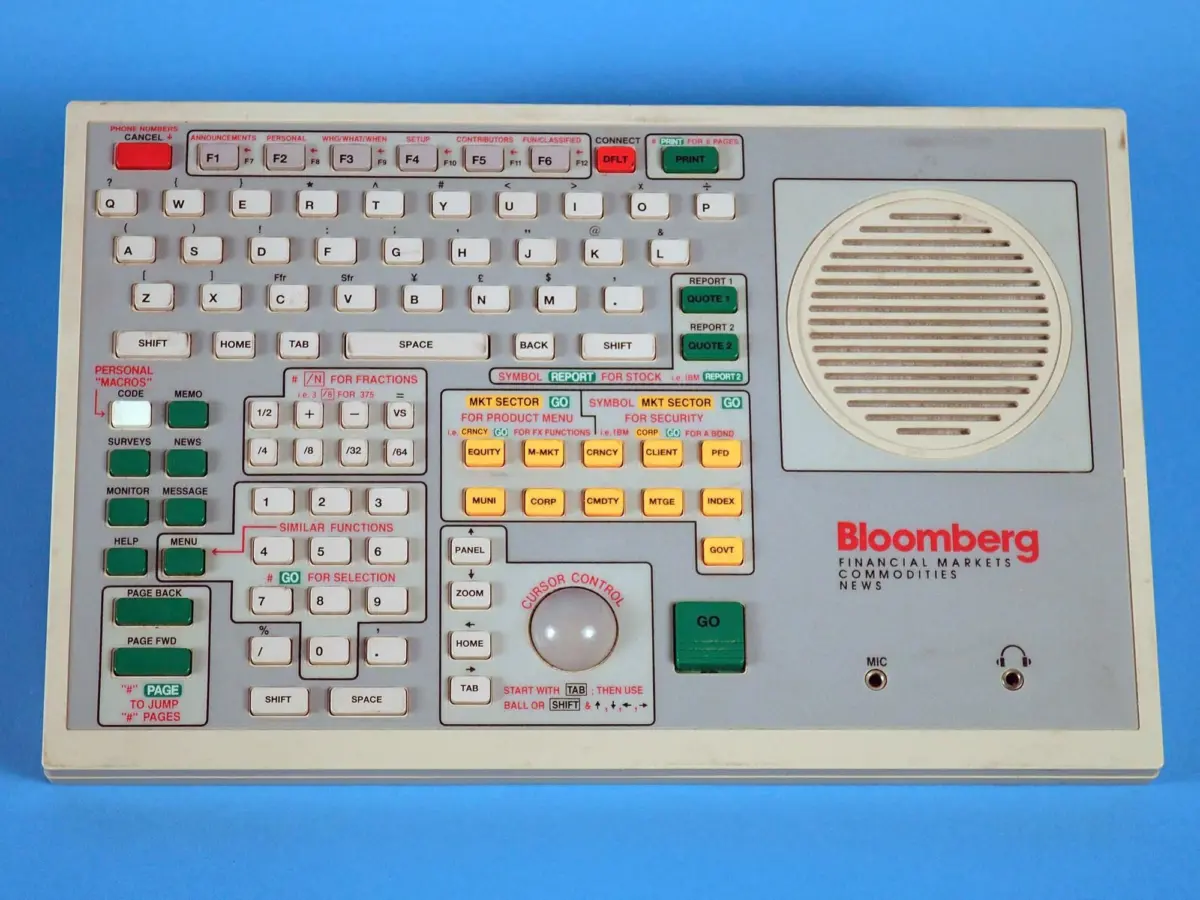
The physical design of the Bloomberg Terminal’s keyboard was meticulously tailored with professional traders and financial analysts firmly in mind. Its function keys were distinctly color-coded and labeled with explicit text specifying their exact usage, eliminating the need for users to memorize complex instruction manuals. The original keyboard, affectionately and widely referred to as "the Chiclet," was constructed largely by hand. A heavy cable ran directly from the keyboard to the Bloomberg Controller, which maintained a dedicated telephone line connecting to a local communications hub. Because the modern internet was not yet commercially available, the company essentially engineered its own closed, private network, utilizing centralized mainframe computers that maintained massive proprietary databases and performed the heavy lifting of financial calculations. Commands entered on the custom keyboard sent an electronic request to the hub, which processed the information and instantly beamed the result back to the screen.
Specialized hot keys allowed busy traders to effortlessly call up precise data regarding government securities, corporate debt, and global currency markets, among numerous other financial instruments. A specific series of intuitive keystrokes could instantly pull up extensive historical and real-time data, execute a sophisticated financial analysis, or place a trade. Learning how to properly operate the terminal and digest the staggering volume of information—which was presented predominantly in dense tabular formats—quickly became an essential rite of passage for finance professionals worldwide.
In 1990, Bloomberg introduced a physical trackball directly onto the keyboard, which significantly helped users navigate the multiple windows and complex menus typically displayed simultaneously on the screen. Two years later, the keyboard gained a built-in speaker to support emerging multimedia information, a design upgrade that also incorporated dedicated telephone, headphone, and microphone jacks. One of the platform’s most popular and enduring features was Instant Bloomberg, a pioneering tool that allowed users to chat directly with fellow Bloomberg Terminal users across the secure proprietary network. By 1996, the company was manufacturing keyboards that fully supported 23 different languages. Into the early 2000s, Bloomberg began incorporating advanced biometric authentication for terminal logins, utilizing a sensitive fingerprint reader built directly into the keyboard layout.
As the company’s business model matured, the Bloomberg Terminal expanded its service offerings well beyond its initial fixed-income roots. In 1990, out of growing concern that Dow Jones might suddenly cut off access to its foundational news stories, Bloomberg established its own independent news service. Company leadership recruited prominent Wall Street Journal reporter Matthew Winkler to oversee an initial team of a dozen reporters. Their breaking stories focusing on market movements and securities shifts utilized distinctive charts, graphs, and calculations that effectively served as brilliant advertisements for the terminal’s powerful analytical capabilities. Today, the expansive Bloomberg news empire encompasses major ventures including Bloomberg Businessweek, Bloomberg Radio, and Bloomberg Television.
Bloomberg’s lucrative subscription-based financial model centered on leasing the physical Bloomberg Terminal—complete with its specialized keyboard and proprietary hardware—alongside access to a dedicated private network and an extensive suite of auxiliary services. In 1999, a subscription for a single Bloomberg Terminal cost $1,600 per month, requiring a minimum two-year contract alongside scaled discounts for each additional terminal leased by an institution. Today, the annual price for a subscription climbs upwards of $32,000, tracking slightly below the rate of inflation. In 1995, the company launched a suite of "Open Bloomberg" software products designed to run directly on the customer’s standard personal computer, and five years later, the firm completely stopped leasing dedicated physical terminal hardware. Modern customers also enjoy access to specialized mobile applications that allow core terminal functions to run seamlessly on smartphones and tablets. Today, the term "Bloomberg Terminal" has come to signify an entire integrated environment encompassing financial data, deep analytics, breaking news, secure communications, and robust trading tools.

The Legacy of the Bloomberg Terminal
Although the gradual shift away from dedicated physical terminals was a wholly logical corporate response to the explosive rise of the internet and publicly available market data, it fundamentally altered the material culture of professional financial work. For nearly two decades, physical Bloomberg Terminals commanded an undeniable aura of raw power and elite financial prowess. They stood as unmistakable emblems of absolute market mastery, featuring a distinct hardware brand that instantly set them apart from standard office computers. With the advent of Open Bloomberg, users were finally liberated from being permanently tethered to a single office desk or a fixed array of specialized monitors.
Consequently, retired and cast-off Bloomberg Terminals eventually found their way into prestigious museum collections around the country. Today, they serve as a physical embodiment of the ethereal, fast-moving nature of modern financial markets, acting as tangible manifestations of complex mathematical calculations, dedicated network infrastructure, and high-stakes business culture.
The Smithsonian Institution’s National Museum of American History currently houses a number of vintage Bloomberg keyboards within its permanent collection. Among them is object number 2014.0012.02, which was actively used by legendary "Bond King" Bill Gross throughout the 1990s and 2000s while working at Pacific Investment Management Company (PIMCO). Gross had cofounded PIMCO in 1971 and successfully built it into a staggering $2 trillion bond investment powerhouse. Notably, Gross famously taped his personal login username and password directly onto the front of his keyboard, a humanizing detail that makes the historical artifact remarkably relatable. While ordinary observers may never truly experience what it feels like to manage billions of dollars in global assets from a Bloomberg Terminal, the universal trial of struggling to remember everyday passwords remains entirely familiar.