






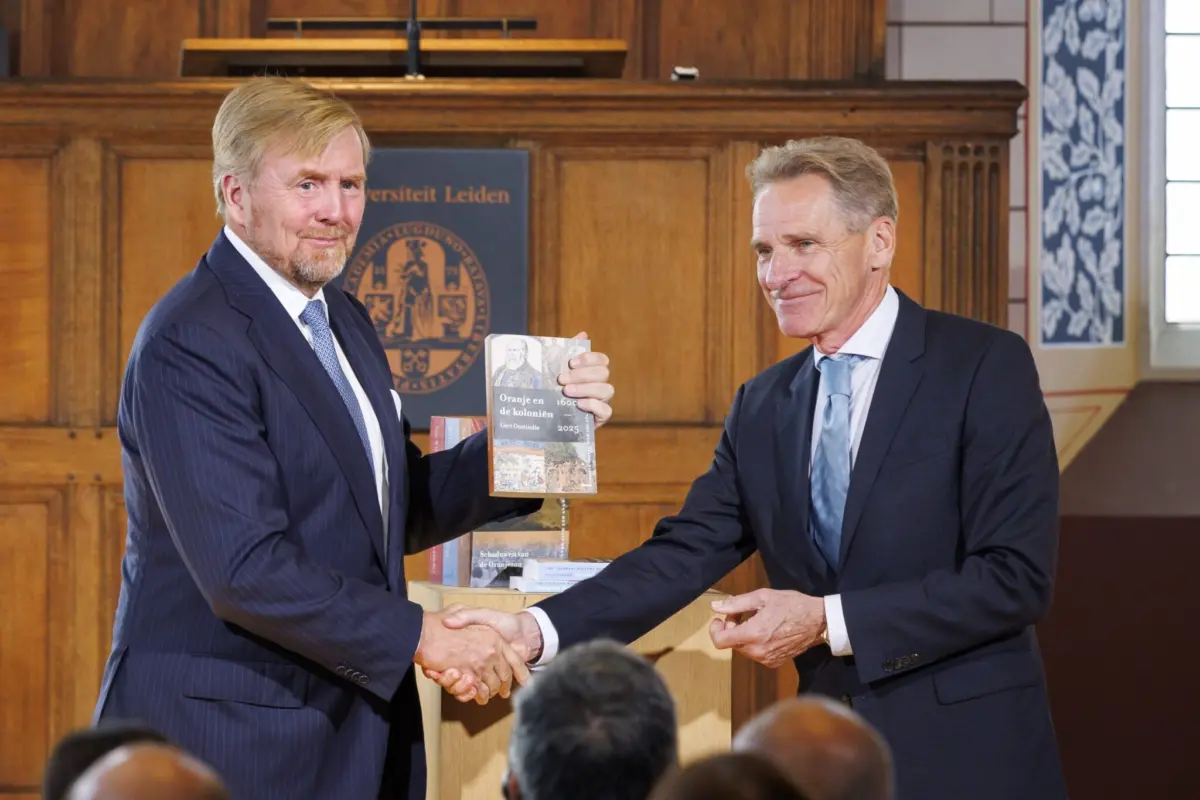
The Dutch royal family, the House of Orange-Nassau, amassed an estimated €576 million from slavery and colonial exploitation, primarily within the former Dutch East Indies, according to a comprehensive new historical investigation into the monarchy. The extensive research project was commissioned directly by King Willem-Alexander, who granted academic investigators unprecedented access to the private royal archives and personally funded the multi-year inquiry to shed light on the institution’s historical ties to the slave trade and colonial rule.
During a formal presentation ceremony held at the Academy Building in Leiden, lead researcher Gert Oostindie shared the sobering conclusions of the vast project. Addressing an audience of academics, historians, and dignitaries, Oostindie noted that generations of the nation’s leadership firmly believed in the righteousness of their actions. All stadtholders, kings, and queens, at least up to and including Queen Wilhelmina, were completely convinced of the legitimacy of colonialism and its vital economic importance for the Netherlands, the lead researcher explained during Friday’s presentation of the findings.
The exhaustive investigation spans an impressive 2,000 pages and has been published comprehensively across five volumes, which were formally presented to King Willem-Alexander upon completion. Reflecting on the heavy historical burden documented within the pages, King Willem-Alexander described the conclusions during the gathering as heartbreaking and confronting. Acknowledging the painful legacy unearthed by the historians, the monarch offered a clear personal perspective on his role regarding the past, stating that while he cannot change history, he is fully committed to making a positive contribution to the present and the future to the best of his ability.
According to the findings detailed in the report, the Dutch royals earned relatively little from the transatlantic slave trade itself. However, this was not because the monarchy held moral objections to the practice at the time, but rather because their specific ventures into transatlantic trafficking proved largely unsuccessful. Oostindie’s exhaustive work revealed that while various monarchs frequently voiced institutional support for the slave trade, very few exercised a direct, hands-on impact on colonial policy during the height of the trafficking eras.
The investigation highlights that among the royal lineage, only King William I, who held power from 1813 to 1840, had a direct and active hand in colonial slavery policies. Prior to his reign, successive royal leaders largely deferred administrative and commercial decisions regarding colonial territories and forced labor to the States General, the country’s early administrative assembly, or to the formidable and immensely powerful Dutch East India Company, commonly known as the VOC. Following the reign of William I, the political landscape of the Netherlands shifted dramatically as monarchs were steadily forced to share political power with an increasingly influential and assertive parliament, which subsequently assumed control over most legislative and policy decisions.
The monumental academic undertaking was initiated in 2022, when King Willem-Alexander formally asked Oostindie, a distinguished former professor of colonial history, to lead the independent investigation. Over the course of nearly four years, the project grew into a massive collaborative effort involving approximately sixty specialized researchers, archivists, and historians who meticulously examined the financial records, correspondence, and administrative documents preserved within the royal collections.
This latest revelation follows a series of significant steps taken by the Dutch monarch in recent years to confront and address the nation’s dark historical chapters regarding human bondage and colonial subjugation. In 2023, the king formally apologised for the Netherlands’ historical involvement in the slave trade during an emotional annual commemoration marking the 150th anniversary of the legal abolition of the practice. Alongside this profound national apology, the monarch also ceased using a ceremonial golden coach that had repeatedly come under intense public fire for featuring a controversial painted side panel depicting romanticized scenes of colonial subjugation and tribute.
The conclusions of the newly presented five-book royal investigation closely mirror the findings of a major prior study conducted by the Dutch home affairs ministry. Published in 2023, that government-backed research came to a very similar financial and historical conclusion. The earlier study was carried out following a binding 2021 parliamentary motion and involved approximately thirty academics and historians, culminating in the publication of the influential book Staat en slavernij, or State and Slavery. Together, these rigorous academic milestones mark an unprecedented era of institutional introspection within the Netherlands, as the nation and its head of state continue to grapple with the enduring legacy of colonial wealth and human exploitation.