






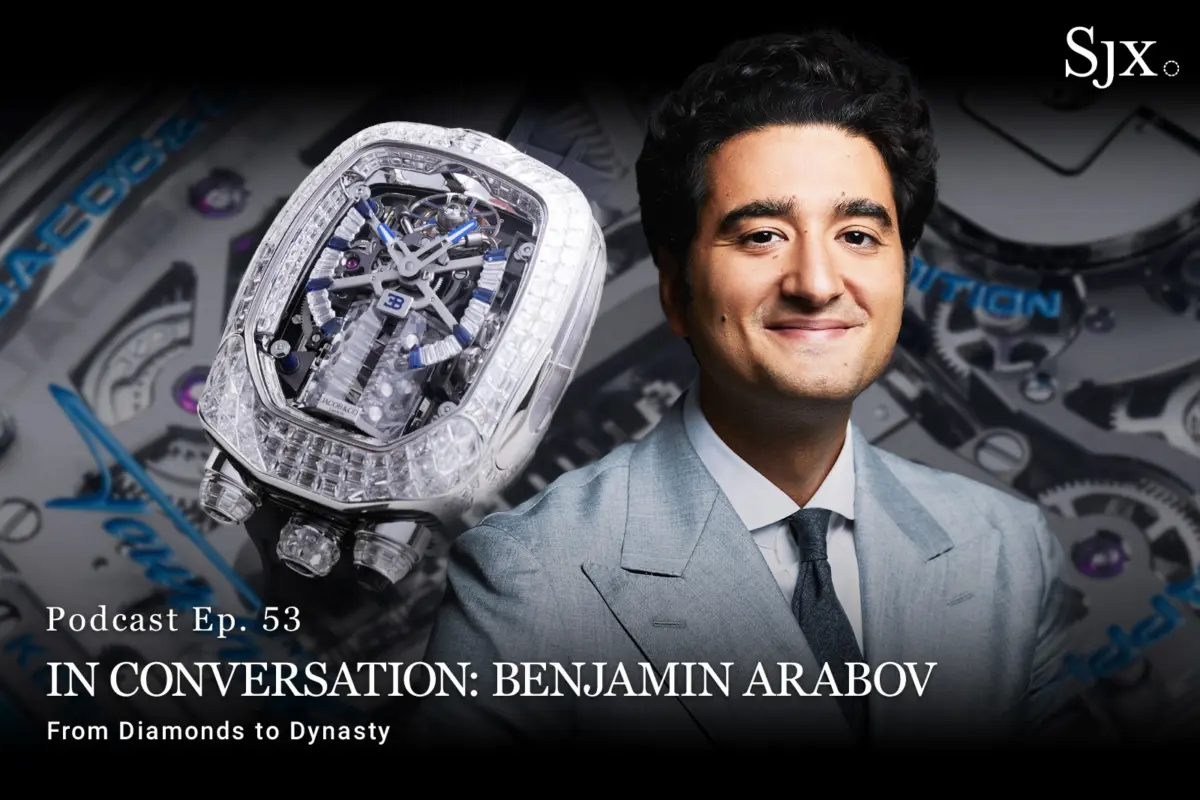
Over the past two decades, Jacob & Co. has undergone one of the most remarkable transformations in the modern watchmaking industry. From its early days defined by iconic pop-culture staples like the Five Time Zone watch to its contemporary status as a creator of ultra-complicated mechanical marvels such as the Astronomia and the Bugatti Chiron Tourbillon, the brand has continually redefined its identity. On the latest episode of the SJX Podcast, SJX sits down with Jacob & Co. CEO Benjamin Arabov to delve deep into this evolution, exploring the family-owned enterprise’s transition, the intricate mechanical ingenuity that often flies under the radar, and the delicate balance between high-profile celebrity culture and serious haute horlogerie.
While the brand is frequently recognized in mainstream media for its dazzling gem-set creations and its devoted following among A-list celebrities, professional athletes, and hip-hop icons, Arabov’s conversation on the podcast sheds light on a different side of the company. Beneath the diamonds and the flashing cameras lies a powerhouse of technical watchmaking innovation. The discussion provides listeners with a rare insider’s perspective on how wild, avant-garde concepts are successfully transformed into functional, highly complex mechanical timepieces that challenge the traditional boundaries of Swiss watchmaking.
A central theme of the episode is the creative pipeline at Jacob & Co., specifically examining how visionary ideas are translated into tangible watches. Designing complications that have never been attempted before requires an extraordinary level of engineering prowess, patience, and resources. Arabov discusses the challenges and triumphs of bringing these unorthodox ideas to life, noting that the brand’s willingness to push aesthetic and mechanical limits is what ultimately sets it apart in a crowded luxury landscape. Whether it is a miniature V8 engine replica beating inside a wristwatch or a multi-axis astronomical complication rotating in three-dimensional space, the brand treats horology as a canvas for unbridled artistic and mechanical expression.
In recent years, the brand has also adapted to shifting market demands by introducing smaller case sizes. This strategic shift has effectively opened the door to a new demographic of collectors who may have previously admired the brand’s creative direction but found the imposing dimensions of earlier pieces unsuited to their wrists. By refining ergonomics without sacrificing the theatricality and complexity that define Jacob & Co., the company has managed to broaden its appeal while retaining its core identity. Arabov elaborates on how these smaller proportions have successfully attracted sophisticated collectors who appreciate both wearability and high-end mechanics.
The conversation also highlights the immense success of Jacob & Co.’s high-profile brand partnerships, focusing specifically on collaborations with automotive legend Bugatti and pop-culture phenomena like The Godfather. Partnerships in the luxury watch sector are common, but Arabov explains what makes these specific alliances genuinely work. Rather than simply slapping a logo onto an existing dial, Jacob & Co. collaborates closely with its partners to create deeply integrated conceptual timepieces. The Bugatti watches, for instance, mimic the fluid lines and mechanical heart of hypercars, while The Godfather-themed pieces incorporate miniature music boxes and rotating mafia motifs, creating an immersive sensory experience that goes far beyond traditional timekeeping.
Beyond product design and mechanical feats, the podcast episode explores the origins of the brand’s enduring celebrity following. Long before haute horlogerie brands embraced hip-hop culture and mainstream entertainment stars, Jacob Arabo, the founder of the company, was actively building personal relationships with artists, athletes, and cultural icons. This organic connection to the entertainment world became a cornerstone of the brand’s early success. Arabov reflects on how this unique celebrity endorsement model started, how it has evolved over the years, and how it continues to influence public perception of the house today.
Retail partners also remain a critical component of the brand’s global strategy. Despite the modern shift toward direct-to-consumer digital sales and flagship boutiques, Arabov emphasizes the continued importance of trusted retail partners who have supported the brand through its various developmental stages. These relationships ensure that collectors around the world can experience the watches firsthand, receiving the high level of personalized service that is essential when purchasing ultra-luxury, high-complication timepieces.
Looking toward the future, a significant portion of the interview centers on legacy and long-term business strategy. As a family-owned brand, planning for the generational handover of leadership is paramount. Benjamin Arabov shares his overarching approach to building a resilient business infrastructure capable of outlasting its visionary founder, Jacob Arabo, while simultaneously preserving the daring creative ambition that built the company’s foundation. Balancing corporate governance and institutional stability with the spontaneous, artistic flair of an independent jeweler is no small task, but it is essential for securing the brand’s place in watchmaking history for decades to come.
Watch enthusiasts and industry observers looking to gain a comprehensive understanding of how Jacob & Co. bridges the gap between high-glamour jewelry and serious independent watchmaking can listen to the full conversation now on Apple Podcasts, Spotify, and YouTube.