





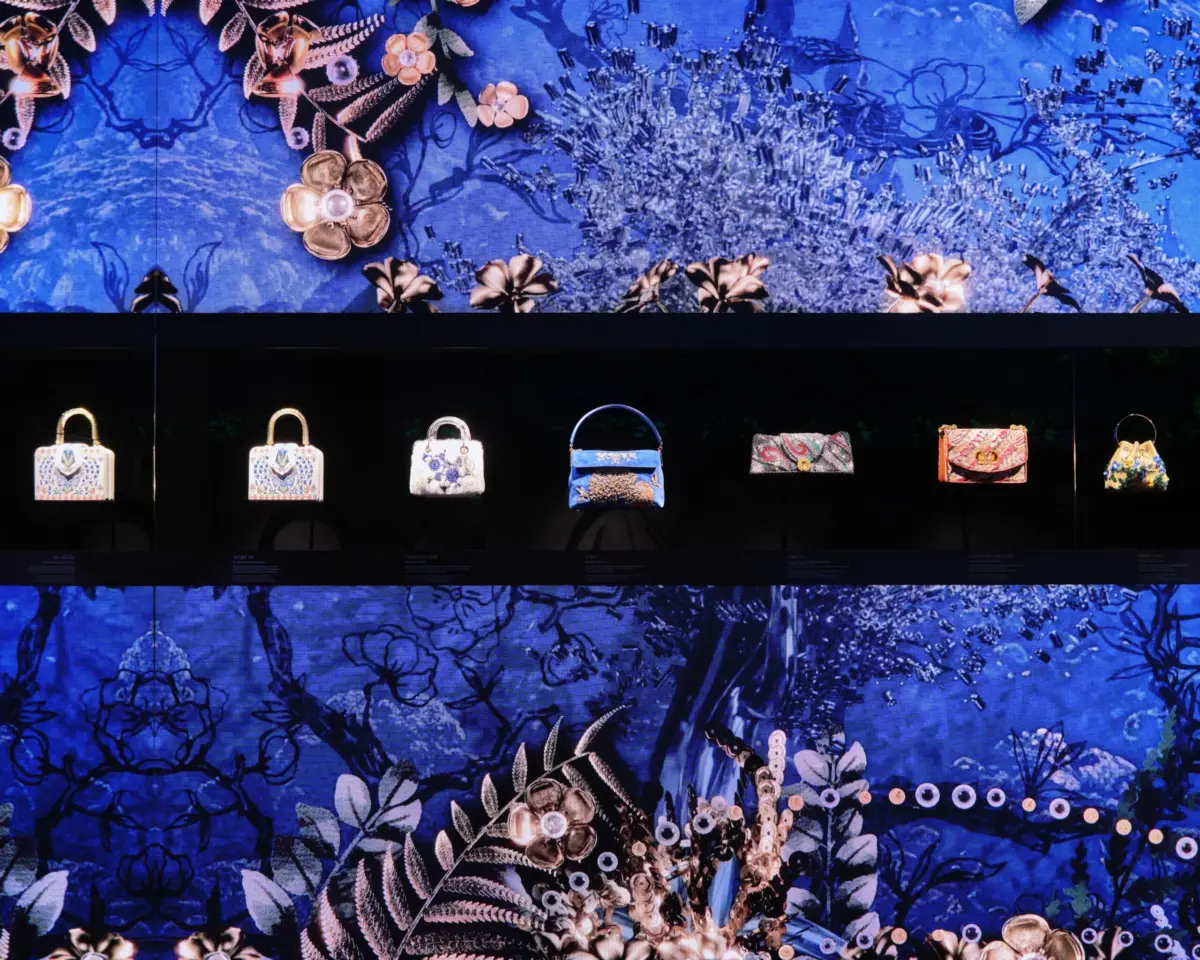
A handbag is rarely just a handbag. Throughout history and modern daily life, it can function as a keeper of secrets, an undeniable declaration of personal status, or a trusted traveling companion—not to mention a rather expensive place to keep one’s keys, smartphone, and lipstick. But at Beymen Tersane, Istanbul’s newest and most ambitious shopping destination, the handbag takes on an entirely different and elevated role: that of a vessel for cultural memory. This compelling idea lies at the absolute heart of “Timeless Treasures—The Eternal Journey of the Bag,” a landmark exhibition inaugurated to mark the grand opening of the cultural complex. Bringing together 80 extraordinary creations from 55 international luxury brands, the exhibition creates a profound dialogue between contemporary high-fashion design and the layered, multifaceted heritage of Anatolia and the Ottoman Empire.
Curated by renowned fashion writer and historian Laurence Benaïm, the presentation is less an exercise in dry historical illustration and much more an invitation to look at collective memory through a completely different perspective. The overarching challenge, Benaïm explained, was never to slavishly reproduce traditional motifs or reduce rich Ottoman references to mere decorative shorthand, but rather to translate their underlying spirit into a modern, sophisticated design language. Her overarching vision was shaped as a metaphorical “curiosity cabinet of dreams and craftsmanship,” where newly commissioned pieces sit in harmonious juxtaposition with rare archival treasures sourced from legendary fashion houses like Dior, Louis Vuitton, and Schiaparelli.

The narrative journey of the exhibition unfolds across seven distinct chapters, each thoughtfully exploring a different facet of the intricate relationship between bags and cultural memory. The first section, Precious Envelopes, includes the delicate pouches once utilized by diplomats and imperial ambassadors to carry confidential letters, imperial decrees, and state secrets, serving as a poignant reminder that the art of keeping things securely under wraps has a long and storied history. Heavenly Gardens draws heavy inspiration from the vibrant flora and fauna found on historic İznik ceramics and lush Ottoman palace gardens, while Golden Jewels explores the eternal human allure of gold and precious ornamentation. Magical Boxes considers the bag in its primal function as the guardian of private possessions and hidden treasures, a role that has scarcely lost its cultural appeal in the modern era. Nomad Memories traces the ancient weaving, intricate leatherwork, and ornate saddlebag traditions that journeyed across vast distances from Central Asia to settle in Anatolia. A final forward-looking glance brings in three innovative designs created by young Turkish talents, selected through a competitive platform supported by Beymen in collaboration with prominent local universities.
Among the monumental historical highlights is a true piece of luxurious archaeology: a massive Louis Vuitton wardrobe trunk, meticulously crafted in 1886 at the Maison’s historic Asnières atelier specifically for Sultan Abdülhamid II. This artifact alone bridges the gap between European craftsmanship and Ottoman royalty, physicalizing the cross-cultural exchanges that the exhibition seeks to celebrate.
For Benaïm, the fundamental point of the project is that heritage should never be treated as a fixed, unchangeable inheritance or as a hollow exercise in nostalgic sentimentality. Heritage, she remarked during the opening events, is not about looking backward; rather, it is about carrying the enduring beauty of the past directly into the future. The exhibition, which required more than two years of meticulous planning and development, stands as a heartfelt “love letter to Turkish culture” and an exploration of the ways in which contemporary fashion can actively preserve cultural memory while simultaneously granting it new, contemporary meaning. Benaïm added that there can be no true luxury without a soul, without heart, without love, and without a profound sense of time.

The choice of venue for this cultural milestone is far from incidental. Beymen Tersane occupies a vital portion of the historic shipyard situated along the Golden Horn, a site whose maritime and industrial history stretches back some 600 years. The monumental area has been brilliantly reimagined by Rem Koolhaas’s architecture firm, OMA, transforming the historic footprint into a sprawling 12,000-square-meter destination dedicated to fashion, art, and lifestyle. Rather than imposing another conventional, homogenized department-store interior onto the historic structure, the architects conceived a striking horizontal sequence of eight galleries that respect the building’s industrial bones while accommodating high-end retail and exhibition spaces.
For Beymen Group CEO Elif Çapçı, the project serves as a natural continuation of the high-profile conversation initiated in 2023 with “Golden Opulence,” a major 50th-anniversary exhibition in which 50 international brands were commissioned to create unique, one-of-a-kind pieces for the Turkish luxury market. This time around, the focus shifted entirely to the handbag, an object whose constantly changing form and function offers a remarkably revealing record of shifting lifestyles, evolving tastes, and changing social codes across generations, Çapçı noted.
Rachid Mohamed Rachid, CEO of Mayhoola and chairman of Beymen, views the launch of Beymen Tersane as part of a much broader corporate and cultural ambition to bring the rich cultural complexities and artistic heritage of Turkey directly to the attention of the international luxury community. However, he emphasizes that there is something much deeper at stake here than a mere showcase of commercial partnerships between global brands and a local retailer. As Istanbul has always historically understood, the most interesting and fertile cultural exchanges happen when different worlds meet without either side having to surrender its unique identity, he observed.

And perhaps this is the ultimate takeaway of the exhibition: the handbag, after all, is a meeting place of its own, serving as a physical repository of fine craftsmanship, personal memory, and unbridled imagination. There is clearly much more to the accessory than what physically fits inside its lining. Though it remains undeniably nice that it also comfortably accommodates a smartphone, a tube of lipstick, and a pair of sunglasses for the modern wearer.
“Timeless Treasures—The Eternal Journey of the Bag” is open to the public at Istanbul’s Beymen Tersane through February 8, 2027.