





Independent British watchmaking has reached a major milestone as Roger W. Smith marks a quarter-century of craftsmanship with the introduction of the Series Seven. Following last year’s launch of the Series Six—the brand’s first new model family in several years—the Isle of Man-based atelier has unveiled its very first regular-production tourbillon wristwatch. While the master watchmaker has previously produced a small number of ultra-exclusive, one-off tourbillon commissions, the Series Seven represents a significant evolution, pairing a 60-second tourbillon and George Daniels’ co-axial escapement with a newly designed double-barrel calibre. Styled deliberately after Smith’s early foundational work, the watch also introduces sweep seconds and an unusual annual calendar mechanism, making it the most mechanically complex timepiece ever released by the brand in series production.
Initial Thoughts and Design Heritage
The architectural lineage of the Series Seven is deeply rooted in the history of modern British watchmaking. The design blends the movement architecture of Roger W. Smith’s early tourbillon pocket watches with the distinctive dial layout seen on the legendary Millennium wristwatches. Complete with a central sweep seconds hand and a discreet month aperture, the dial immediately signals that something out of the ordinary is at play beneath the surface.
Aesthetically, the Series Seven embraces the signature artisanal hallmarks that collectors have come to expect from the Isle of Man workshop. The engine-turned silver dial provides a textured, classic backdrop for the heavy, sculptural hands, which are blued in a characteristically organic and slightly imperfect manner that underscores the human touch behind their creation. While the construction of the tourbillon carriage itself leans heavily on earlier commissions, the broader movement architecture—particularly the sweeping contours of the barrel bridge—more than compensates, elevating the overall visual and mechanical harmony of the calibre.

Though whispers of a formidable, seven-figure price tag circulate among collectors, demand for the British independent master’s creations remains extraordinary. Even at the pinnacle of haute horlogerie pricing, Mr. Smith is expected to easily find eager buyers for the limited production runs he has planned for the Series Seven.
A Nostalgic Movement Rooted in British Tradition
To understand the mechanical soul of the Series Seven, one must look back nearly three decades. The movement inside the watch is directly styled after Movement No. 2, a perpetual calendar tourbillon pocket watch that Roger W. Smith completed in 1998 during his formative years working alongside his mentor, the legendary George Daniels.
That pocket watch, in turn, was meant to emulate the supreme standards of high-end English fusee tourbillons of the nineteenth century—particularly those crafted by Nicole Nielsen, a maker profoundly admired by Daniels. However, in adapting this historical aesthetic for a contemporary wristwatch, Smith made a deliberate practical choice: he traded the traditional fusee-and-chain transmission for a more reliable and space-efficient double-barrel architecture.

Rather than seeking to maximize the power reserve into multiple days of sluggish operation, this double-barrel setup is engineered to deliver exceptionally stable and consistent torque over a standard 48-hour period, ensuring optimal timekeeping performance throughout its running cycle.
In keeping with the pedigree of great historical English tourbillons, the balance is free-sprung. Yet, it departs from strict historical replication by utilizing oddly shaped inertia blocks on the balance wheel for rate adjustments, replacing the traditional timing screws. Furthermore, it completely omits the once-ubiquitous overcoil balance spring. Smith maintains that an overcoil is entirely unnecessary here, an argument supported by the fact that an overcoil would lose much of its effectiveness on the disproportionately compact balance springs preferred by the brand.
At the epicenter of the movement beats the Co-Axial escapement. Invented by George Daniels, this revolutionary mechanism reduces sliding friction within the escapement to such a profound degree that Daniels famously believed timekeeping stability would remain largely unaffected by the degradation or thickening of lubricants over time.

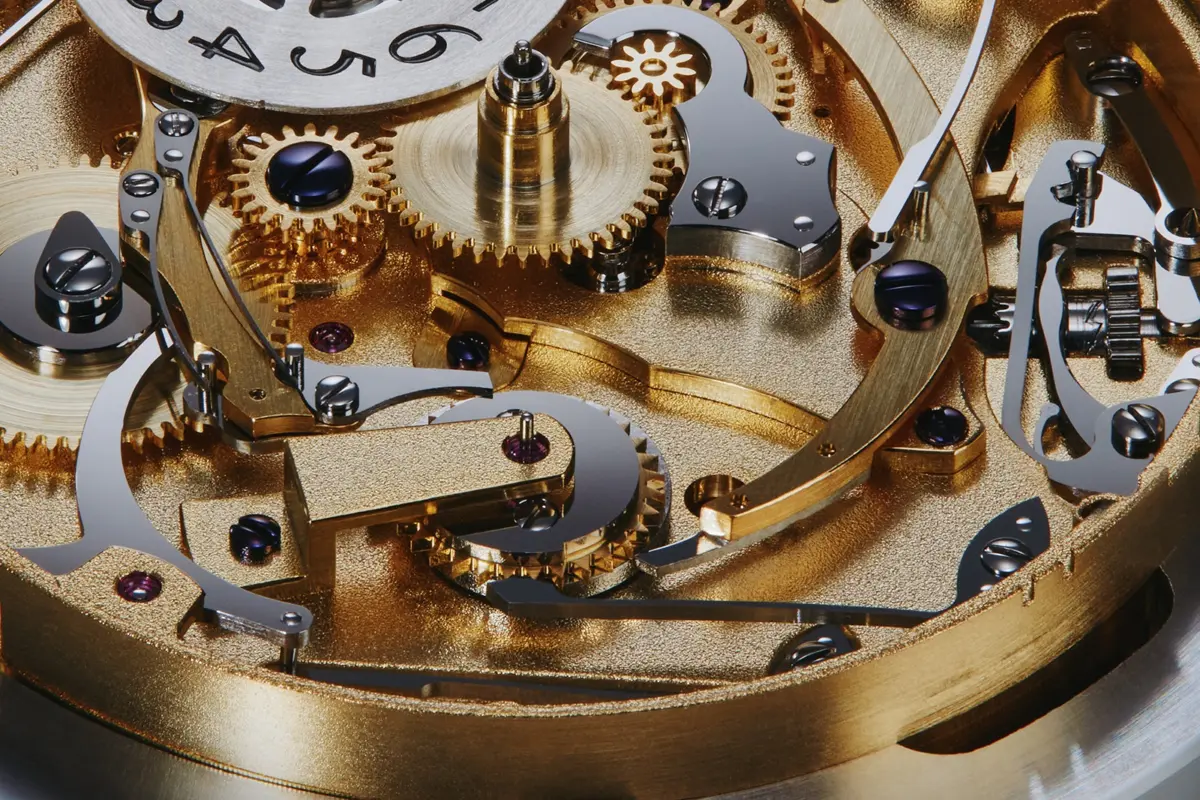
Notably, this is also the slimmest tourbillon movement Roger W. Smith has ever produced. This reduction in thickness was achieved in part by adopting Daniels’ "slim-line" variant of the co-axial escapement, stepping away from Smith’s own single-wheel design that has characterized the rest of the brand’s contemporary lineup.
Despite the compactness of the calibre itself, the watch as a whole is far from delicate. Measuring 40 mm in diameter, the case stands a substantial 14.6 mm thick. This reassuring heft and sturdy architecture are emblematic of British watchmaking traditions, which have historically favored robust, enduring construction over paper-thin profiles.
The finishing throughout is executed to an extraordinary standard in the classic British style. There is no mistaking the historical weight of the milestone this timepiece represents; the third wheel bridge of the very first production model, completed in August, is proudly engraved with the Roman numerals "MMXXVI" alongside the inscription "Twenty Five Years of RWS."

An Ingenious Annual Calendar
Perhaps the most surprising mechanical facet of the Series Seven is its calendar complication. The annual calendar function is designed to automatically account for the varying lengths of thirty-day and thirty-one-day months, requiring manual adjustment only once a year at the end of February. However, unlike standard annual calendars on the market, Smith has constructed this mechanism using the traditional architecture of a grand perpetual calendar—simply omitting the complex mechanisms required to track the quadrennial addition of a leap day.
This construction holds fascinating potential. Mechanically speaking, converting this annual calendar into a full perpetual calendar would be as straightforward as integrating a Maltese cross mechanism onto the twelve-month cam to govern the fluctuating length of February. Whether that points to future developments from the atelier remains to be seen.
This traditional perpetual-calendar foundation does, however, introduce a specific operational quirk. Unlike annual calendars found in many Swiss manufactures—such as those by Patek Philippe—where turning the hands backward past midnight causes the calendar to safely retreat, the Series Seven’s under-dial mechanism lacks a true one-way decoupling mechanism. Consequently, reversing the time past midnight will cause the calendar date to advance rather than move backward.

To ensure everyday wearability, the watch does feature a practical amenity: independent correction of the month display, operated via a discrete pin-pusher integrated directly into the case band, mirroring the functionality of the date corrector.
Key Facts and Specifications
Roger W. Smith Series Seven
Diameter: 40 mm
Height: 14.6 mm
Material: Red gold or platinum
Crystal: Sapphire
Water Resistance: Not applicable

Movement: S7
Functions: Hours, minutes, sweep seconds, tourbillon, annual calendar
Winding: Manual winding
Frequency: 21,600 vibrations per hour (3 Hz)
Power Reserve: 48 hours
Limited Edition: No, but strictly limited production
Availability: Direct from Roger W. Smith
Price: Upon request