






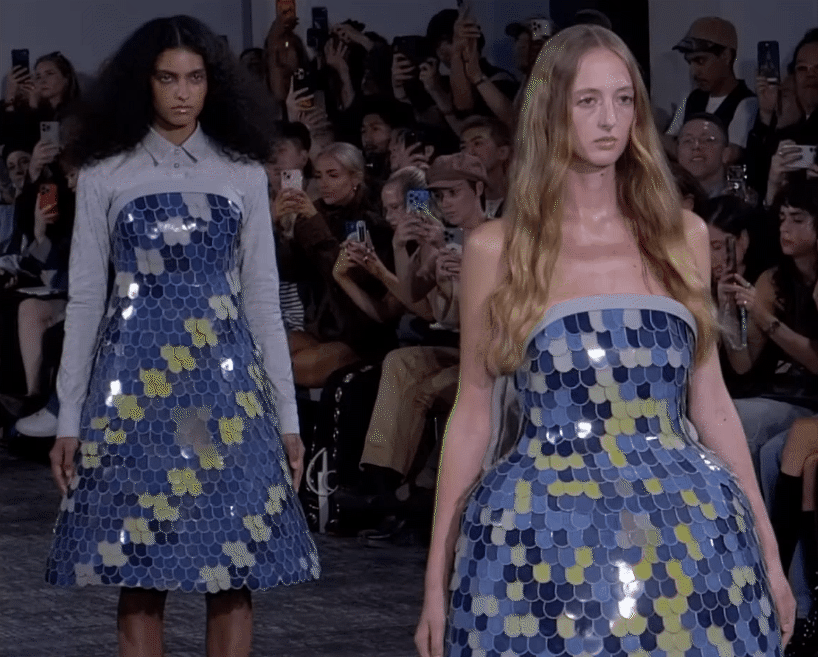
For Spring/Summer 2027, the avant-garde Japanese fashion label Anrealage has taken the concept of a wardrobe update quite literally. Presented during Paris Fashion Week at the Maison de la Radio et de la Musique, designer Kunihiko Morinaga’s latest collection, titled "Skin," reimagines clothing not as a static textile covering, but as a living, outer layer capable of shedding, mutating, and regenerating in real-time. Drawing striking parallels between biological skin and the interchangeable, pixelated outfits of digital avatars, Morinaga has built a collection around surfaces that refuse to stay visually fixed.
The premise is one that feels instantly familiar to anyone who has ever customized a digital avatar’s outfit in a matter of seconds within a video game or virtual space. However, translating that fluid, digital behavior onto the physical human body has long been one of fashion’s most complex engineering challenges. With his SS27 presentation, Morinaga confronts this challenge head-on, blending high-end fashion design with cutting-edge materials science, artificial intelligence, and electronic engineering to create garments that behave more like biological organisms than traditional apparel.
The transformative journey of the collection begins relatively quietly, introducing the audience to a world where the boundaries between the physical and the virtual are deliberately blurred. Second-skin bodysuits hug the models’ bodies, carrying pixelated graphics and intricate trompe-l’œil versions of familiar garments. As the eye travels across these garments, overlapping scalloped forms gradually detach from the printed surface, transforming into physical, three-dimensional scales.
In constructing these surfaces, Morinaga utilizes a diverse palette of advanced materials. Toray Ultrasuede appears throughout the collection, offering a luxurious yet technical base, alongside translucent elements crafted from traditional Japanese washi paper. This careful curation of materials shifts the collection constantly between fabric, graphic image, and something much closer to an engineered interface. The layered surfaces directly reference chromatophores—the specialized, pigment-changing cells found in various living organisms such as cephalopods—effectively turning biological science into a visual system for clothes that are designed to actively behave rather than simply sit passively on the body.
3D Printed Scales Shift Color Without a Screen
This dynamic behavior quickly escalates from subtle suggestion to literal motion through SEKISAI’s Effective Skin technology. In these pieces, 3D-printed scales are meticulously formed and colored so that their visual appearance shifts dramatically depending on the viewing angle of the observer. As models walk the runway, the movement of their bodies creates a striking optical effect, making the garments appear alive and shifting without the aid of any conventional electronic display.
Instead, geometry, surface design, and human motion do the heavy lifting. Ridged skirts amplify this visual effect by turning the scales outward, landing somewhere between Op Art and a wearable rendering glitch, while keeping the underlying mechanism resolutely physical and mechanical.
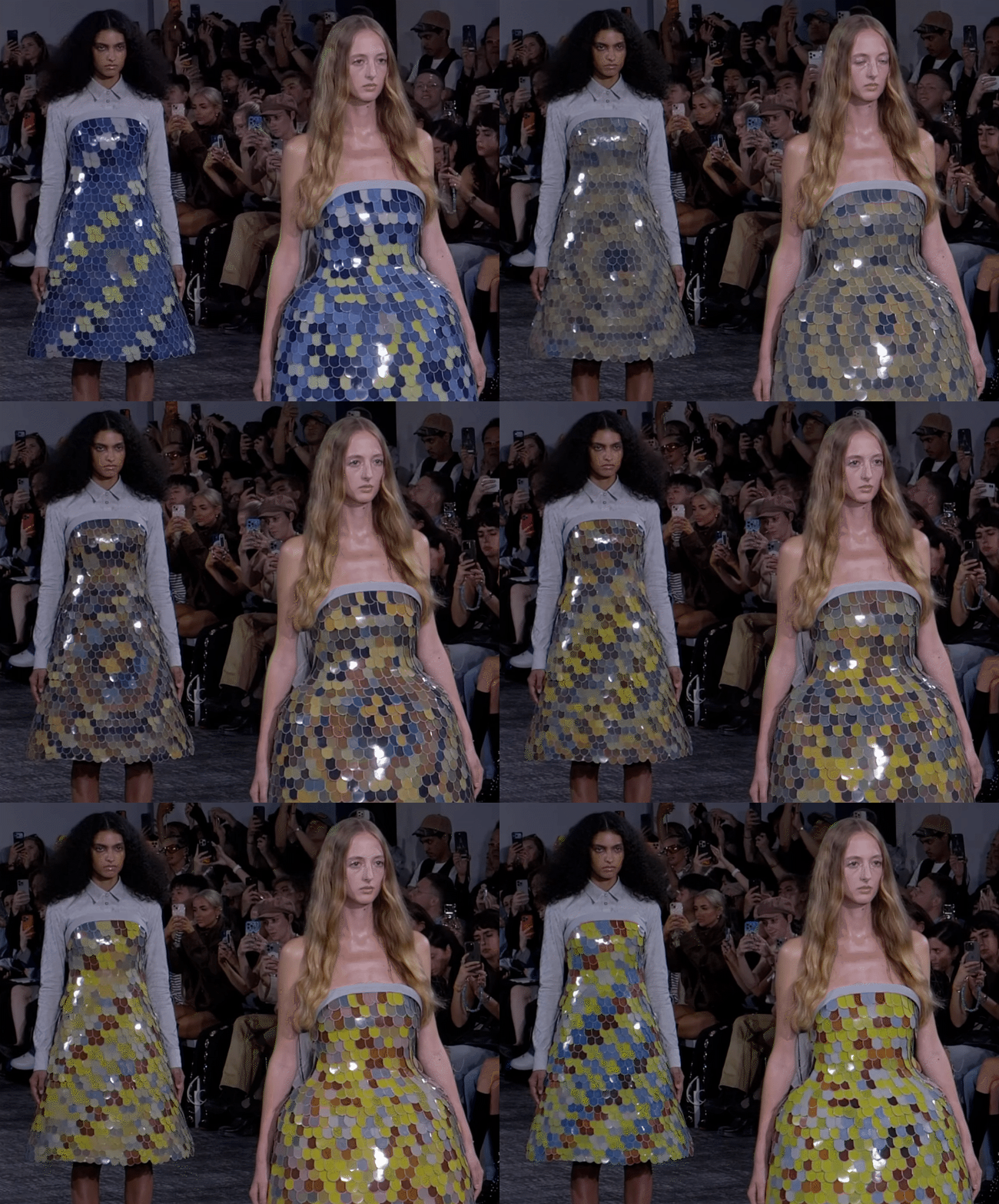
The collection then steps firmly into the realm of advanced electronics. Six armor-like cocktail and evening dresses serve as the technological centerpiece of the runway show, covered extensively with between 1,000 and 2,000 individually controlled electronic-paper scales utilizing e-ink technology. Unlike traditional LED panels, which generate their own harsh light, electronic paper functions by reflecting ambient light, allowing the e-ink material itself to change color naturally.
This mechanism allows rich pigments and intricate patterns to travel fluidly across the body before draining back into a neutral gray and reassembling into entirely new configurations. Beneath this ornate, decorative shell lies a remarkably dense network of wiring that successfully connects the individual electronic modules. To achieve this, AI-assisted mapping was employed to organize and streamline the complex circuitry, proving that modern high fashion increasingly relies on computational design. Suddenly, traditional garment embellishment starts looking suspiciously like advanced hardware engineering.
Kyocera Forearth Extends the Fashion Technology Experiment
While the e-ink and 3D-printed elements provide high-tech theatricality, this digital layer sits comfortably alongside another, less flashy but equally innovative technology integrated into the collection: Kyocera’s FOREARTH textile-printing system. The industrial printing process utilizes proprietary water-based pigment inks and drastically reduces the massive water consumption traditionally associated with conventional textile printing. It achieves this by streamlining production entirely through direct printing and drying stages, eliminating the water-intensive steaming and washing phases that have historically plagued the garment manufacturing industry.
According to Kyocera, its system uses a mere 0.02 liters of water per kilogram of fabric, a figure that includes system maintenance, while simultaneously supporting high-definition printing across a wide variety of materials, including cotton, silk, polyester, and nylon. For Anrealage, which has successfully collaborated with FOREARTH across several previous seasons, this advanced printing method becomes yet another sophisticated way to program the visual and tactile surface of the garment.
Morinaga closes the loop on the presentation by bringing back the striking LED-based digital camouflage that was first explored in the brand’s previous season. Now, however, these digital patterns flash through fiery, brilliant colors as a direct reference to Osamu Tezuka’s classic manga character Phoenix, a recurring artistic symbol of rebirth and renewal that underpins the thematic core of the entire Skin collection.
The dramatic finale makes the collection’s core proposition unusually literal: clothing can successfully behave like a third skin, remaining neither entirely textile nor entirely screen, yet remaining fully capable of changing its visual identity without ever changing the person underneath. Following more than two decades of rigorous Anrealage experiments with reflection, light, shape, and digital effects, the future of fashion presented on this runway is not simply another wearable gadget or tech accessory. Instead, it is the garment itself finally becoming the device.