





For centuries, the trajectory of human design has been defined by extraction and transformation. Living organisms—from cattle to marine algae—have long been treated as passive reservoirs of raw materials, stripped of their ecological context to serve human utility. German-born designer Julia Lohmann has spent her career challenging this foundational premise, asking a radical question: What happens when materials are allowed to shape their own design, and how can we account for the living systems that sustain them?
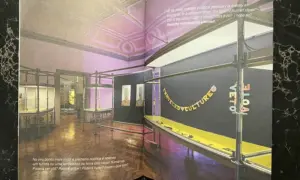
At London’s Design Museum, Lohmann’s work takes center stage in the ongoing exploration of sustainable futures. Arranging five towering kelp sculptures in a deliberate circle for the exhibition More than Human, the designer presents an installation titled Kombu Council. The structure immediately commands attention. Translucent skins stretch taut across intricate ribbed frameworks, bearing an uncanny resemblance to unfamiliar, otherworldly creatures dredged from the deepest recesses of the ocean floor.
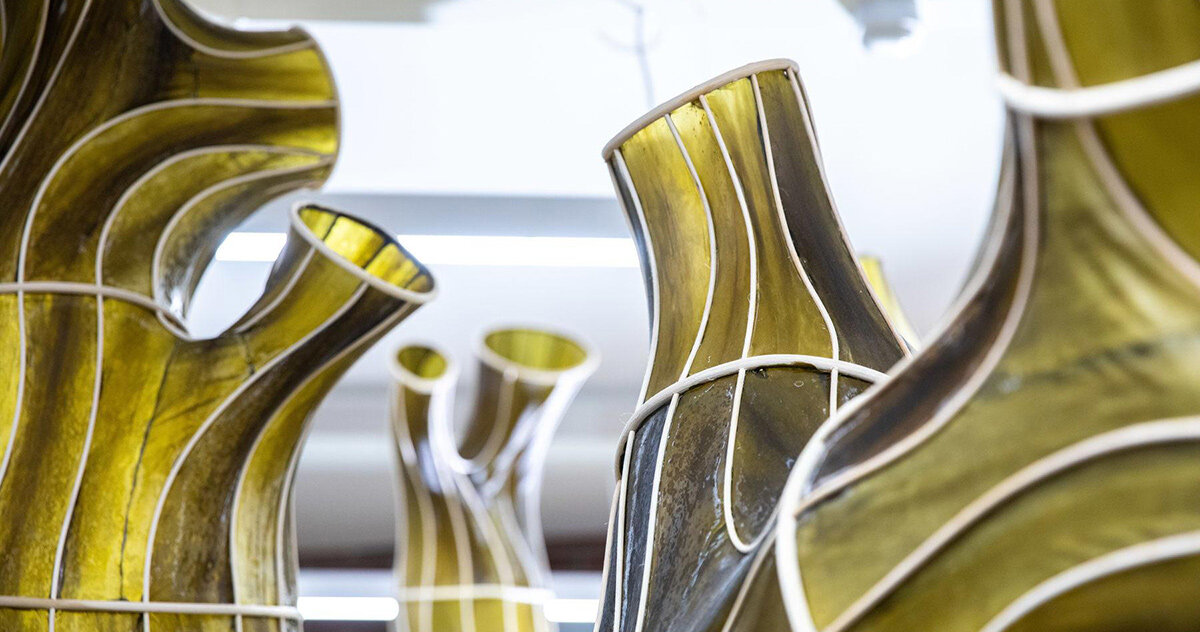
Rather than serving as static decorative objects, the installation invites contemplation. It imagines a quiet gathering of marine organisms deliberating the precarious condition of their shared environment, actively drawing exhibition visitors into the conversation. As the global design community increasingly turns to seaweed as a viable, low-impact alternative to conventional plastics and textiles, Lohmann sounds a cautionary note. She questions the long-term repercussions on the fragile ecosystems tasked with supplying these burgeoning industrial demands. Through her sculptures and iterative material experiments, she maps out a future where design works in tandem with nature, maintaining a strict accounting for the living systems behind every harvested resource.
From Animal Bodies to Natural Materials
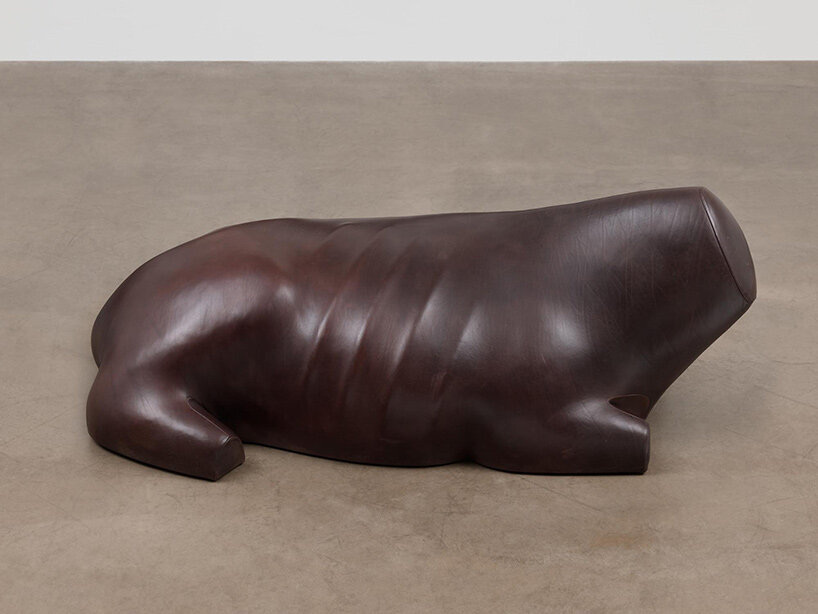
Lohmann’s deep-seated fascination with the hidden origins of everyday materials did not begin with the ocean; it started on land with familiar domesticated species. In 2004, she created the Waltraud Cow-Bench, a striking piece of furniture shaped explicitly to resemble a reclining cow and upholstered entirely in its own leather. By returning a familiar, heavily processed commercial material directly to the anatomical form of the animal from which it originated, Lohmann exposed a uncomfortable disconnect. She drew sharp attention to a biological and ethical relationship that typically vanishes entirely during standard industrial production cycles.
This uncompromising line of inquiry eventually guided her gaze from terrestrial livestock toward marine flora. During a transformative 2003 residency at London’s Victoria and Albert Museum (V&A), Lohmann founded the Department of Seaweed. Conceived as a collaborative research initiative, the department set out to rigorously explore the unique physical properties of kelp and evaluate its realistic potential for future applications in design.
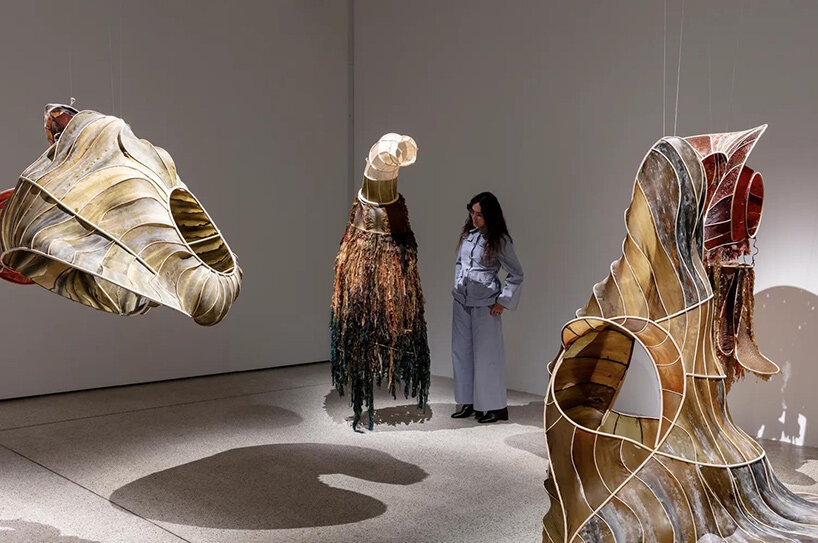
Collaborating closely with marine scientists, botanists, and material specialists, Lohmann began developing revolutionary handling techniques. Instead of forcing the seaweed into predetermined geometries, her methods allowed the natural, intrinsic characteristics of the drying material to dictate her sculptural forms, marrying artistic intent with organic autonomy.
When Kelp Shapes the Structure
This philosophy of material-led design is vividly demonstrated in works like Kombu Ahtola (2020). In this piece, damp pieces of seaweed are carefully stretched across the structural ribs of a flexible rattan framework. As the kelp slowly dries in the open air, it naturally contracts, exerting physical tension that pulls the rigid structure into graceful, organic curves. The inherent behavior of the material thus determines the final geometry of the sculpture, introducing a healthy, unpredictable degree of agency into the traditional making process.
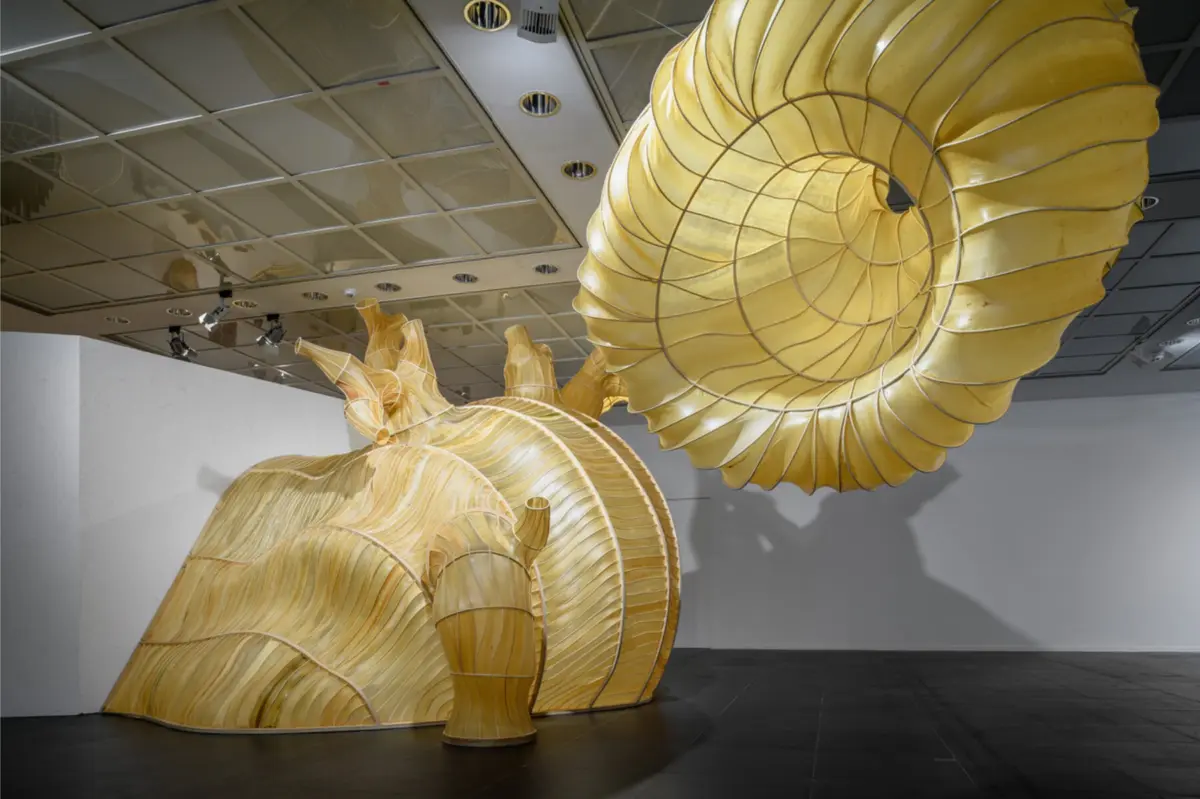
Lohmann scaled up these experimental principles later that same year with the creation of the Hidaka Ohmu pavilion. Measuring an impressive six meters across, the monumental structure is enveloped entirely in translucent seaweed panels that filter natural light softly into its curved interior. Visitors stepping inside can move through the installation, experiencing the rich, unusual tactile qualities and physical presence of a substance usually relegated to the periphery of human awareness in the ocean.
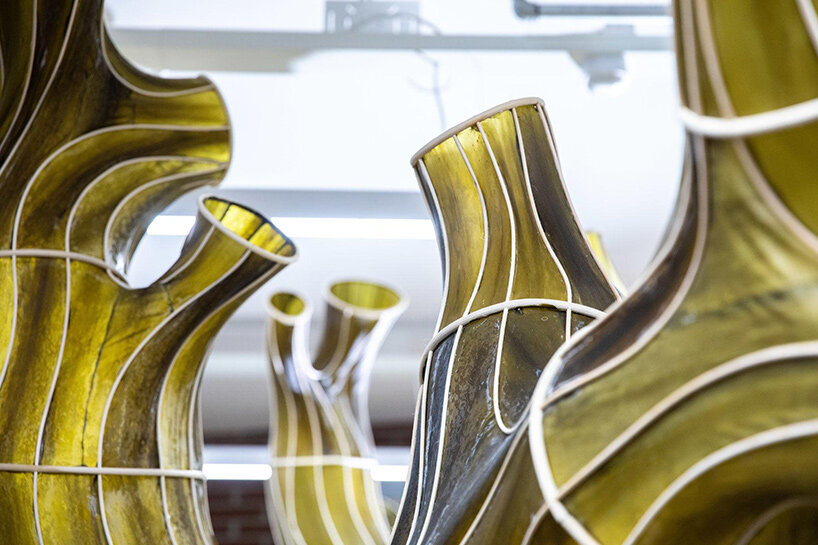
Earlier iterations of this architectural exploration, such as Oki Naganode showcased at the V&A and later at MoMA, similarly tested the limits of seaweed as a structural medium. By utilizing large panels of brown algae, Lohmann demonstrated that marine plants could rival traditional architectural materials in scale, texture, and visual depth, provided creators were willing to respect the material’s structural limitations and environmental origins.
Designing With the Needs of Other Species in Mind
Kelp forests represent some of the most ecologically vital habitats on Earth, supporting complex marine food webs and providing critical shelter for countless aquatic species. While seaweed undoubtedly offers promising pathways for regenerative material development, expanding its commercial cultivation and harvesting introduces complex ecological questions that the design industry cannot afford to ignore. Lohmann’s ongoing research directly addresses how these renewable resources might be responsibly utilized while actively preserving the marine environments that sustain them.
The Kombu Council installation brings these urgent conservation concerns into a deeply speculative, imaginative setting. By visualizing marine organisms gathered in structured discourse, Lohmann challenges viewers to consider whose interests are genuinely prioritized when humanity makes decisions regarding the exploitation of natural resources. Her sculptures provide a powerful physical manifestation of a core philosophy that links her early terrestrial furniture design with her contemporary seaweed research: that the future of sustainable design depends just as critically on how we ethically obtain our materials as it does on the objects we ultimately manufacture from them.
As part of designboom’s Posthuman Utopias chapter—an editorial series exploring scenarios where humans are no longer the exclusive measure of all things—Lohmann’s work exemplifies a broader paradigm shift. By championing interspecies architecture, living materials, and regenerative landscapes, her practice points toward a future where human creativity collaborates with, rather than dominates, the natural world.