





“Cities, like dreams, are made of desires and fears, even if the thread of their discourse is secret, their rules are absurd, their perspectives deceitful, and everything conceals something else.” — Italo Calvino, Invisible Cities
When arriving in an unfamiliar metropolis, travelers instinctively search for orientation, feeding an internal GPS with physical points of reference. Natural markers like coastlines, winding rivers, or rolling mountain ridges make this navigation effortless. Yet, in the absence of geography, the built environment steps in. Open public squares, ancient religious architecture, grand arenas, expansive thoroughfares, and bridges all anchor human movement through a city. Among these man-made orientation points, towers of every height and purpose stand out, piercing the skyline with their striking verticality.
While this holds true for most urban centers around the world, in Shanghai—a sprawling megalopolis defined by its massive scale and accelerated development—the need for reliable guiding posts takes on profound significance. Navigating a densely built, labyrinthine urban expanse covering approximately 14,000 square kilometers requires more than a casual glance at a map. Much like sailors navigating a pitch-black night, visitors and residents alike look up and into the distance for a North Star to anchor them within the complex urban fabric.
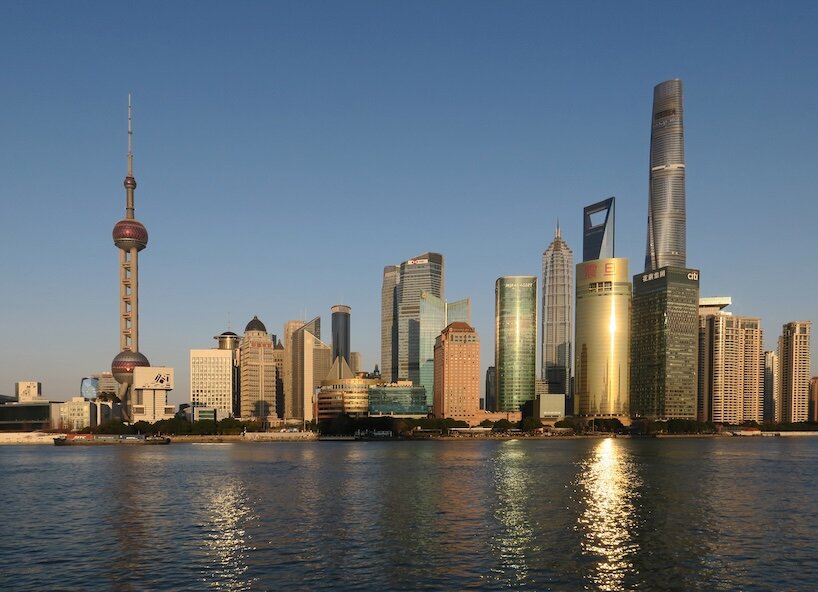
Scaning the horizon for a single skyscraper to act as a lighthouse seems logical at first glance. However, in a metropolis boasting roughly 200 skyscrapers standing 492 feet high or taller, one towering structure easily blends into the next. Height alone ceases to be a reliable differentiator when every block competes for altitude. Fortunately, the designers behind many of Shanghai’s soaring towers recognized this challenge. They dedicated as much creative energy to crafting the summits of their buildings as they did to engineering their record-breaking heights, focusing on the definitive element that turns a structure into a memorable, sometimes iconic, landmark: its crown.
The Crown as Compass
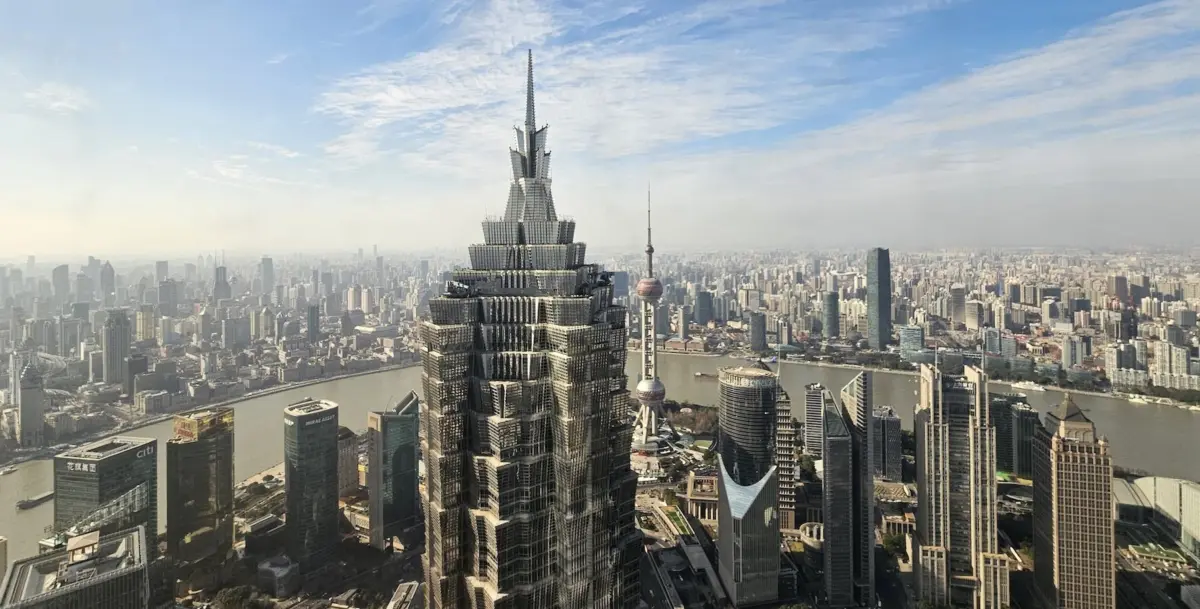
Observing this phenomenon firsthand from the 81st floor of the Park Hyatt Shanghai—nestled comfortably inside the Shanghai World Financial Center, completed in 2008 by architectural firm Kohn Pedersen Fox—offers a literal skybox view for contemplation. Staying directly beneath one such architectural crown creates a fascinating duality: simultaneously searching the horizon for other landmarks while residing inside one. Surveying the sprawling metropolis from this elevated perch across all hours of the day reveals a shifting theatrical tableau. From the soft, early light glow of sunrise to a moody, Blade Runner-esque dusk, scanning the skyline to pick out which unique crown stands out against the clouds transforms into an experience that is at once deeply insightful and profoundly meditative.
“The catalogue of forms is endless: until every shape has found its city, new cities will continue to be born. When the forms exhaust their variety and come apart, the end of cities begins.” — Italo Calvino, Invisible Cities

Gazing down at the vast cityscape below, even through a persistent veil of urban haze, reveals an absolute abundance of crowns. Some designs are sleek and cutting-edge, others exhibit sophisticated nuance, and a few lean toward novelty that borders on kitsch. Together, they form an eclectic, futuristic architectural mosaic that speaks volumes about the diverse influences, styles, cultural tastes, and historical eras that have shaped Shanghai’s rapid development and, by extension, the modern architectural identity of China.
Symbols on the Skyline
Two of the most emblematic crowns on the Shanghai skyline were designed by John Portman & Associates, one of the earliest American architecture practices to establish a presence in the country. Known globally for ambitious, glassy, and frequently glossy high-rise projects, the firm adopted a more elaborate, symbolic geometric direction for these specific commissions.
Tomorrow Square, completed in 2003 and curiously housing the world’s highest library on its 60th floor, features a distinctive pointed apex composed of four structural corners inclined toward the center, stopping just short of meeting. Clad in gleaming aluminum, the crown catches and reflects sunlight even on overcast days, serving as a reliable navigational beacon in the heart of the city’s urban core.

Portman’s other major contribution to the local skyline is the Bund Center, completed in 2002. Here, the architects drew direct inspiration from the lotus flower, a revered cultural symbol of purity and spiritual integrity. Atop the cream-colored terracotta and glass-sheathed tower sits a massive, 58-meter-wide, 582-ton garland of lotus petals. Whether viewed under the harsh midday sun or at night when the petals are illuminated in a warm golden glow, the crown is impossible to miss, injecting a lyrical, poetic touch into the dense corporate horizon. Yet, for many observers and photographers, it is the slender, glistening stainless steel pinnacle of the Jin Mao Tower that truly pierces the imagination.
Jin Mao and the Language of Heritage
Completed in 1999, the Jin Mao Tower served as the catalyst that transformed the Pudong district into a world-class high-rise financial hub. As China’s inaugural entry into the global arena of supertall architecture, the building carried a heavy burden: its design needed to project an optimistic, forward-looking future while simultaneously honoring the nation’s deep historical heritage.
When Adrian Smith’s design team—then operating out of Skidmore, Owings & Merrill’s Chicago office—undertook the project, they drew inspiration from the traditional Chinese pagoda typology. They integrated geometric patterns derived from the number eight, a traditional symbol of prosperity in Chinese culture, into both the architectural layout and the structural engineering systems. The result was a tiered masterpiece that asserted its unique place in modern history—briefly standing as the tallest building in China upon completion—while offering a respectful nod to the past.

Staring each morning at the spire atop the Jin Mao crown as it glinted against the cacophony of the megalopolis below offered an inspiring reminder of its dual purpose. That architectural "sword in the sky" functions equally as a monument to a specific era of urban planning and as a functional place-maker for everyday navigation.
Contemplating this structure from the elevated vantage point of the neighboring Shanghai World Financial Center provides a fascinating study in contrasting approaches to architectural crowning. While the Jin Mao opts for a literal, heritage-driven regional reference, its neighbor takes a more abstract route. The Shanghai World Financial Center forms its crown from the negative space left by a massive, inverted trapezoid opening carved into the summit. Originally designed to be circular, this dramatic void pays homage to the traditional moon gates found in classical Chinese gardens. Despite their stylistic differences, both designs demonstrate a nuanced, sensitive use of symbolism that anchors each building firmly in its cultural and physical context, cementing their status as Shanghai’s most enduring icons.
From Ornament to Identity
Over time, as the surrounding skyline becomes familiar, the initial sense of architectural wanderlust naturally shifts toward a deeper appreciation of what these diverse crowns reveal about the city’s cultural DNA. A true building crown functions as much more than a mere embellishment or decorative cap; it serves as a bold statement of identity and a deliberate tool for commanding awe. The eclectic mix of architectural styles—oscillating between traditional heritage motifs, radical contemporary geometries, and pure technological exhibitionism born from decades of rapid modernization—reflects the multifaceted reality of modern Shanghai.

Etymologically, the word "landmark" derives from the fusion of two Old English terms, land and mearc, originally denoting a physical boundary marker used to delimit territory. As centuries passed, the definition evolved, expanding from a simple geographical boundary to encompass historic moments of societal change and architectural achievement, as seen in phrases like "a landmark case" or "an architectural landmark."
Shanghai’s dramatic skyscraper crowns easily qualify as landmarks under both interpretations. They operate simultaneously as geographical waypoints for anyone traversing the sprawling metropolis and as permanent monuments marking the distinct eras of transition that birthed them.
Of course, supertall structures and their idiosyncratic summits are not the sole keys to truly understanding a city. Grasping the soul of a place requires walking its sidewalks, moving through its neighborhoods, absorbing street-level energy, sharing a meal, and interacting directly with local residents. Yet, much like the selective architectural wonders cataloged in Italo Calvino’s classic literary exploration, Invisible Cities, these remarkable crowns have an undeniable voice in shaping the human experience of an urban landscape, offering a window into its evolving genius loci.