





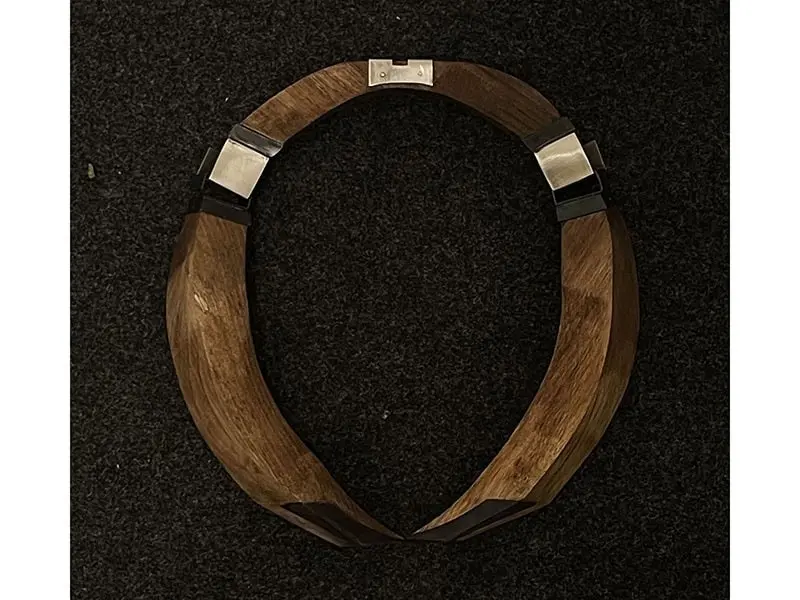
Contemporary jewelry has long oscillated between conventional notions of beauty, luxury, and social status. However, emerging artist Marie-Caroline Locquet is deliberately upending these traditional paradigms. Rather than viewing jewelry as an emblem of wealth or a tool for graceful self-expression, Locquet conceptualizes adornment as an instrument of provocation. Her striking body of work—comprising defensive weapons, restraints, and architectural neckpieces—challenges viewers and wearers alike to confront the boundaries of the human body and the complexities of social interaction.
In recognition of this bold, uncompromising vision, Locquet has been named a finalist for the prestigious Young Artist Award. Supported by Karen and Michael Rotenberg, the biennial award is dedicated to celebrating promise, innovation, and individuality among emerging jewelry artists aged 35 or younger. By championing radical talents like Locquet, the Art Jewelry Forum (AJF) aims to elevate pioneering work that charts new paths and pushes the medium into uncharted territory.
A Radical Education and Early Influences
Locquet’s journey into the avant-garde realm of contemporary jewelry began during her foundational fine arts studies in France. It was there that she encountered the work of visionary creators who completely dismantled her preconceptions of what adornment could achieve. Rather than gravitating toward pieces designed to flatter or display affluence, she found herself drawn to objects that felt strange, uneasy, and inherently dangerous.
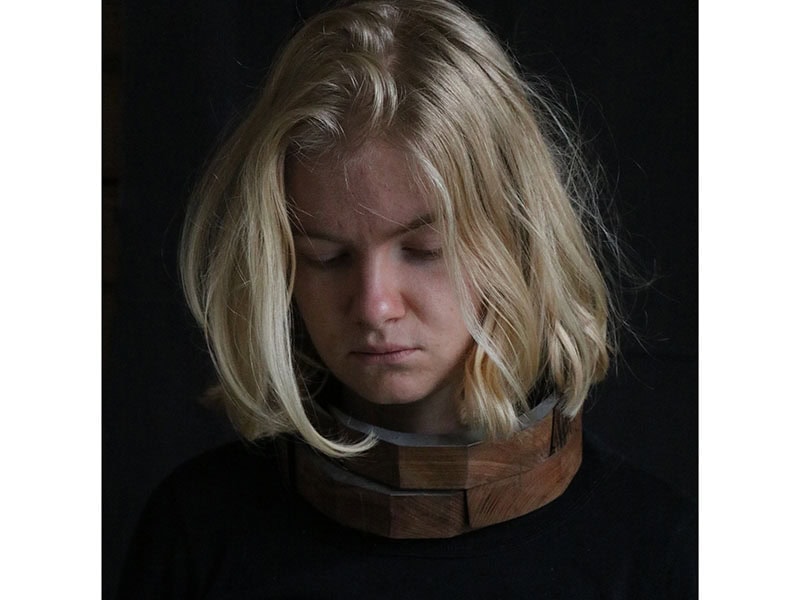
She points to the pioneering work of Bernhard Schobinger and Dorothea Prühl as pivotal turning points in her artistic evolution. These makers demonstrated how jewelry could act as a catalyst for critical disruption.
"It really changed my point of view on art," Locquet reflects. "In a way, jewelry interests me as an object of disruption, reflection, and provocation."
This realization sparked a persistent line of inquiry that would ultimately become the cornerstone of her practice: Why create and wear objects that provoke immediate psychological disturbance? What are the implications of fashioning pieces that society superficially deems "unwearable"? Locquet dove headfirst into these questions, deciding to use jewelry not as a showcase for precious materials, but as a medium for psychological exploration.

Confronting the Public Space
Growing up in the north of France, Locquet developed an early sensitivity to the pressures of social presentation. She observed firsthand how clothing and adornment often serve as a form of camouflage—a way to signal social affiliations and project status. This sociological observation heavily informs her artistic output today.
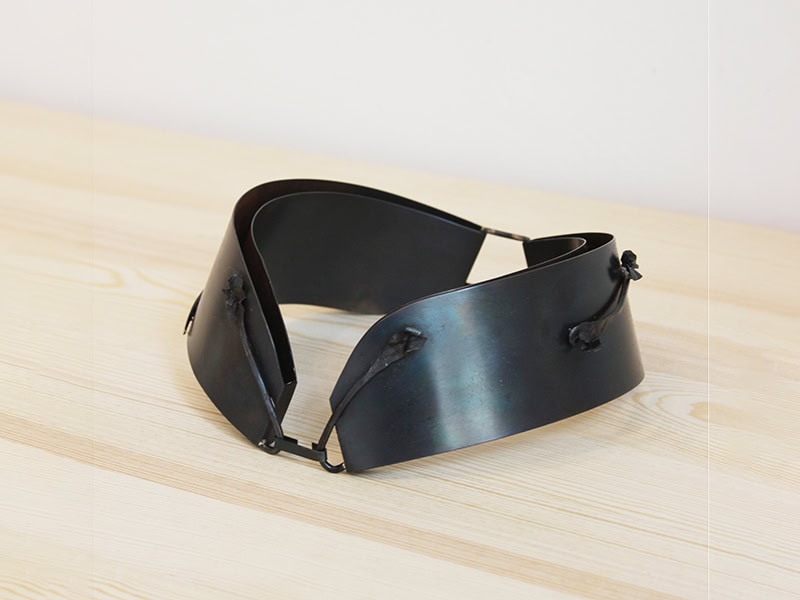
Her applied portfolio for the Young Artist Award showcases pieces that reject seduction in favor of intense psychological tension. Her wearable sculptures blur the boundaries between defensive armaments and restraint devices, exploring the delicate equilibrium between vulnerability and confinement. Pushing materials like steel, forged iron, wood, and silver to their extreme limits, she exposes their raw nature through forms that evoke both deep-seated desire and existential dread.
Whether a wearer is donning a heavy steel neckpiece or interacting with a complex kinetic sculpture, the experience is designed to be deeply visceral. The works maintain a perpetual tension, oscillating uncomfortably between social anxiety and the temptation of an embrace. For Locquet, being selected as a finalist for the Young Artist Award serves as profound validation of this path, offering her renewed confidence to push her radical methodology even further.
The Mechanics of Vulnerability: Examining Hands
Locquet’s practice frequently draws on historical and cultural objects associated with control, servitude, and labor. Her research has encompassed traditional items such as the collier d’appartenance—a historical collar utilized in submissive relationships—the 19th-century Norman and Auvergnat "slave collar" once given to women at marriage as a symbol of possession, and utilitarian animal-labor equipment like horse collars.
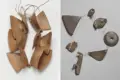
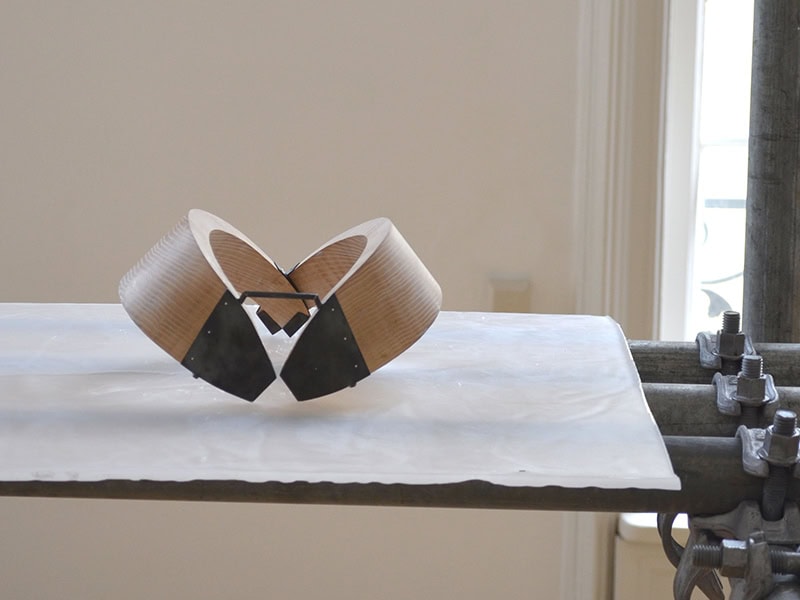
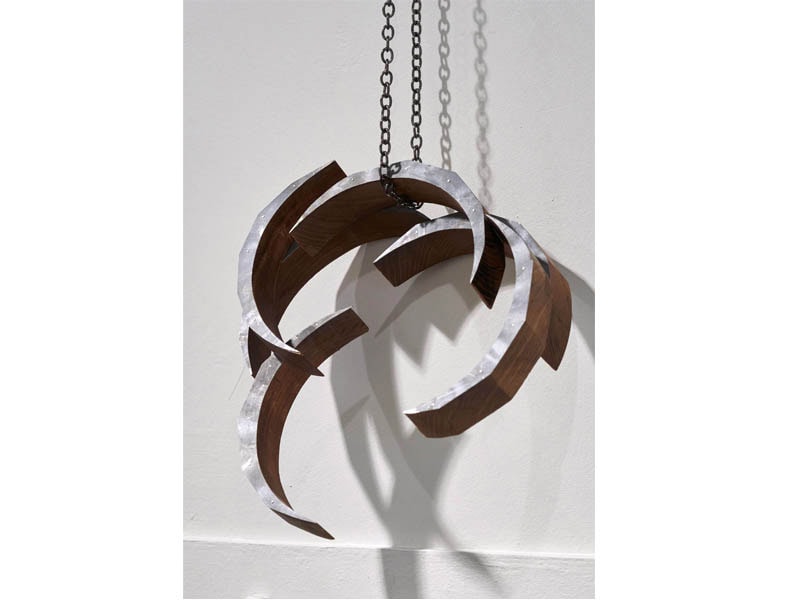
These deep historical investigations culminate in complex, highly intimate physical objects. One of the standout pieces in her award application, titled Hands (2024), exemplifies the breadth of her sculptural and conceptual research. Constructed from elm wood, zinc-plated steel, and silver, the neckpiece showcases Locquet’s obsessive fascination with mechanical systems, hinges, clasps, and the fluid border separating jewelry from standalone sculpture.
When initially displayed, the piece unfolds and claims physical space much like an intricate piece of machinery. However, its ultimate function is arresting; it closes around the wearer’s neck with a gesture evocative of strangulation. By transforming a wearable object into a manifestation of confinement and physical dominance, Hands stands as one of her most intensely psychological creations to date.
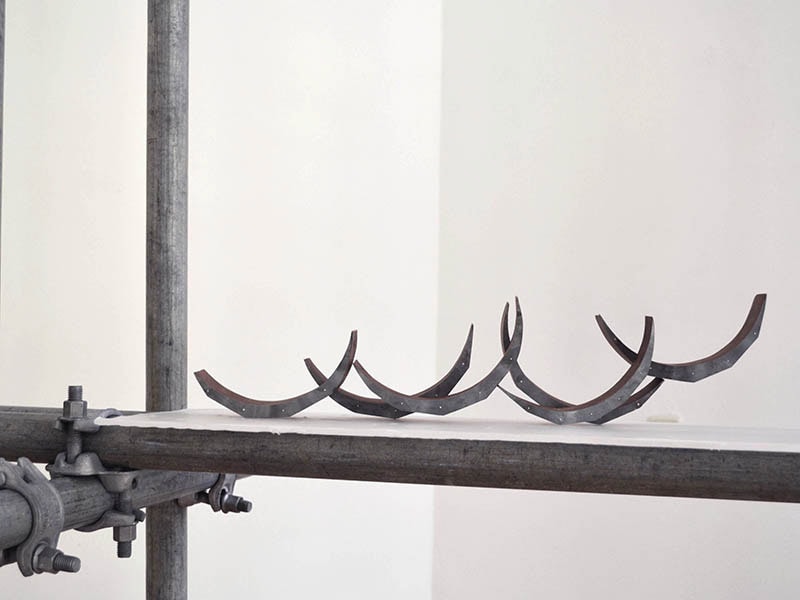
This exploration of space and scale is also evident in her other major projects, such as Panicroom Vector I (2025) and Attelage II (2024). In Panicroom Vector I, exhibited at the A-Galerii in Tallinn, Estonia, Locquet utilized iron, elm wood, silver, and rubber to craft a neckpiece that serves as a literal and conceptual gateway for audiences, easing them into the heavier philosophical themes of her broader installation work.
Challenging the Boundaries of the Field
Despite the growing recognition of contemporary art jewelry, Locquet remains candid about the challenges facing the medium. Reflecting on her time studying in French fine art institutions, she frequently encountered the lingering prejudice that jewelry is somehow a lesser, more superficial, or overly niche discipline compared to traditional fine arts.
Yet, Locquet views this perceived marginalization not as a weakness, but as a unique strength. The peripheral status of jewelry allows makers to bypass rigid academic expectations and invent entirely new frameworks for looking and thinking about the body. At the same time, she acknowledges the inherent gap that can exist between radical makers and audiences outside the specialized art community—a realization that drives her to create literal "keys," such as Panicroom Vector I, to help viewers navigate her conceptual landscape.
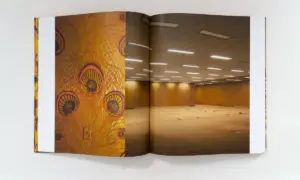
Her critical engagement with adornment extends far beyond individual objects. Locquet has spearheaded extensive iconographic research and archiving projects under the provocative banner "Unwearable—adornment is impure, makeup is obscene, disguise is an abomination." Through this ongoing research, she investigates how body ornament consistently reflects the cultural values, boundaries, and hidden anxieties of the society that produces it, slipping continuously between private intimacy and public exposure.
Looking Forward
Reflecting on the five years that have passed since her graduation, Locquet expresses deep satisfaction with the trajectory of her career. Her recent work has increasingly expanded beyond the confines of the body, creating immersive spatial installations where her jewelry and the surrounding architecture resonate in tandem—a dialogue she plans to showcase in upcoming exhibition projects.
Looking toward the future, Locquet aims to continue expanding her artistic language through international residencies, collaborative projects with fellow artists, and further explorations into the intersections of space and adornment. Furthermore, she harbors a strong interest in entering academia. She regards teaching as an ideal environment to challenge collective perceptions of body ornamentation and encourage the next generation of makers to push the boundaries of what jewelry can signify.
As she navigates this next chapter, backed by the recognition of the Young Artist Award, Locquet remains steadfast in her commitment to keeping the medium daring, experimental, and deeply provocative.