





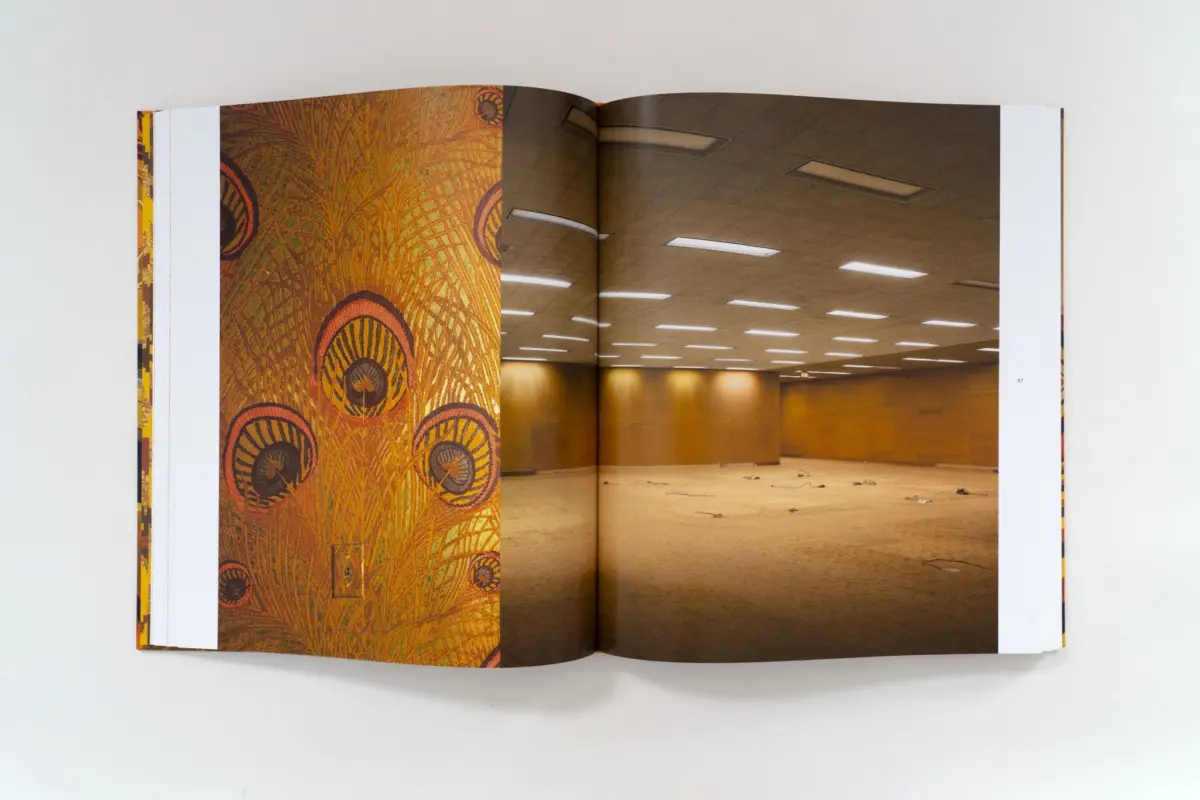
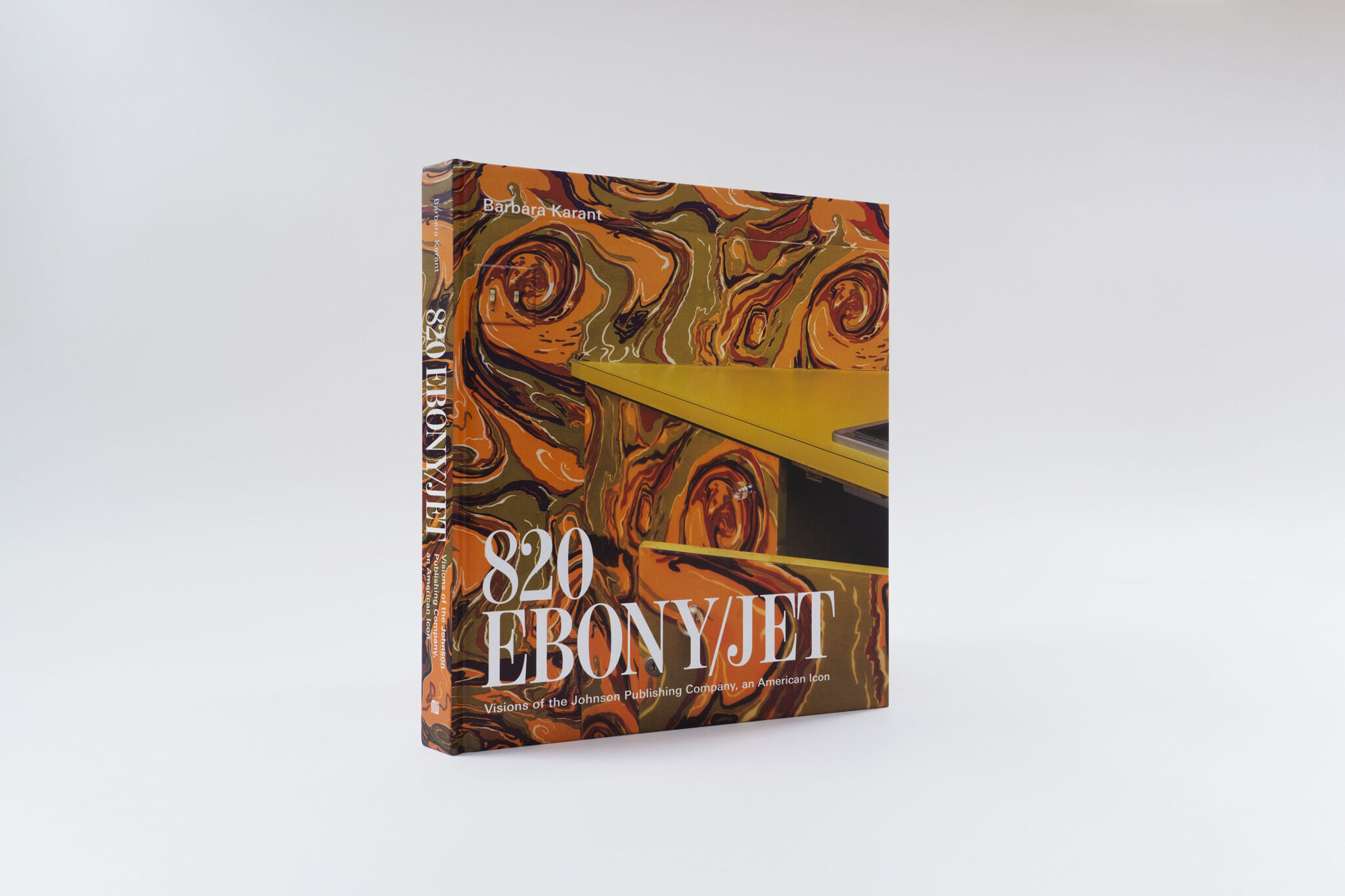
For decades, Ebony and Jet stood as monumental pillars in the documentation, shaping, and celebration of Black American life and culture. Through these pioneering publications, the Johnson Publishing Company cemented its status as the era’s most influential Black-owned media corporation, projecting a powerful vision of Black excellence, fashion, politics, and daily life into millions of homes across the United States and around the world. The cultural presence of these magazines finally found a permanent physical form in 1972 with the completion of the company’s corporate headquarters at 820 South Michigan Avenue in Chicago, Illinois. More than forty years after its doors first opened, photographer Barbara Karant began the meticulous process of documenting the now-abandoned building, capturing its striking kaleidoscopic patterns, reflective mirrored surfaces, and remarkably intact 1970s interiors before they were lost to time. Those haunting, evocative photographs have now been gathered into a comprehensive new monograph titled 820 Ebony/Jet: Visions of the Johnson Publishing Company, an American Icon, published by MW Editions, which seeks to preserve the building and its monumental design legacy for future generations.
The historical significance of the headquarters began long before anyone ever stepped foot across its threshold. Publisher John H. Johnson encountered persistent resistance from commercial real estate agents and conservative bankers who were deeply wary of financing a major downtown high-rise owned and operated by a Black company. Undeterred by these systemic roadblocks, Johnson ultimately commissioned John Moutoussamy, who made history as the first Black architect to design a prominent downtown Chicago high-rise. Rejecting the cold, anonymous glass-and-steel towers that were rapidly coming to define the architectural landscape of the era, Johnson envisioned a building that radiated permanence, dignity, and distinct character. Moutoussamy delivered precisely that, creating a restrained yet commanding exterior clad entirely in elegant travertine marble that stood as a proud architectural statement along Michigan Avenue.
While the exterior of the building projected a dignified and measured restraint, stepping inside revealed an environment that was radically more expressive, vibrant, and daring. To curate the corporate workspaces, publisher John H. Johnson and co-founder Eunice Johnson enlisted the renowned Palm Springs interior designers Arthur Elrod and William Raiser. The visionary duo gave each of the building’s eleven distinct floors its own unique combination of saturated color, bold texture, and complex pattern, creating an interior landscape that reflected the Johnson Publishing Company’s towering cultural ambitions just as much as its corporate identity.

Every single floor told a different visual story. The employee cafeteria, for instance, paired energetic bursts of orange, purple, and gold chevrons to foster a lively communal atmosphere. In contrast, co-founder Eunice Johnson’s executive office embraced a sophisticated cream-and-honey palette that artfully incorporated prized pieces from the couple’s personal fine art collection. Across the headquarters, geometric wallpapers, expansive mirrored surfaces, bold patterned carpets, and richly textured finishes appeared in continuous dialogue, creating an immersive corporate environment unlike anything else in corporate America at the time.
Remarkably, a vast majority of this bold, mid-century interior design remained completely untouched and unchanged until the Johnson Publishing Company finally departed the building in 2012. Recognizing the profound historical and artistic value of what remained inside, photographer Barbara Karant began documenting the empty, silent headquarters the following year, continuing her painstaking visual survey through 2018. With all the original furniture, desks, and office equipment removed, Karant focused her camera lens squarely on the architectural surfaces, textures, and intimate details that had defined the workspaces for decades: mesmerizing geometric wallpapers, mirrored dressing rooms that played tricks with perspective, and the legendary Test Kitchen’s swirling laminate cabinetry, whose psychedelic, undulating patterns heavily recall traditional Italian marbled paper. Throughout her compositions, carefully positioned mirrors double and multiply motifs, while the expansive picture windows of the executive floor continuously draw the natural vistas of Lake Michigan and Grant Park into the frame.
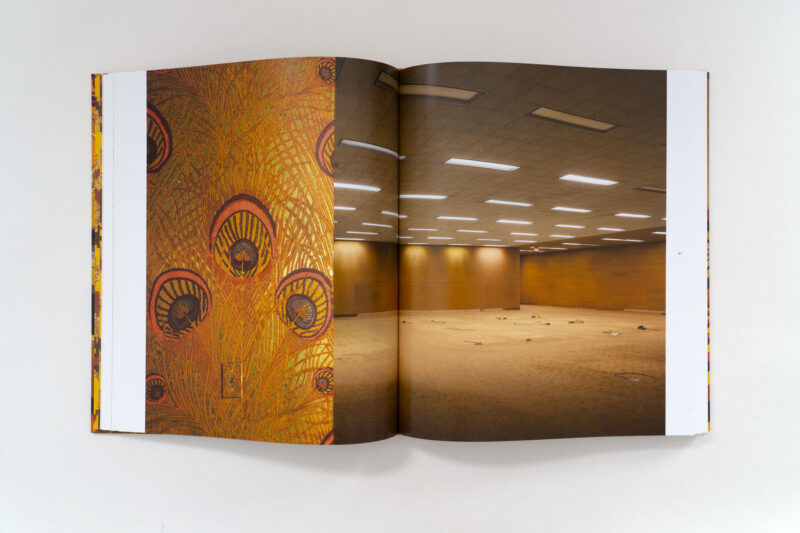
The profound emptiness of the building is precisely what lends Karant’s photographs their unique emotional and aesthetic power. Stripped entirely of the people, the rustling pages of magazines, and the day-to-day corporate activity that once animated the bustling headquarters, the empty rooms transform into meditative studies in color, pattern, and material. At the same time, they serve as poignant, elegiac records of a workplace and a cultural institution that no longer exists in this physical form.
The new monograph broadens this visual record significantly by incorporating rare documentary imagery of the original, fully furnished interiors and Ebony’s legendary in-house photo studio, where countless iconic images of Black luminaries, activists, artists, and everyday citizens were captured. The book also highlights prominent site-specific art installations commissioned for the building, such as Richard Hunt’s striking lobby sculpture, Expansive Construction, completed in 1972. To ground the architectural and visual study in human history, the volume includes vivid recollections from former employees who offer firsthand accounts of what daily life was really like inside the bustling building. Furthermore, the book traces the enduring design influence of the headquarters on a subsequent generation of contemporary artists and creators, including Theaster Gates, Hank Willis Thomas, Kwame Brathwaite, Lorna Simpson, Martine Syms, and David Hartt.
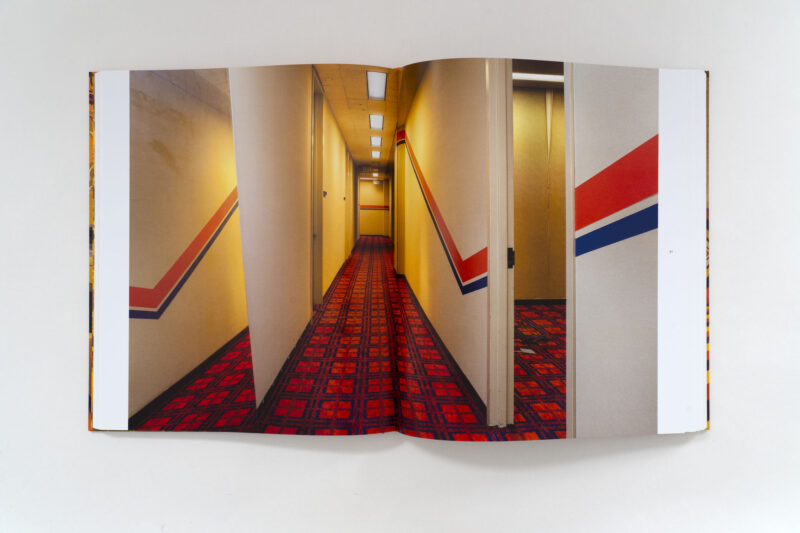
Spanning 240 pages, 820 Ebony/Jet brings together a meticulously curated collection of 142 vibrant color photographs and eight striking black-and-white images. The publication is anchored by an insightful foreword penned by artist Deborah Willis, alongside rigorous critical essays written by Aaron Bryant, Cheryl Finley, Carla Williams, Jon Ott, Brenna Wynn Greer, and E. James West. Together, the text and imagery work in tandem to preserve a remarkable chapter of American design history—capturing the physical environment deliberately created for two groundbreaking publications that fundamentally helped shape how Black American life was seen, documented, and celebrated on a global scale.
Published by MW Editions, 820 Ebony/Jet: Visions of the Johnson Publishing Company, an American Icon is available beginning October 13 for $65.