





While the wider landscape of Geneva Watch Days featured a relatively limited slate of truly brand-new releases, focusing instead on clever new variants and material iterations of existing collections, one standout timepiece managed to capture the attention of serious horological enthusiasts. Among the crowded exhibition halls, the Ferdinand Berthoud FB 3SPC.4-1 drew intense scrutiny for its lightweight yet rugged ceramised titanium case, offering a distinctly casual and surprisingly sporty interpretation of the brand’s refined marine chronometer DNA.
Initial thoughts
Ferdinand Berthoud is certainly no stranger to experimenting with exotic and unconventional case materials. The high-end marque has previously utilized ceramised titanium for select references such as the FB 1RES.4, alongside historical-leaning metals like carburised stainless steel and bronze. However, the introduction of the FB 3SPC.4-1 marks only the second time an FB 3SPC model has been dressed in a non-precious metal case, and it stands as the very first instance of the non-precious variant receiving a specialized ceramised coating.

In terms of aesthetics, the open-worked architectural layout of the FB 3SPC arguably sacrifices a traditional measure of visual convention, though such traits remain inherently subjective among collectors. Many connoisseurs actively prefer an exposed movement over a conventional solid dial because it allows them to appreciate the intricate hand-finishing and mechanical choreography of the watch without needing to remove it from the wrist or examine the case back. Even so, this design choice inevitably impacts overall legibility. Furthermore, certain structural elements of the layout can feel slightly counterintuitive at first glance, most notably the unconventional upside-down orientation of the dial-side balance wheel and its associated escapement components.
First making its global debut in 2022, the FB 3SPC family continues to serve as the entry-level gateway into the rarefied world of Ferdinand Berthoud. Yet, with a retail price approaching the US$200,000 threshold, it competes directly with deeply complicated grand complications from long-established historic Maisons. The fundamental value proposition of this time-only timepiece hinges entirely on the romantic appeal of its cylindrical hairspring—an element that, while no longer entirely unique in contemporary independent watchmaking, is executed to an astonishing standard of precision—paired with a strict, no-expense-spared approach to traditional hand-finishing that defines the Fleurier-based manufacture.

This lofty pricing structure is also a direct reflection of the exceptionally low-volume production model maintained by Ferdinand Berthoud. Situated in the historic watchmaking cradle of Fleurier, the manufacture produces no more than 35 individual pieces of the FB 3SPC per year. This modest output accounts for roughly half of the brand’s total annual production across all collections, ensuring that every watch that leaves the workshop is treated as a bespoke work of mechanical art.
Firing on all cylinders
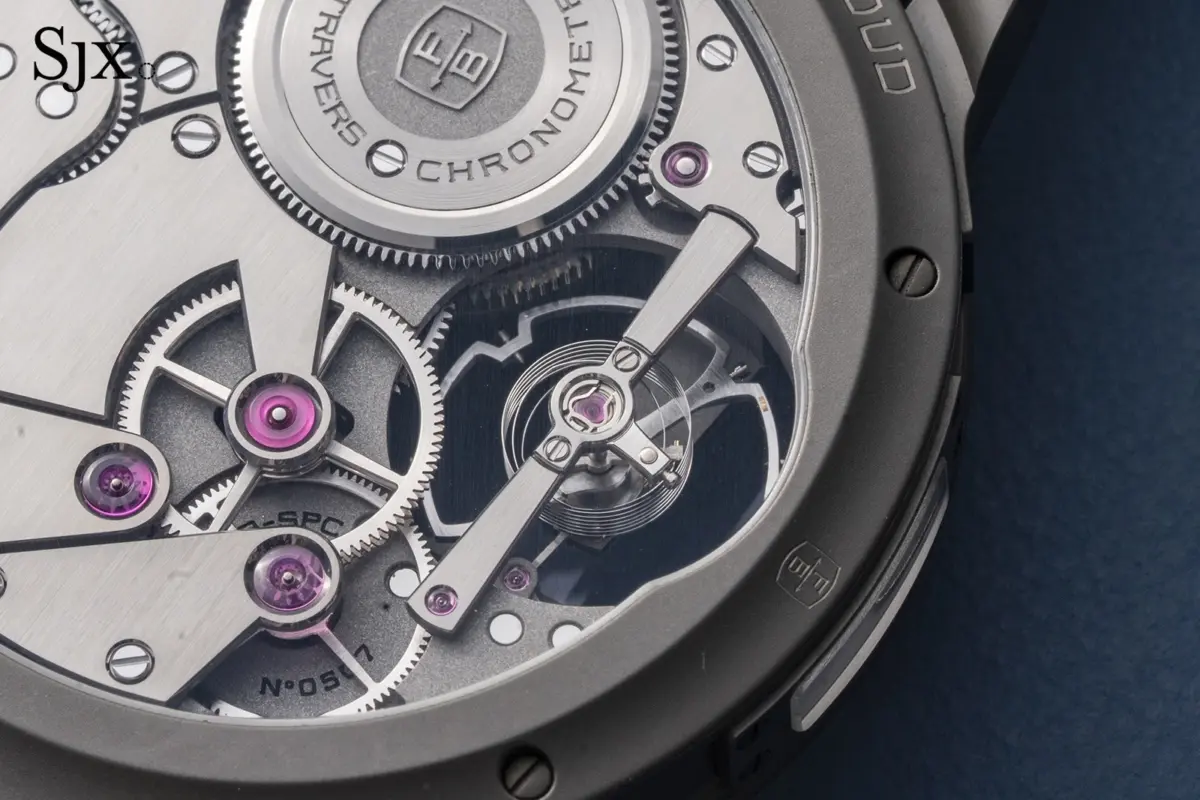
At the absolute heart of the FB-SPC movement’s appeal is its extraordinary cylindrical hairspring. This distinct architectural detail represents an uncommon horological anachronism that creates a tangible, physical link between modern watchmaking and the pioneering marine chronometer work of master watchmaker Ferdinand Berthoud and his talented heir and nephew, Louis Berthoud. Historical pieces utilizing these complex springs, such as a rare pocket chronometer successfully offered at auction by Sotheby’s, demonstrate the deep lineage behind the modern interpretation.

Cylindrical hairsprings were originally developed across the English Channel by renowned British watchmaker John Arnold. Arnold arrived at the unique three-dimensional geometric shape through painstaking trial and error in a relentless historical quest to improve isochronism—the scientific principle ensuring a watch maintains a consistent rate regardless of the mainspring’s tension level.
Though inherently functional and scientifically advantageous for maintaining concentric breathing of the coil, cylindrical hairsprings were historically—and remain today—notoriously tedious to shape by hand. They also consume a significantly larger volume of vertical space inside a watch movement compared to flat springs. It was not long before master watchmaker Abraham-Louis Breguet realized that the exact same performance benefits regarding isochronism could be achieved within a much flatter profile by utilizing a standard spiral spring fitted with a specially formed terminal curve, widely known today as the Breguet overcoil.

Given the undeniable space-saving advantages of the overcoil, cylindrical hairsprings largely fell out of favor in wristwatches, though they remained a vital component within high-precision marine chronometers well into the twentieth century until the dawn of reliable electronic timekeeping around 1970.
Yet, the modern realm of haute horlogerie has always embraced fascinating anachronistic mechanisms, and the cylindrical hairspring possesses a uniquely dynamic, mesmerizing visual rhythm in operation that thoroughly justifies its contemporary renaissance. While Ferdinand Berthoud is certainly not the sole contemporary independent brand to revive the cylindrical hairspring—prestigious names such as Jaeger-LeCoultre, Montblanc, H. Moser & Cie., and MB&F have all previously explored the architecture—it stands out as the very first manufacturer to submit movements featuring cylindrical hairsprings for official chronometer certification by the Contrôle Officiel Suisse des Chronomètres (COSC). This extra layer of regulatory testing speaks volumes about the intellectual thoughtfulness of the design concept and the immense amount of individual adjustment required for each completed unit.

The cylindrical hairspring of the FB-SPC is impressively large in scale and can be admired from multiple dramatic angles. Viewers can observe its breathing action not just from the front dial side and the exhibition case back, but also from the profile of the watch through an additional sapphire crystal porthole set directly into the side of the caseband. While such side windows in modern watchmaking can occasionally drift into the realm of gimmicky design, the feature feels entirely authentic here. Not only does it carry direct historical precedent—Ferdinand Berthoud himself utilized similar side apertures in historical marine chronometers to monitor the functioning of his oscillators—but the active spectacle of the beating cylindrical hairspring is genuinely worthwhile to observe up close.
The movement is the design
The FB 3SPC.4-1 is housed within a case crafted from ceramised titanium, endowing the timepiece with a remarkably robust, almost tactical visual character. Despite its substantial dimensions and visual presence, the watch feels effortlessly light on the wrist, a sensation further enhanced when paired with the optional titanium folding clasp equipped with a practical micro-adjustment mechanism. This material and strap configuration gives the watch a relaxed, casual attitude that pushes right up to the edge of sportiness.

The case itself represents a masterclass in finishing, featuring a fine matte texture that successfully hides fingerprints and daily smudges. Even the microscopic screws securing the crown guards, the strap lugs, and the nine o’clock side porthole exhibit incredible attention to detail with sharp, clean slots and polished bevels.
Beyond the remarkable case work, the overall design language of the FB 3SPC remains deliberately restrained, allowing the intricate FB-SPC movement to perform all the heavy lifting in terms of visual impact. The dial has been stripped down to its bare essentials, reduced entirely to a printed minute track on the outer flange and a matching, open-worked sub-dial dedicated to the running seconds.

For this specific ceramised titanium iteration, the overarching color palette is deliberately muted and monochromatic. There is minimal visual contrast between the matte black elements and the brushed grey components. While this restrained color scheme slightly reduces quick legibility—the plated gold hands occasionally blend closely into the background of the movement bridges—it serves a crucial design purpose. It successfully prevents the watch from descending into a chaotic visual clutter, which could easily happen given the sheer number of exposed mechanical components on display, ranging from the prominent oscillator positioned at nine o’clock down to the barrel bridge anchored near twelve o’clock.
The heavy predominance of fine vertical brushing distinctly differentiates the finishing of the FB 3SPC.4-1 from earlier iterations of the FB 3SPC line. Those previous models relied primarily on heavy sandblasted textures inspired directly by the gilded, frosted movements found inside historical pocket watches created by Ferdinand and Louis Berthoud. The shimmering, linear quality of the vertical brushing creates an interesting dynamic against the matte, industrial textures of the ceramised case.

Examining the escapement reveals an arrangement that initially appears to be completely inverted toward the dial side, supported visually by a prominent, stepped finger bridge. However, a closer inspection uncovers a more traditional underlying construction. The impulse roller faces upward, meaning the overall oscillator geometry is actually oriented upside-down when compared to similar open-dial escapement designs found elsewhere in contemporary independent watchmaking, such as creations from Greubel Forsey. This unconventional layout provides an unobstructed, panoramic view of the pallet lever and escape wheel in direct action, even if seeing the lever positioned on what feels like the visual top of the assembly takes a moment to process.
Naturally, every single aspect of the traditional finissage is executed with uncompromising care. While some purists might debate specific aesthetic choices, the absolute quality of the hand-finishing is top-class. Even though the movement architecture was not explicitly laid out to maximize the interior sharp angles that have become a modern hallmark of independent finishing, the polished anglage appears effortlessly executed, featuring impressively crisp interior corners and perfectly even, mirror-polished circular borders surrounding each functional jewel pivot in the gear train.

Key Facts and Price
Ferdinand Berthoud Chronometre FB 3SPC.4-1
Ref. FB 3SPC.4-1
Diameter: 42.3 mm
Thickness: 9.43 mm
Material: Ceramised titanium
Crystal: Sapphire
Water resistance: 30 m

Movement: FB-SPC
Functions: Hours, minutes, seconds, and power reserve indicator
Winding: Hand-wind
Frequency: 21,600 beats per hour (3 Hz)
Power reserve: 72 hours
Strap: Textile strap with titanium pin buckle or optional titanium folding clasp

Limited edition: No
Availability: At boutiques and authorized retailers
Price: Upon request
For more information, visit Ferdinandberthoud.ch.