





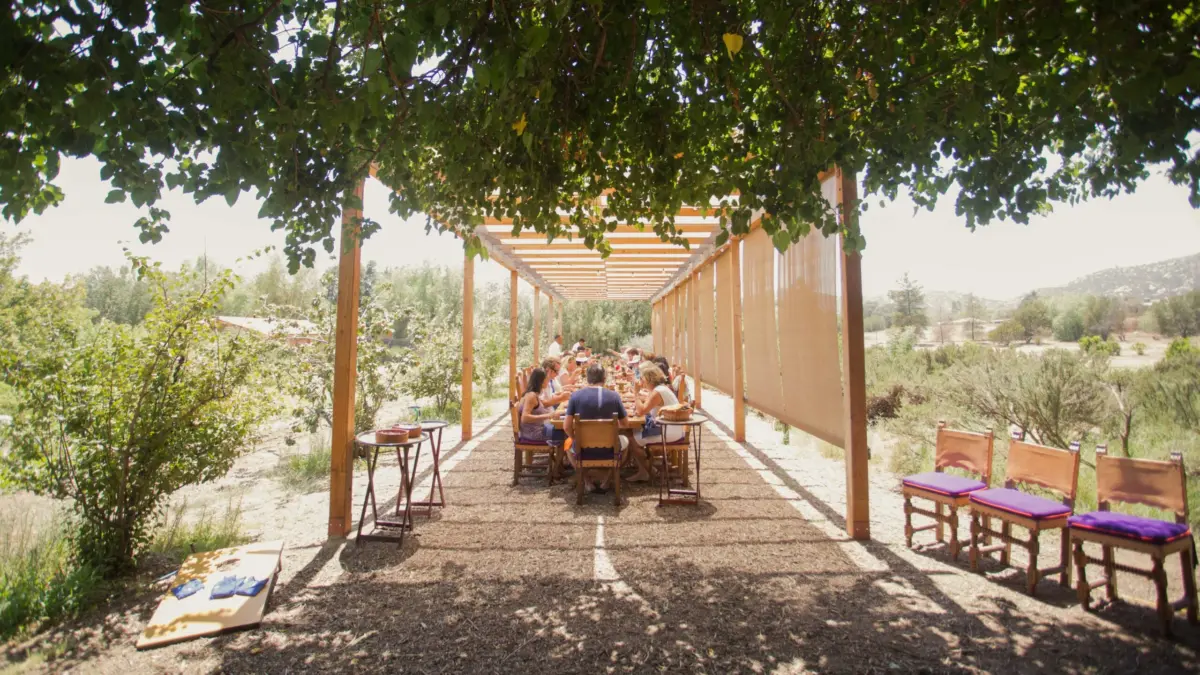
The awkwardness settled over the room almost immediately, heavy enough to suppress the uncomfortable smile tugging at my cheeks as I looked around from stranger to stranger. I had, after all, signed up for a seat at a 90-minute, five-course meditative meal with 16 people I had never met, and had agreed to do it all without sharing a single word. But knowing you are about to break bread in absolute silence and actually finding yourself seated at a rectangular table that looked vaguely reminiscent of a Game of Thrones feast—with the sounds of forks scraping plates, throats being cleared, and the seconds ticking away on the wall clock, and most importantly, nothing else—are two very different things.
While this might sound like torture to some people, all 16 of us had willingly volunteered to participate in Rancho La Puerta’s iconic Silent Dinner, a complimentary event the renowned wellness hotel has been hosting for at least 15 years. And we are not the only ones intrigued by the idea of adding quiet experiences into our vacations. Hilton’s 2026 Trends Report recently identified “hushpitality” as one of the year’s emerging travel trends, highlighting a growing desire among travelers to seek out destinations and experiences that help turn down the noise of everyday life and embrace moments of quiet.
At the Ranch, that philosophy has long been woven into the guest experience, from onsite labyrinths and silent meditation sessions to sunrise mountain hikes, all free of man-made noise. In our small private indoor dining room nestled in the mountainous countryside of Tecate, Baja California, the absence of noise wasn’t simply the backdrop to dinner; it was the main course.

Once our guide rang the bell, the rules of the evening were officially in effect. To request something from our waiter—more butter, a straw—we had to find other ways to communicate. When I wanted an extra slice of bread, I raised my arm and mimed slicing a loaf across the palm of my hand; thanks to my unexpected thespian skills, the waiter understood instantly.
Around the room, other guests found their own creative ways to navigate the restriction. Some closed their eyes throughout the meal to focus inward, while others chose to eat entirely with their hands. Phones, which are already highly discouraged outside of individual private guest rooms at the Ranch, were barred from the dinner completely.
Instead, the various knickknacks sprinkled across our communal table offered an unexpected form of entertainment. At one point, I turned to the three-eyed ceramic creature nearest me and swiveled it around so that we were watching each other, the extra company serving as a welcome distraction from fighting the nervous laughter that was desperate to give any explosion of sound to the evening.

It wasn’t until the third course was whisked away—a delightful and comforting black bean soup—that I truly started to settle into my chair. I found myself less interested in whether my neighbor was cringing at the sound of me slurping from my spoon and far more attuned to the way my mind started to pleasantly wander.
As a mother with a toddler at home in New York City, my life is rarely graced with stillness. Usually, I prefer it that way, surrounded by the constant hum of a bustling family and professional life. However, in this unexpected pocket of reprieve, where nobody needed anything from me, nobody could reach me, and I had only the vantage point of my own self for 90 whole, consecutive minutes, part of me started to shift.
My shoulders fell away from my ears, I breathed deeper, and the voice in my head went from rattling through an endless to-do list to something much closer to genuine reflection. Without my brain sprinting forward, I recounted a favorite line from a book I had read last summer that I had scribbled down in my digital notes and promptly forgotten entirely. A montage of childhood memories featuring my daughter sauntered quietly by, and the ending to an article I had been struggling to finish simply materialized in my mind. My writer’s block was annihilated so immediately that the moment felt almost anticlimactic.

I wasn’t trying to do anything in particular; I was simply being. And in that state of being, silence transformed from an intimidating void into an opportunity to listen, make internal connections, and encounter pleasant surprises. When the bell tolled 90 minutes later, signaling the end of the experiment, I was not the only one to involuntarily jolt from my cocoon of profound calm.
Located on 4,000 sprawling acres in Tecate, Baja California, Mexico, just a few miles from the United States border, Rancho La Puerta has stood as a pioneer in the wellness destination space since 1940. It was founded when visionaries Deborah and Edmond Szekely set out to open a summer health camp near San Diego, establishing a foundational mission that continues to this day: to guide those who are interested in a sane, well-balanced program of living. Today, the resort offers holistic therapies such as acupuncture, Reiki, and WATSU water therapy, alongside an extensive menu of massages, facials, and body wraps utilizing herbs and plants grown directly on the property.
Physical exertion remains a core pillar of the Rancho La Puerta experience, offering a daily lineup of optional activities ranging from rigorous hiking and running to kickboxing, cycling, salsa dancing, and yoga. Guests stay among 86 private casitas, which serve as cozy sanctuaries accented by vibrant Mexican textiles and terra cotta tile floors. Yet, despite all the physical amenities, it is often the mental resets, such as the Silent Dinner, that leave the most lasting impressions.

All of us stayed long after the bell rang to share our observations with the group, shedding our self-imposed isolation and discovering the shared human experience underneath. One of the women remarked that she had never smiled at so many people in a single room before without speaking a word. An older gentleman shared that he had spent the meal pretending he was dining alongside his late wife, a poignant confession that prompted his neighbor to lean over and offer a comforting, wordless hug. Our guide thanked the person next to her who had helped interpret her request for salt, the two having worked as a team to signal their desire to the waiter.
Without conversation to fill the empty space between us, we had become acutely more attuned to each other—and ultimately to ourselves. Silence, it turned out, wasn’t isolating us at all; it was offering us a entirely different way to connect.
As our evening concluded, nobody rushed to leave the table. People lingered in the warm air, trading observations and phone numbers. During the dinner itself, we had all retreated entirely into our own little worlds, but we left having, somehow, shared one.