




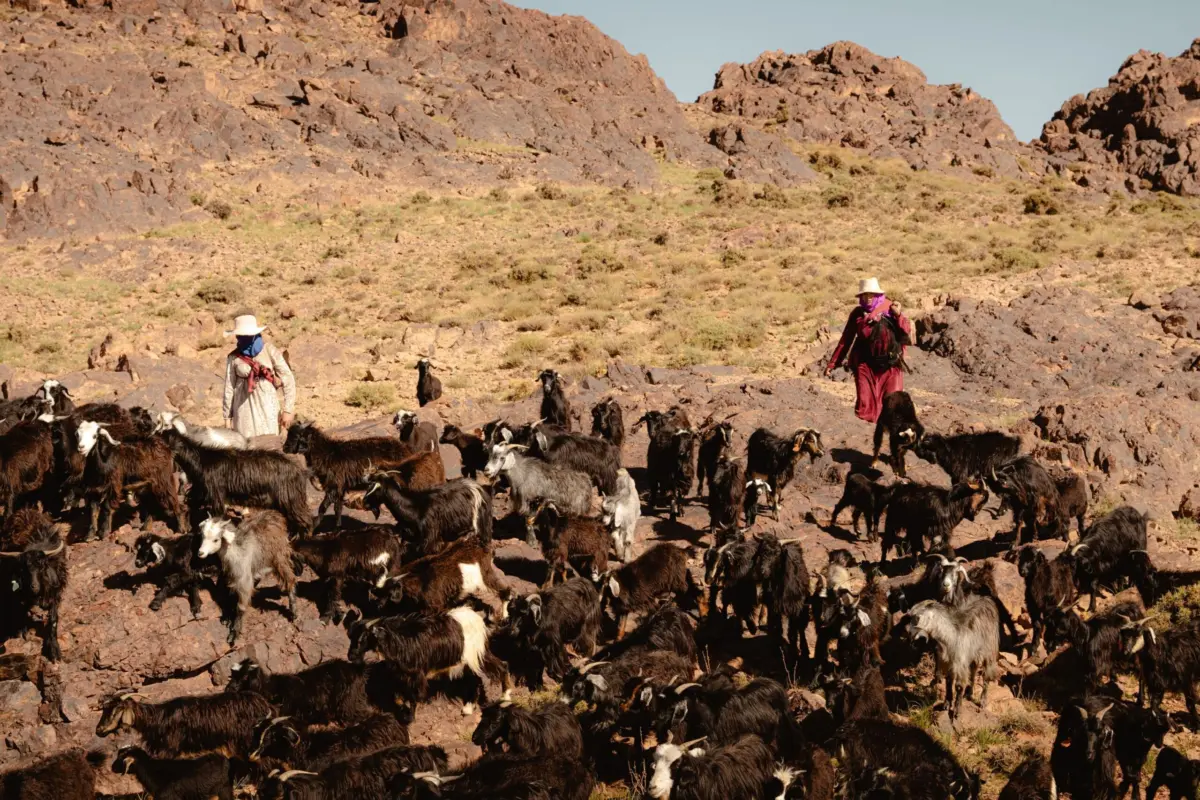
A persistent chorus of shrill bleats and guttural baas echoes across the canyons and basalt towers of Jebel Saghro. squinting against the blinding midday sun, a traveler spots a flash of crimson high on a rocky peak—the red djellaba worn by Telhou Belçawane, the matriarch of the Berber family whose journey she has joined in southeastern Morocco. Her presence confirms that the goats are close by, though to an untrained eye, their onyx-coats remain frustratingly indistinguishable from the volcanic terrain.

Jebel Saghro is the ancestral homeland of Telhou’s people, the Aït Atta, a historically powerful Berber—or Amazigh, meaning "free people"—tribe in southeast Morocco. This rugged region unfurls from the High Atlas Mountains to the edge of the Sahara, and twice each year, it serves as the dramatic backdrop for one of the oldest migrations in Africa. For millennia, the Aït Atta and other Berber families have moved their livestock upwards of 180 miles from the lush summer grazing grounds of the High Atlas to the arid winter pastures of Jebel Saghro. This seasonal pastoral journey, known as transhumance, defines a semi-nomadic way of life that is rapidly disappearing in the modern world.
It is late September, and Telhou, her husband Hmad, and their daughter Saâdia are ten days into their arduous trek when writer Jen Murphy joins them alongside a support team from luxury travel operator Black Tomato. Hiking alongside a family and their livestock herd is one of five immersive experiences that comprise "The Keepers," Black Tomato’s collection of travel itineraries. Each trip is built around people whose generational knowledge continues to be practiced and passed down, ranging from a 28th-generation Daoist master in Chengdu, China, to a mariscador on Chiloé Island in Chile who has spent a lifetime reading the ocean’s unpredictable tides.

As a pioneer of off-the-grid luxury travel, Black Tomato has developed an instinct for what discerning travelers crave in an era of digital saturation. With "The Keepers," Black Tomato co-founder Tom Marchant predicts that in a world where nearly anything can be looked up or generated in seconds, deep human knowledge and authentic connection are the ultimate luxuries. More than ever, contemporary travelers want to be active students rather than passive spectators.
Before Murphy’s arrival, the Belçawane caravan comprised 200 goats, two dogs to help herd the animals, two chickens for eggs, and three donkeys to transport the chickens, tea kettles, water jugs, blankets, and other basic food and camp supplies. To accommodate travelers and ensure safety and comfort, Black Tomato added five mules and a dozen additional personnel, including two drivers, four logistics workers to pitch canvas tents equipped with beds and flush toilets, a chef, and five mule handlers. Several of these handlers are cousins of the Belçawane family. Like their head mule handler, Zaïd Oukhazaid, many have reluctantly abandoned their traditional nomadic ways for permanent village life due to compounding factors, including the pressing challenges of climate change.

On the day of arrival, Zaïd and another mule handler met Murphy roadside in Tagdilt, a village situated at the edge of the Dadès Valley. Both men wore coarse, sheep’s wool djellabas layered over trekking pants and plaid shirts, with turban-like scarves known as shesh piled high on their heads. Zaïd flashed a wide smile that revealed the gap left by four missing front teeth. Despite his diminutive stature, he possessed an outsized personality and a deep, palpable pride in his Aït Atta heritage.
Reaching out a sinewy arm, he offered a firm handshake followed by a hearty bear hug, exclaiming "welcome, welcome"—one of the few English phrases he had picked up from working with international tourists. Because Murphy’s Arabic, French, and Berber language skills were rudimentary, Noureddine "Nouri" Bachar joined the excursion as a translator to facilitate conversations. However, over the following days, the group discovered how much profound communication could happen simply through phrases like "thank you very much" and "very, very good," punctuated by shared laughter and smiles.

With rain looming on the horizon, the family had started earlier with the herd and planned to meet the rest of the group at camp. Nouri explained that the nomads dictate the rhythm of the days. "You are here to support their journey and we are here to support yours," he noted. Once the pack mules were loaded, Zaïd beckoned the group forward into the Martian landscape ahead. The harsh environment immediately clarified why Saghro translates to the "Land of Thirst" in the Berber tongue. Before them sprawled an endless expanse of flat-topped mesas, dry riverbeds, and severe umber cliffs. Sensing any potential apprehension, Zaïd offered reassurance: "Drop me in a city, I’d be lost. Drop me anywhere in these mountains, and I know my way."
The initial two-hour hike served as a warm-up for the rigorous days ahead, which would involve trekking for five hours or more. The group reached the Tircht pass, set at an elevation of 6,100 feet, just as the support team finished establishing the campsite. Each Aït Atta family holds traditional rights to specific migration routes, including designated camps where they have built stone pens known as azib to shelter their herds overnight. Zaïd fetched water from a local well and built a fire to heat a kettle for traditional tea. When he reached for an ice-berg sized chunk of sugar to drop into the pot, Murphy joked through Nouri that she wanted to keep her teeth. Appreciating the humor, Zaïd let out a deep belly laugh and poured an unsweetened cup.

After sunset, the family and the travel team gathered inside a traditional goat-hair tent for introductions and a communal meal by candlelight. The atmosphere resembled a family reunion, with the men gossiping while Telhou and her shy 17-year-old daughter, Saâdia, sat quietly together. Traditionally, the man of the house leads the caravan and sets up camp each night, while the wife and children shoulder the arduous task of moving the goats alongside domestic responsibilities like preparing meals. Murphy’s presence meant the women enjoyed a brief respite from cooking. The camp chef ladled out bowls of harira, a thick tomato-based soup spiked with beans, herbs, and spices. Though Nouri offered a spoon, Murphy followed Zaïd’s lead, picked up her bowl with her hands, and took a long slurp. "The nomad way," Zaïd nodded approvingly.
Yet, this traditional way of life faces unprecedented pressures. Rising global temperatures and severe droughts have shrunk available pastures. Furthermore, since 2019, Moroccan law has required children between the ages of 6 and 16 to attend school, leaving fewer young hands available to tend the herds. Four of Telhou’s six children are enrolled in school, one daughter is married, and Saâdia will soon marry as well. Once youth experience modern conveniences—such as electricity and running water—returning to the severe hardships of living off the land becomes increasingly difficult. Hmad shared with Nouri that only six families within his sub-tribe, the Ait Slilou, made the trek to Jebel Saghro this year, down from upwards of 80 families in the past. It is a narrative playing out globally, from the sheep herders of the Swiss Alps to ranching families in the American West, where lifestyles dependent on family and land are slowly fading.

Each morning, the hee-haw of donkeys served as the camp alarm, rousing the party before sunrise. While Murphy sipped coffee and enjoyed a breakfast of baghrir—crepe-like pancakes topped with amlou, a Moroccan variation of almond butter—the team packed up the camp, leaving no trace behind except for the stone shelters that kept the goats safe overnight. By 7:30 a.m., Nouri and Murphy set off with the family. Hmad guided the donkeys along a dusty trail lined with almond and date trees, while Telhou and Saâdia navigated the rougher terrain alongside the herd. Watching Saâdia scramble up nearly vertical cliffs of loose scree in a shimmery gold-striped dress and plastic loafers with the ease of a mountain goat left observers in awe.
The day’s 7.5-mile trek led the group up and over Tizi n’ Tircht, a mountain pass sitting at 8,200 feet that offers sweeping views back toward the High Atlas and down to a remote campsite named Azib Almou n’ Ouarg. Aside from another nomadic family traveling with a caravan of three camels, the route remained entirely desolate. Nouri and Hmad arrived at the camp shortly after 1 p.m. Famished, Murphy devoured a lunch of kefta and Moroccan salads before removing her hiking boots and joining the crew for a late-afternoon rest. The women, whose pace matches the natural grazing rhythm of the herd, did not descend into camp until nearly 5 p.m.

By the second night, the boundaries between traveler and host had dissolved, underscored by the news that a goat had been sacrificed in Murphy’s honor. The chef prepared a comprehensive meal featuring every part of the animal, from heart and lungs to intestines. Over dinner, the conversation shifted to politics upon learning that the King of Morocco had appointed the country’s first female prime minister. Zaïd joked that it signaled the end for men, while Saâdia stated she cared only for the goats. Telhou smiled broadly, explaining through Nouri that she was happy "because I’m a woman, too."
On the third morning, Murphy joined the women off the beaten trail for a seven-mile hike steeper than previous days. Over time, she began recognizing individual goats, including a one-year-old kid with white ears she nicknamed "Mittens." Telhou deployed primal shouts to keep the herd unified, while Saâdia used a slingshot to skillfully deter straying animals. When Saâdia let Murphy try, both erupted in giggles as the rock launched backward. Telhou expressed her approval through Nouri, asking if Murphy enjoyed the demanding labor. For Murphy, the work added genuine purpose to what would otherwise be a standard hiking trek, grounding the otherworldly landscape in human connection.

The surrounding red rock formations and flat mesas closely resembled the American Southwest, with Nouri pointing out geological features resembling elephants and camels. Upon descending into camp, physical exhaustion set in, but rinsing off the desert dust in a bucket shower brought a sense of accomplishment. While the experience offered a blissful digital detox due to limited cell reception, it also highlighted the stark realities of nomadic life: the daily struggle to find water, stay warm, and protect the family’s primary currency—the herd—from jackals and wild dogs.
Even after a strenuous day, Telhou knelt by the campfire to teach Murphy how to make aghroum, traditional Moroccan flatbread, effortlessly tossing the circular dough between her hands. Murphy’s breadmaking skills proved less successful than her rock-tossing attempts, but the evening concluded warmly around a communal bowl of couscous topped with goat meat, carrots, and zucchini. Before bedtime, Saâdia decorated Murphy’s hands with traditional henna paste, which dried by the fire’s warmth.

On the final day of the journey with the family, Murphy joined the women once more, navigating the rocky terrain with newfound confidence. Spotting a flash of white high on a ridge, she recognized "Mittens" straying from the group. Mimicking Telhou’s commanding howl and tossing rocks, Murphy successfully guided the young goat back to the herd. Before parting ways at the family’s winter home, Murphy had Nouri pass along her deep gratitude for their hospitality. Telhou responded that Murphy had earned her keep and would always be welcome back, declaring her a "nomad at heart."
Black Tomato organizes this five-night, six-day journey through the High Atlas and Jebel Saghro with the Aït Atta as part of "The Keepers" collection. The experience includes luxury glamping accommodations, traditional activities such as bread-baking and jewelry-making, and a private local guide. Pricing begins at $12,950 per person, inclusive of a night in Marrakech, internal flights, and transfers.