






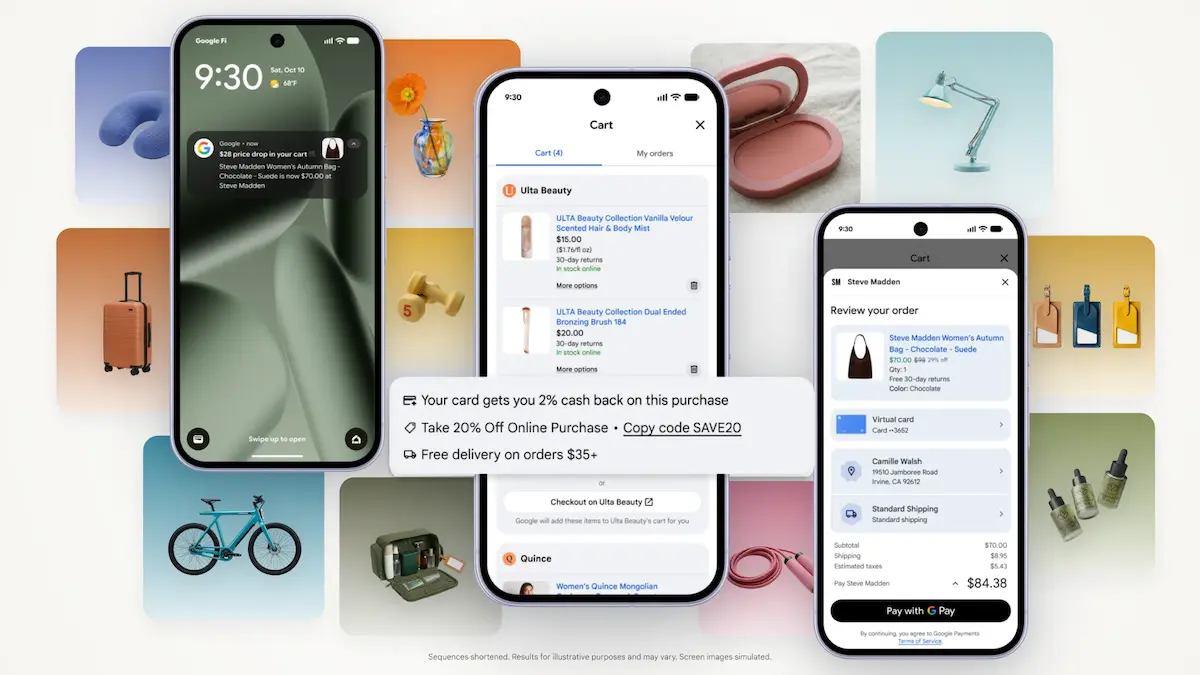
Google has officially rolled out "Universal Cart," a centralized shopping tool designed to let users collect, monitor, and manage products found seamlessly across Google Search and the Gemini application. First previewed by the tech giant earlier this year at the Google I/O developer conference in May, the newly launched feature is now immediately available to users across the United States.
The primary objective behind Universal Cart is to remove the friction and fragmentation traditionally associated with online retail browsing. In the modern e-commerce landscape, consumers often jump across dozens of different tabs, brand websites, and digital storefronts before making a purchase decision. Google’s new tool seeks to solve this scattered experience by offering a single, persistent destination where shoppers can save items they discover during their digital journeys.
Under the system’s design, when a user finds an appealing product anywhere within Search or the Gemini app, they can instantly drop it into their Universal Cart and continue browsing. When they return to the platform later, their saved items and ongoing shopping progress remain intact, eliminating the tedious need to re-search for products or rebuild shopping sessions from scratch. Because Universal Cart is engineered to aggregate items from multiple distinct retailers, it effectively functions as a unified digital hub for tracking potential purchases across the entire web.
Beyond simply storing items, Google has equipped the cart with proactive monitoring capabilities designed to help consumers stay informed about fluctuating prices and inventory levels. The tool features automated notification systems that alert shoppers when a saved product undergoes a price drop or when an item that was previously out of stock becomes available for purchase once again.
Furthermore, Universal Cart is built to provide context-aware, personalized assistance throughout the buying process. According to Google, the tool can factor in specific credit card perks and rewards programs when helping users determine the most advantageous payment method at checkout. It is also capable of automatically surfacing relevant promotional codes and discounts, ensuring that shoppers can easily capitalize on potential savings without having to manually hunt for coupon codes across external websites.
The underlying infrastructure for this streamlined checkout experience is tied directly to Google’s Universal Commerce Protocol, commonly referred to as UCP. Introduced by the company earlier this year as an open standard, UCP is specifically engineered to bridge the gap between autonomous AI agents and traditional retailers. The protocol facilitates seamless collaboration across various stages of the digital shopping journey, extending all the way through to the final checkout transaction.
The introduction of Universal Cart underscores Google’s deep and ongoing investment in artificial intelligence-driven e-commerce. The feature arrives as the latest addition to a growing suite of tools aimed at making online retail more intuitive and convenient for everyday consumers. It joins existing innovations such as conversational product discovery features within Search’s dedicated AI Mode, as well as Google’s "Let Google Call" functionality. The latter tool leverages an advanced AI agent to place phone calls to nearby brick-and-mortar stores on behalf of the user, verifying real-time item availability before a consumer makes a trip.
Google is far from alone in its pursuit of transforming e-commerce through advanced artificial intelligence. The broader tech sector has seen an aggressive race toward "agentic commerce," with major competitors developing their own sophisticated retail ecosystems. Industry giants including Amazon and OpenAI have introduced their own AI-powered shopping agents and systems over the past year, as technology companies continually seek innovative ways to make conversational chatbots and digital assistants far more practical and utilitarian beyond simple question-and-answering tasks.
As these agentic shopping features continue to roll out to the public, the digital retail landscape is shifting toward a more interconnected and automated future, with tools like Google’s Universal Cart sitting at the forefront of the consumer experience.