






Nestled in the picturesque hills of Saxony, the small German town of Glashütte stands as a veritable paradise for watch enthusiasts. To the uninitiated, the sheer density of high horology packed into this compact municipality can be staggering, with some of the most prestigious names in German watchmaking situated literally next door to one another. Yet, without question, the most iconic standard-bearer for Glashütte watchmaking—and German high horology at large—is A. Lange & Söhne. True to its reputation for exclusivity, the legendary manufacturer rarely flings open its doors to outsiders, preferring to keep the inner workings of its secretive sanctuary shielded from the public eye.

Earlier this year, during the damp and rainy month of July, a handful of editors from the Hodinkee team made the pilgrimage to Glashütte to catch a glimpse of the meticulous craft unfolding behind Lange’s guarded walls. To describe the visit as unforgettable would be a profound understatement. While much of the extensive reporting from that trip is still waiting to be shared, one of the unequivocal highlights of those few days was the rare opportunity to examine a breathtaking collection of exceptionally special watches pulled straight from the brand’s private archives.

The Designs Behind The Revival
The journey into the archives began with a look at three of modern A. Lange & Söhne’s inaugural silhouettes, all cast in yellow gold and representing the visionary designs unveiled by Günter Blümlein on October 24, 1994. That autumn day marked a monumental pivot in modern horological history, effectively reviving the historic A. Lange & Söhne name after decades of dormancy following the disruptions of the twentieth century. More than that, it established an entirely new benchmark for high-end mechanical watchmaking in the mid-1990s, offering a distinctly German counterpoint to the established Swiss hegemony.

Chief among these foundational creations is the Lange 1, arguably the single most iconic model the brand has ever produced. Remarkably, it remains the only design from that original foundational collection that is still actively manufactured today. Featuring its characteristic asymmetrical dial layout, outsized date display, and non-linear power reserve indicator positioned on the right side of the dial, the watch looks and feels remarkably similar to the timepiece that shook the conservative watch industry over three decades ago. For collectors, knowing that the contemporary Lange 1 remains so faithful to Blümlein and his team’s original vision is a testament to the enduring strength of the design.

Alongside the Lange 1 sat the Arkade, a timepiece that stands out for its distinctive rectangular case shape, representing a uniquely Teutonic and surprisingly versatile approach to a women’s watch in 1994. Measured in a compact 29mm by 22mm footprint, the Arkade showcased serious mechanical watchmaking housed within a shaped caliber designated as the L911. A notable detail concerning both the vintage Lange 1 and Arkade models viewed in the archive is that they featured exhibition casebacks—indicating they were slightly later references than the absolute earliest production runs, which were notably delivered with solid metal casebacks rather than sapphire display windows.

Rounding out the trio of standard complications from that foundational launch was the original Saxonia. As the simplest silhouette in the initial lineup, it focused heavily on legibility and the prominent display of the oversized big date window. Featuring a modest and wearable 34mm proportion, the Saxonia has long been a favorite among dedicated Lange collectors. The watch is powered by the same shaped rectangular movement found inside the Arkade, creating a fascinating horological irony: a classically round dress watch that actually houses a shaped movement hidden behind its closed caseback.

Notably absent from this specific trio of standard production models was the Tourbillon Pour le Mérite, the most technically complex and ambitious timepiece introduced on that fateful day in 1994. That watch, alongside a rare companion piece, warranted an entirely separate, deeply emotional viewing experience reserved for the latter half of the archive tour.

Some Epic Handwerkskunst
Beyond the historical staples, the archival visit offered a rare encounter with A. Lange & Söhne’s mesmerizing Handwerkskunst series. Translating roughly to "handicraft," this elite collection pairs some of the manufacturer’s most complicated mechanical movements with staggering levels of artistic hand-finishing that push far beyond the already exceptional standards found on standard Lange models. Production figures for these references are minuscule, and each piece features distinct artistic motifs, making them a fascinating study in the brand balancing absolute technical seriousness with moments of artistic whimsy and flourish.

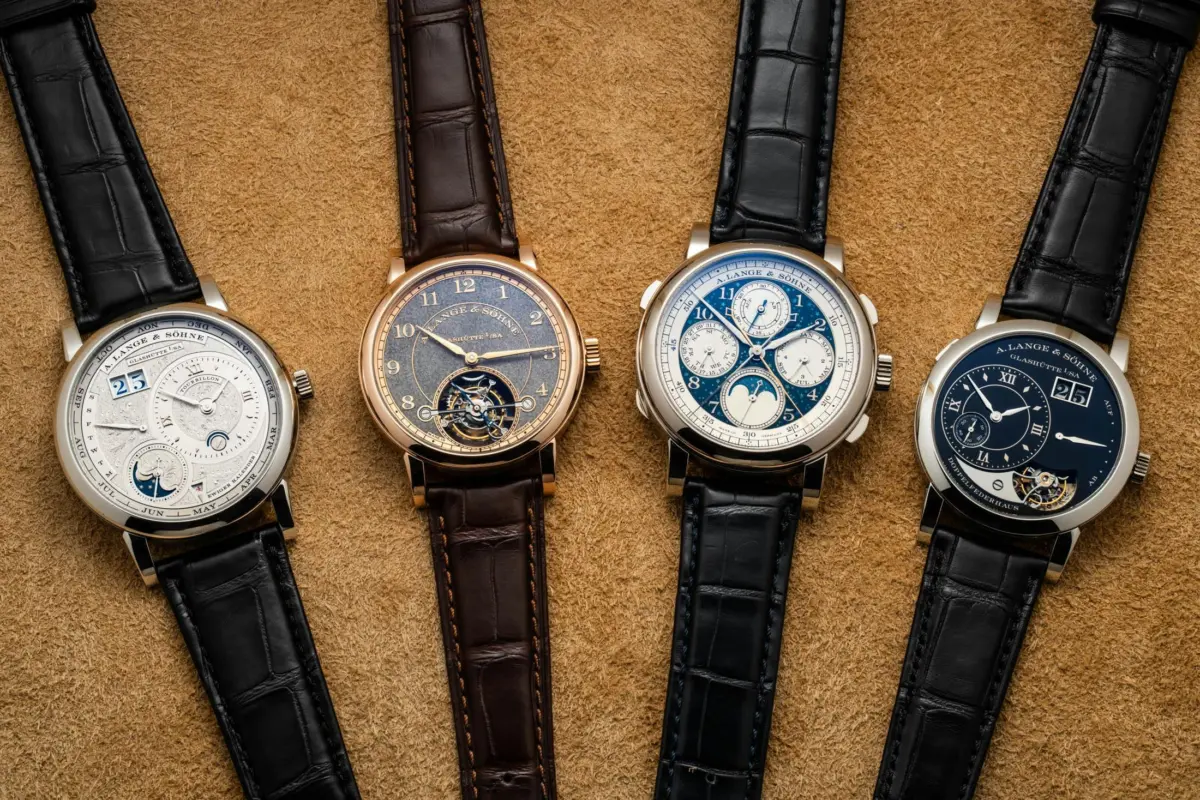
Among the standout pieces in this specialized category was the 1815 Tourbillon Handwerkskunst (Reference 730.048), introduced in 2015 in a strictly limited run of just 30 pieces. This watch paired a one-minute tourbillon—featuring a diamond endstone and synchronized with the running seconds—with an in-house tremblage dial executed entirely by hand by Lange’s master engravers. Furthermore, the 1815 Tourbillon holds the distinction of being the first watch to feature both a hacking seconds mechanism and a zero-reset function for a tourbillon, bridging the gap between delicate complications and practical chronometric utility.

The intricate tremblage technique itself demands immense patience and steady nerves. During a separate visit to Lange’s engraving department, artisans could be observed executing the painstaking random-dot texturing by hand using specialized gravers. The engravers must navigate meticulously around raised typography, minute tracks, and numerals, ensuring absolute visual consistency across the entire dial surface so that light plays evenly across the textured metal.

The archive also displayed a compelling contrast within the Lange 1 family: the Lange 1 Perpetual Calendar Tourbillon Handwerkskunst (Reference 720.048) and the Lange 1 Tourbillon Handwerkskunst (Reference 704.048). These two models represent diametrically opposed aesthetic philosophies within the exact same collection. The former leans heavily into baroque extravagance, showcasing dense relief and tremblage engravings alongside hand-painted date discs. The latter adopts a stoic, no-nonsense black-and-white aesthetic that almost conceals the intense artisanal labor required to create Lange’s first in-house grand feu enamel dial.

The ultimate expression of maximalist Handwerkskunst, however, is found in the 1815 Rattrapante Perpetual Calendar. Featuring a rich blue enamel dial adorned with a playful, relief-engraved starry motif, the watch is a masterclass in layered artistic depth. Although the prototype examined in the archive lacked a movement, leaving its hinged hunter caseback closed to the public, the sheer paradox of combining playful celestial themes with uncompromising German precision engineering encapsulates the very soul of the Handwerkskunst ethos.

Two References of the Tourbillon Pour le Mérite, as Owned by Walter Lange and Günter Blümlein
The emotional pinnacle of the archive visit centered on two specific timepieces that were separated from the rest of the 1994 revival collection: the Tourbillon Pour le Mérite models in yellow gold and platinum. The Tourbillon Pour le Mérite holds a legendary status in modern horology as the first wristwatch in history to combine a tourbillon escapement with a fusee-and-chain constant-force transmission mechanism.

Yet, what elevated this viewing beyond standard horological appreciation was the provenance of the two watches on display. These exact timepieces—both bearing the coveted serial number "1" in their respective editions—belonged personally to the late Walter Lange and the visionary industrialist Günter Blümlein. These two men served as the foundational architects behind the modern rebirth of A. Lange & Söhne in the wake of German reunification. Walter Lange sought to reclaim his family’s lost legacy in Glashütte, while Blümlein provided the strategic brilliance that had previously revitalized brands like IWC and Jaeger-LeCoultre.

Both watches remain preserved in a completely unrestored state, maintaining the exact physical condition they were in while worn on the wrists of their historic owners. Walter Lange’s watch, rendered in yellow gold, bears clear signs of active wear, complete with natural oxidation and a warm patina accumulated over years of daily use.

During the presentation, Lange CEO Wilhelm Schmid confirmed that these two irreplaceable historical artifacts will never leave the confines of the Glashütte headquarters. While collectors might occasionally spot a first-generation Lange 1 or a Handwerkskunst piece out in the wild, the watches of Walter Lange and Günter Blümlein remain permanently anchored to their spiritual home. Handling Walter Lange’s personal timepiece with gloved hands offered a deeply moving connection to the past, serving as a silent reminder of the human perseverance required to put Glashütte back on the global watchmaking map.