





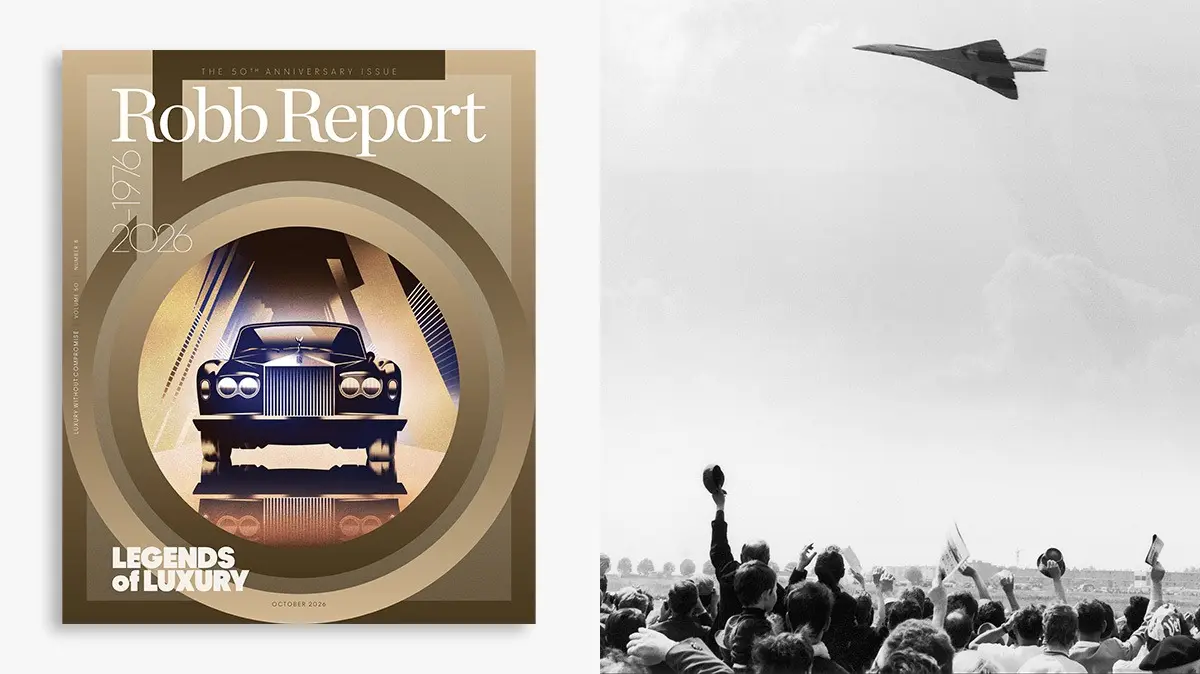
On January 21, 1976—the very year Robb Report was founded—the Concorde began flying commercial passengers at twice the speed of sound. While it would be a stretch to claim there was some grand, cosmic design behind the timing, it stands as a remarkably fitting coincidence. Just as the Concorde was abruptly shrinking the Atlantic Ocean and redefining the boundaries of modern travel, a new magazine emerged to chronicle these exact kinds of bold feats, daring engineering, and unmatched ingenuity.
Now, half a century later, this milestone marks the publication’s 50th-anniversary issue. Any media outlet that manages to remain vibrant, relevant, and influential after five decades has more than earned the right to indulge in a bit of retrospection. So when the editorial team began assembling "Legends of Luxury," the expansive feature at the heart of this commemorative edition, the goal was to celebrate the occasion with a sprawling retrospective filled with nostalgia and reflection. However, sifting through the archives and charting the trajectory of the past five decades quickly revealed something far more compelling than mere trip-down-memory-lane reminiscing.
Examining the 74 distinct objects, people, places, and experiences chosen for the retrospective painted a vivid picture of a world in motion. Collectively, these choices offered striking hints about the future that was quietly approaching—a future that would fundamentally transform how human society communicates, dresses, travels, dines, and chases thrills.
Consider, for instance, the Motorola DynaTAC 8000X. When the world’s first commercial handheld cell phone officially hit the market in 1984, it came with a staggering price tag of just under $4,000—which equates to roughly $12,000 in today’s currency—and tipped the scales at nearly two pounds. Owning one was an unambiguous statement of elite privilege and financial muscle. If an individual was fortunate enough to afford what quickly became known as "the Brick," they invariably made certain that everyone around them saw them using it. One need only look to cinematic icons like Gordon Gekko for a cultural touchstone of that era’s high-tech flexing. Fast forward to the present day, and the smartphone successors of that bulky apparatus are arguably far more ubiquitous than television sets. What began its life as an ultra-exclusive status symbol has morphed into an absolute, everyday necessity of modern existence.

Of course, history demonstrates time and again that true innovation does not always require a microchip, a motherboard, or advanced digital processing. In the late 1970s, legendary Italian designer Giorgio Armani executed a radical departure from convention by stripping the rigid structure entirely out of the traditional men’s suit. He softened its shoulders, relaxed its lines, and loosened its trousers. The resulting aesthetic was at once louche, effortless, and deeply sophisticated—a look that Hollywood quickly recognized as perfection, ideal for a very well-dressed man about town. At the time, the deconstructed suit looked revolutionary and daring. Decades later, that same silhouette is no longer a fashion statement of rebellion; it is simply an accepted, foundational part of the modern man’s wardrobe.
Not every groundbreaking idea manages to permanently secure a place in everyday life, yet some managed to completely upend their respective fields before eventually fading or evolving into something else. At the legendary restaurant El Bulli, avant-garde culinary visionary Ferran Adrià utilized science, chemistry, and culinary physics to radically scramble diners’ expectations of what a meal could possibly be. Unfortunately, a wave of poorly executed imitations eventually reduced the broader movement of molecular gastronomy to an easy punch line centered around fleeting foams, theatrical fogs, and a controversial binding agent unappealingly known as meat glue. Yet, despite the missteps of imitators, the best elements of Adrià’s culinary philosophy stuck, permanently influencing and elevating a fresh generation of world-class chefs.
Then there is the sheer maritime ambition represented by Octopus, a staggering 414-foot vessel. When the late Microsoft co-founder Paul Allen’s Lüssen-built superyacht was officially delivered in 2003, it successfully bridged two previously distinct worlds: the pampering opulence of a traditional luxury superyacht and the rugged, functional capabilities of a serious ocean-going expedition ship. It was engineered to go virtually anywhere on the map, effectively shifting the primary purpose of yachting from passive leisure to active exploration. While sunbathing at a tranquil anchorage remained very much on the itinerary, venturing autonomously to the farthest, most isolated reaches of the globe became an attainable reality. Today, explorer yachts of varying scales have become a standard staple of nearly every major luxury shipyard’s global lineup.
Looking back across these sweeping shifts, it is tempting to construct a narrative suggesting that the ultimate outcome of these innovations was clear and obvious all along. In truth, none of it looked quite so definitive or inevitable at the time. As the editors and long-time observers of Robb Report know firsthand, predicting the trajectory of the future is an exercise that only looks easy in hindsight. The publication holds personal experience in this regard, having once confidently declared the total death of the internal-combustion engine—a piece of machinery that, as anyone paying attention to the automotive landscape may have noticed, remains very much alive and evolving. Conversely, other supposedly guaranteed "next big things" managed to disappear into obscurity almost as quickly as they arrived on the scene. Bored Apes, anyone? The future, it turns out, has a consistent habit of humbling everyone who tries to forecast it with absolute certainty.

Looking ahead toward the horizon, it is entirely possible that one of the extravagant pursuits, technologies, or lifestyle choices highlighted within the pages of this anniversary issue will, in another twenty years, be viewed as mundane and commonplace as the smartphone is today. Alternatively, another might quietly vanish from the cultural landscape entirely, leaving behind only a foundational idea that somehow outlives the physical product itself.
There is little use in pretending to know precisely which trends will endure for the long haul and which will fade into memory. But after five decades of chronicling the pinnacle of high living, craftsmanship, and ambition, one fundamental truth remains clear: every so often, the future shows up first disguised as a luxury. And as the next chapter begins, the curiosity surrounding what that future might bring next remains as sharp as ever.
Here is to the next fifty years. Enjoy the issue.