





At New York’s CUE Art Foundation, Brazilian artist Mari Nagem invites viewers to confront a profound and unsettling contradiction defining modern human ambition. As governments, private aerospace companies, and technology titans pour unprecedented resources into visions of extraterrestrial colonization—framing worlds like Mars as humanity’s inevitable next frontier—our home planet faces mounting ecological degradation and systemic climate breakdown. Through a compelling exhibition titled The Tropics, The Moon, and Mars, Nagem draws a sharp, provocative line between humanity’s grand fantasies of interplanetary survival and the neglected, highly complex ecosystems we are currently struggling to sustain on Earth.
The exhibition explores a striking paradox in our relationship with modern technology and ecological stewardship. Today, society is developing increasingly sophisticated, high-tech systems designed to extract resources, manufacture synthetic habitats, and sustain human life in hostile, alien environments. Yet, simultaneously, we routinely overlook, undervalue, and mismanage the extraordinary, self-sustaining networks of life that already exist all around us. By juxtaposing the sterile, speculative promise of space exploration with the visceral realities of terrestrial climate crises, Nagem’s work challenges the assumption that humanity can simply export its deeply rooted extractive habits to new worlds without repeating the very mistakes that endangered Earth in the first place.
Imagining the Future from a Changing Earth
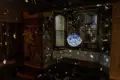
Stepping inside the gallery space, visitors are immediately immersed in a saturated, glowing red light. This monochromatic atmosphere fills the room, illuminating a series of motorized sculptural branches and small, folded ceramic formations. At first glance, the installation evokes an unfamiliar, barren planetary landscape—perhaps a Martian canyon or a lunar outpost bathed in extraterrestrial twilight. However, closer inspection reveals that the materials, forms, and conceptual references driving the exhibition are firmly anchored in Earth’s rapidly changing environments. The effect is intentionally unsettling, forcing viewers to bring the sleek, forward-looking promises of space exploration into direct conversation with the pressing, terrestrial ecological emergencies unfolding right now.

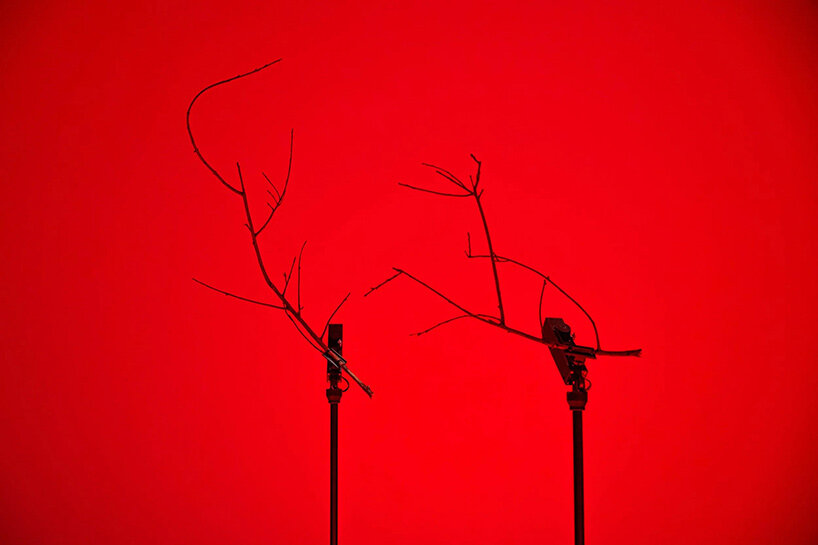
Much of Mari Nagem’s artistic practice begins with rigorous scientific research, which she then interprets and translates through the physical mediums of sculpture, installation, and digital media. Her creative process bridges empirical data and emotional resonance, transforming cold statistics into tangible artistic encounters. This methodology is vividly demonstrated in Flora Futura (The Survival Dance), a kinetic sculpture featuring bare, weathered branches mounted on motorized stands. These mechanical elements move in slow, deliberate arcs against the harsh red-lit backdrop, casting long, shifting shadows across the gallery walls.
The work draws direct inspiration from ESECAFLOR, a long-running, large-scale scientific experiment conducted in the heart of the Brazilian Amazon. In this real-world study, researchers deliberately divert and exclude rainfall from designated sections of the rainforest to observe and record how mature trees and local root systems respond to prolonged, artificial drought conditions. Nagem takes this urgent scientific inquiry into an imagined, speculative future. As the motorized branches sway and twitch, their movements suggest a haunting ambiguity between growth and decline, resilience and eventual collapse. It becomes remarkably difficult for the viewer to determine whether these strange, machine-driven plants are successfully adapting to a hostile climate or slowly dying. This uncertainty mirrors the larger, anxiety-ridden question facing conservationists and climatologists today: how can the world’s great forests continue to survive as their foundational climates shift beneath them?
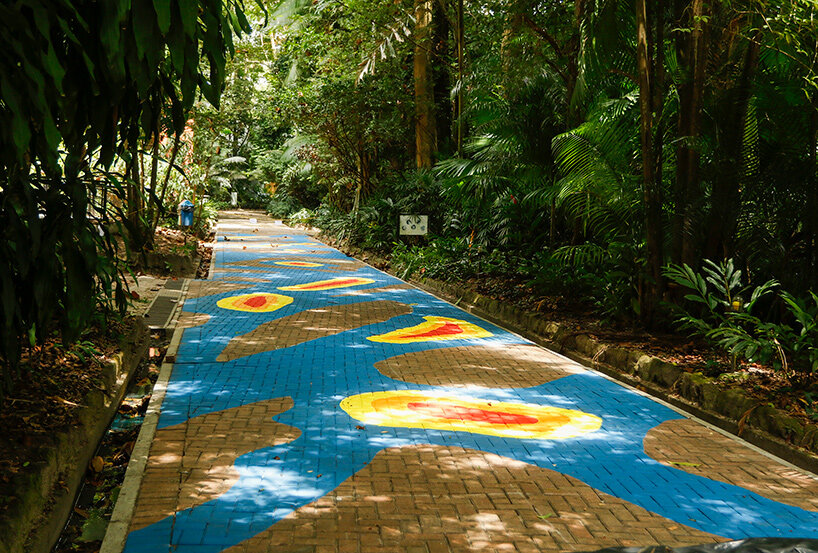
This deep-seated relationship between technological experimentation, human intervention, and environmental transformation also serves as the foundation for 41°C, a massive 43-meter-long ground painting created in 2025. Originally installed at the Emílio Goeldi Zoobotanical Park in Belém during the COP30 climate conference, the sprawling artwork utilizes vivid colors to trace the winding geographic path of the Tefé River. During the devastating Amazonian drought of 2023, water temperatures within the Tefé River famously spiked to an unprecedented 41°C, contributing directly to the mass mortality events of hundreds of endangered river dolphins. By drawing upon satellite imagery, thermal data, and hydrological mapping, Nagem successfully translates a massive, macro-scale environmental tragedy into a physical form that visitors can literally walk alongside and encounter at the scale of their own bodies.

Both Flora Futura and 41°C highlight Nagem’s unique ability to make complex ecological processes—often too vast or gradual for the human eye to easily observe—feel unusually immediate and pressing. One work animates a forest under systemic stress, while the other gives concrete, physical shape to an extreme climatic temperature. Through these careful translations, Nagem prompts audiences to consider how advanced scientific tools and data visualization might fundamentally change the way we perceive, value, and respond to the living world around us.
What if Nature is Already Our Most Advanced Technology?
This critical inquiry into the intersection of technology, human habitation, and environmental design comes to the forefront in The Right to Shade, a project developed in 2026 that closely examines access to shade and thermal comfort across the urban landscape of Fortaleza, Brazil. Utilizing advanced satellite imagery and artificial intelligence-assisted spatial analysis, Nagem and her collaborators meticulously mapped the distribution of mature trees, urban greenery, and concrete infrastructure across the city. The resulting data revealed stark disparities, demonstrating how daily exposure to intense solar radiation and dangerous urban heat islands varies dramatically depending on neighborhood socioeconomic status.
The project initially began as an investigation into architectural solutions for urban cooling, focusing heavily on modern iterations of traditional Brazilian architectural elements such as the cobogó—a perforated brick designed to filter harsh sunlight while allowing ventilation. However, as the research progressed, Nagem’s focus shifted toward a biological infrastructure that is infinitely older and far more complex than any human-made masonry: trees. The canopies of mature urban trees provide passive cooling through intricate, self-regulating biological systems, raising an uncomfortable question for urban planners. Why do modern cities continue to pour resources into expensive, high-tech artificial cooling solutions while systematically neglecting and cutting down the living infrastructure that is already freely available?
By deploying sophisticated computational tools to map ecological deficits, Nagem uses technology to draw attention to forms of organic intelligence that developed millions of years before human engineering. The work suggests an alternative paradigm for future urban development—one where architectural and technological progress begins not with the conquest of nature, but with a renewed understanding of our deep dependence on other living organisms.
Learning to Listen Beyond the Human World
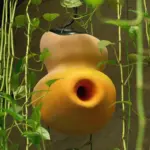
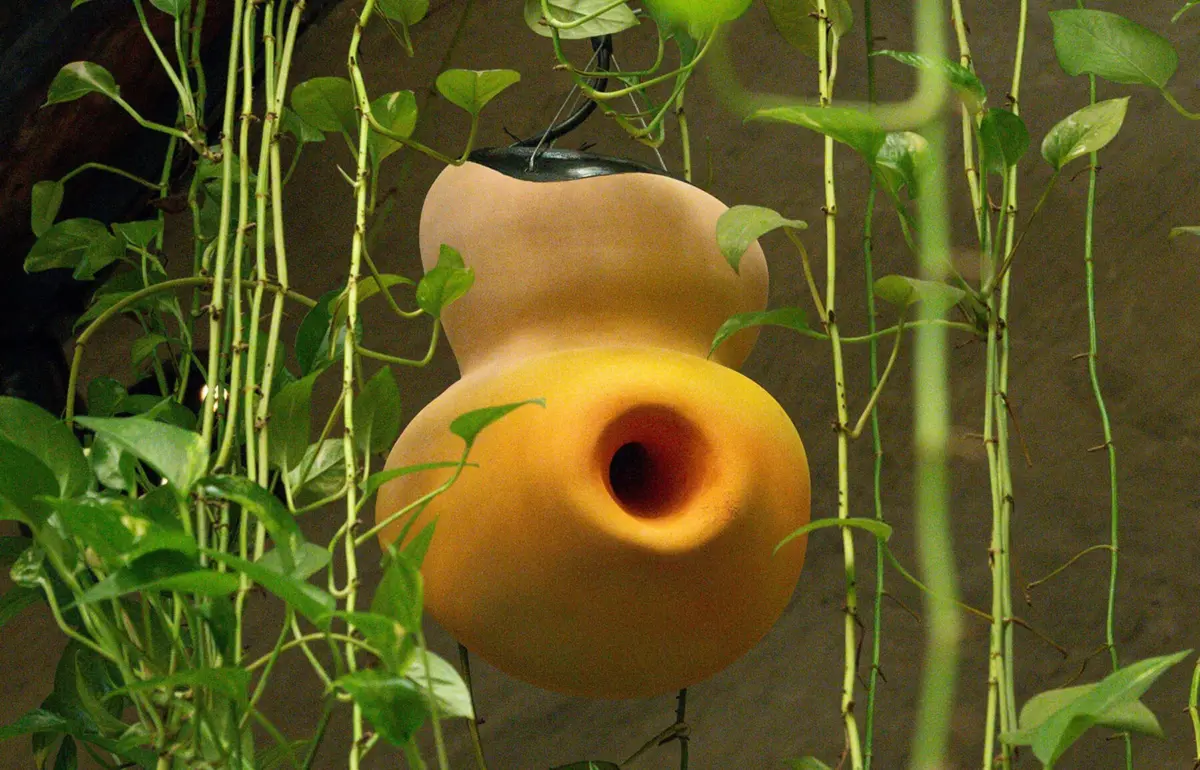
Elsewhere in her practice, Nagem confronts the sobering reality of what happens when those vital organisms disappear entirely from the biosphere. In Siren, a collaborative 2024 installation created with Leandro Lima for the SFER IK Museion in Mexico, artificial intelligence is harnessed to recreate and imagine the haunting songs of extinct South American bird species. These phantom melodies emanate from a series of sculptural speakers designed to resemble natural avian nests, expertly combining digitally fabricated ceramics with traditional handcraft techniques.
The installation evokes an uneasy, melancholic possibility. While cutting-edge technology may grant humanity the uncanny ability to simulate and conjure the voices of vanished species, the actual birds and the rich, interdependent ecological relationships they once maintained remain permanently lost. The artwork occupies a tense middle ground between scientific speculation and a synthetic form of remembrance, questioning the ethical implications of using machines to recreate hollow traces of a natural world that human activity has dismantled.
Across her diverse body of work, Mari Nagem consistently interrogates the vast distance between what human ingenuity can invent and what humanity has truly learned to understand. From AI-generated bird songs that echo through ceramic nests to the intricate thermal intelligence of an urban tree canopy, her multidisciplinary practice encourages viewers to reconsider the arrogance of human dominance and the proper place of technology within the broader natural world. As detailed visions of future human settlements on the Moon and Mars capture the public imagination, Nagem’s exhibitions serve as a vital, grounding reminder to turn our attention backward—focusing our urgency, care, and innovation on the fragile ecosystems and vulnerable species with which we already share a planet.