





Independent watchmaking continues to push boundaries in both design and mechanical execution, and few ateliers embody this ethos quite like Petermann Bédat. Following the release of their acclaimed split-seconds chronograph in 2023, independent watchmakers Gaël Petermann and Florian Bédat have returned with their first conventional chronograph: the Petermann Bédat Reference 2914 Monopusher Chronograph. This new release combines the elaborate, meticulous hand-finishing of its predecessor with a strikingly compact 36.5 mm platinum case, bringing the brand’s core strengths into a format that aligns closely with contemporary collector preferences for restrained, vintage-inspired proportions.
The Reference 2914 arrives as a masterclass in horological refinement. Featuring a partially transparent dial that provides a captivating view of the intricate finishing beneath, the watch is powered by the newly developed Calibre 234. This movement bridges historical roots with meaningful technical upgrades, including a free-sprung balance and an instantly jumping minutes counter. Limited to just 20 pieces worldwide, the new monopusher chronograph highlights the duo’s dedication to uncompromising craftsmanship, securing its place as one of the most talked-about releases in independent horology.

Initial Thoughts
The Reference 2914 could hardly be more attuned to prevailing collector tastes. Its enduring appeal rests on two qualities that are increasingly sought after by enthusiasts: high-end, uncompromising finishing and restrained, wearable proportions. This emphasis on finishing feels entirely natural for Petermann Bédat, having been central to the brand’s identity since its inception.
While many upstart independent brands choose to outsource their movement decoration to a circle of well-known specialized artisans, Gaël Petermann and Florian Bédat handle this intensive work directly in-house. This hands-on approach gives their watches a more direct and intimate connection to the people behind the brand, reinforcing the intrinsic value of what they bring to the table. Every anglage, black polish, and frosted surface reflects the personal touch of the founders.

This meticulous finishing is immediately apparent from both the front and the back of the watch, thanks to the partially transparent dial—an architectural approach first established with the brand’s debut time-only piece, the Reference 1967 Deadbeat Seconds. This design effectively answers growing collector demand for more visible craftsmanship by revealing the side of the main plate that is normally concealed beneath a solid dial, all without resorting to full skeletonization. In this respect, the aesthetic strategy shares a conceptual kinship with contemporary high-end pieces such as the JM Fleury Chronograph Openwork and the FVF Genève FVF2 Openwork.
Crucially, however, the thoughtful shading of the various dial elements—most notably the dark-tinted sub-dials—provides much of the visual definition and depth expected of a solid dial, ensuring that legibility and distinct character are never sacrificed for the sake of transparency.
Then there is the matter of dimensions. At 36.5 mm in diameter, the dense platinum case fits snugly around the 30 mm Calibre 234, yielding proportions that closely mirror the vintage chronographs that served as the primary inspiration. This compact diameter allows the sub-dials to comfortably fill the width of the dial layout, successfully avoiding the crowded center and empty, desolate periphery that so often plague small movements housed inside oversized modern cases.

Naturally, the many charms of the Reference 2914 come at a significant financial cost. Priced at CHF 180,000 before taxes, the watch sits at an aggressive price point, even by today’s continually shifting goalposts for what constitutes value in the upper echelons of independent watchmaking. Yet, with a strictly limited run of only 20 pieces slated for production, the price tag is unlikely to deter dedicated collectors; securing an allocation will almost certainly prove to be the much greater hurdle.
It is also worth noting that this retail price positions the watch even higher than the celebrated Rexhep Rexhepi Chronograph Flyback, a timepiece that arguably raised the benchmark for the category with its original and almost entirely symmetrical movement architecture. Despite this, the Petermann Bédat creation justifies its standing through an extraordinary dedication to artisanal execution and component-level upgrades.
Clear and Compact

The dial architecture borrows heavily from the design language of the Reference 2941 and the earlier Deadbeat Seconds, utilizing a transparent chapter ring that surrounds an opaque center. In the case of the Reference 2914, the central disc is itself crafted from a partially translucent sapphire crystal, offering fleeting glimpses of the underlying motion works and keyless works.
True to Petermann Bédat’s past models, the dial is manufactured by Comblémine, the elite dial specialist company owned by master watchmaker Kari Voutilainen. Yet, the distinct design language—developed in close collaboration with industrial designer Barth Nussbaumer—gives the watch an unmistakable identity, steering well clear of the all-too-common pitfall of looking derivative.
The platinum case is similarly familiar to followers of the brand, featuring stepped, soldered lugs that add architectural definition to an otherwise simple, elegant round form. Without the crystal, the case measures a slender 9.9 mm thick, expanding to 11.6 mm once you factor in the prominent, box-shaped sapphire crystal. As a result, the vintage-inspired sizing is never compromised by an unduly chunky profile, sitting comfortably and securely on the wrist.

One minor detail worth noting within the hand arrangement is the tall hand stack, which slightly detracted from an otherwise seamless vintage aesthetic. A chronograph seconds hand gently curved downward toward the tachymeter or outer scale would be a welcome touch, further reinforcing the historical inspiration while simultaneously improving practical legibility by reducing parallax error when the dial is viewed at an angle.
Historical Heart
At the mechanical core of the Reference 2914 beats the Calibre 234, a movement loosely based on the legendary Valjoux 23 ébauche. This historical calibre was historically utilized by numerous prestigious brands, most notably by Patek Philippe not only for flagship complications like the iconic Reference 1518 perpetual calendar chronograph, but also for its Category D entries at the fiercely contested Geneva Observatory trials during the 1950s.

The 30 mm diameter of the Valjoux 23 was notably larger than any of Patek Philippe’s own wristwatch calibres of that era. Its exceptionally efficient use of internal space—which maximized the physical dimensions of both the mainspring barrel and the balance assembly—made it an ideal competition platform once it was stripped of its standard chronograph complications and optimized for raw timekeeping precision.
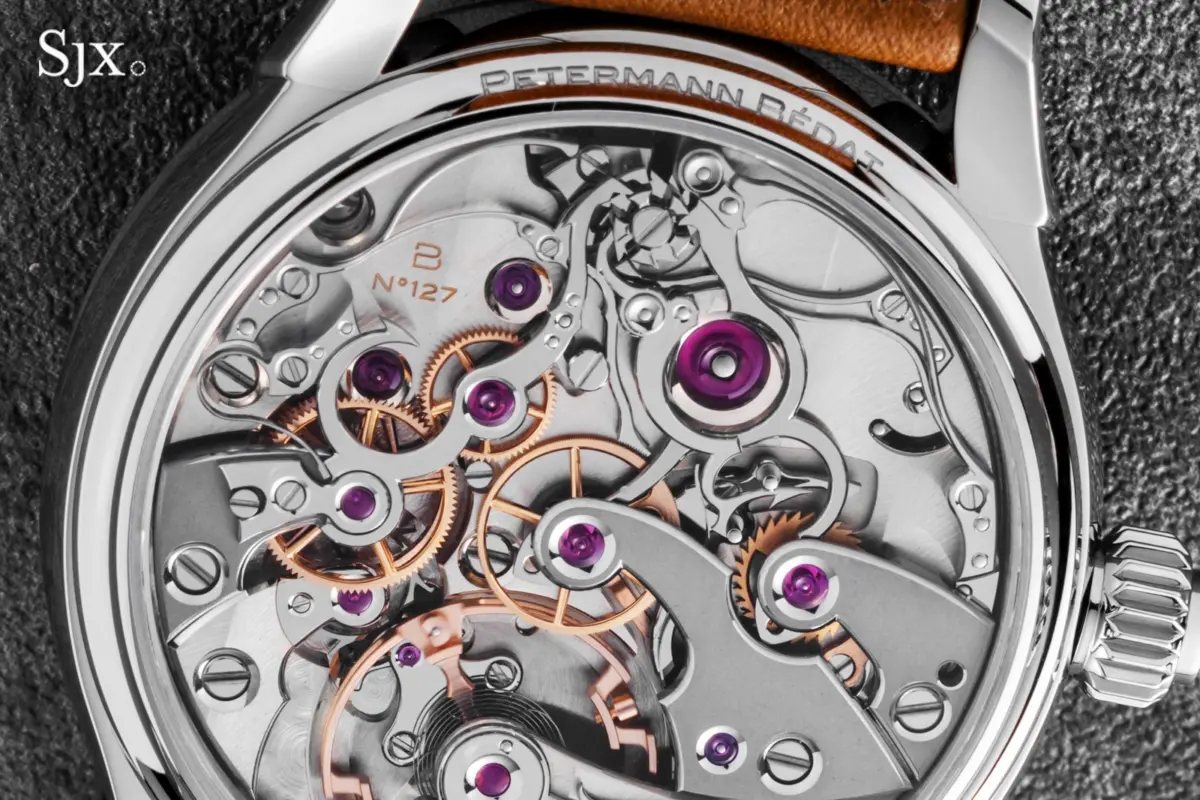
Those exact same structural qualities make it an enduring, stalwart calibre even today. Petermann Bédat’s refined, deeply considered recreation stands proudly as one of the finest historically inspired chronographs on the market. While the source material is partially obscured by several sweeping technical and aesthetic alterations—namely, the complete elimination of the characteristic horseshoe-shaped bridge in favor of a pair of exquisitely frosted finger bridges for the chronograph seconds and minutes counters—the foundational architecture shines through.
In short, the calibre shares much of its DNA with the Calibre 202 that powers the earlier Reference 2941, minus the dial-side rattrapante mechanism. However, it represents a step forward in several key areas. Keen-eyed horological enthusiasts will immediately spot the inclusion of a free-sprung balance, a technical feature that Petermann Bédat first developed for the time-only Reference 1825.

It would certainly have been more cost-effective—and largely forgivable by the market—for the brand to have simply reused its existing chronograph architecture as-is, curb-pin regulator included. Instead, this principled mechanical upgrade reveals a pair of watchmakers who care deeply about horological integrity down to the smallest detail.
The going train further distinguishes itself through the use of solid gold wheels featuring hand-beveled spokes. Unlike standard plated beryllium copper wheels, solid gold wheels can be meticulously touched up and polished after being riveted to their pinions, entirely removing any residual microscopic scratches caused during the manufacturing and assembly process.
Naturally, any thorough analysis of the movement must acknowledge the lusciously black-polished reset hammers and chronograph clutch. These specific components are rarely treated to such an extreme degree of finishing because achieving a true, distortion-free black polish on such long, remarkably thin pieces of steel requires immense skill and time. The reset hammer itself is thoughtfully sculpted and shaped to elegantly frame the extra-large chaton and jewel for the barrel pivot—a detail rarely seen in movements based on the Valjoux 23 platform.

Serving as a likely nod to the watchmakers’ formative time spent working together at A. Lange & Söhne, the movement incorporates an instantly jumping elapsed minutes counter. This modern mechanical adaptation brings the historical platform fully in line with contemporary expectations for a high-end chronograph. In another subtle nod to German watchmaking aesthetics, a swan’s neck regulator has been ingeniously repurposed to adjust the stud carrier—a clever mechanical workaround that preserves the exquisite aesthetic appeal of black-polished steelwork while delivering the superior chronometric performance of a free-breathing hairspring.
It is precisely these kinds of material upgrades and uncompromising mechanical choices, well beyond baseline finishing, that clearly separate the Reference 2914 from the myriad vintage-inspired chronographs relying on unmodified Valjoux 23 movements.
Key Facts and Price

Petermann Bédat Reference 2914 Monopusher Chronograph
Reference: 2914
Diameter: 36.5 mm
Height: 9.9 mm (excluding crystal)
Case Material: Platinum
Crystal: Sapphire
Water Resistance: Unspecified
Movement: Calibre 234
Functions: Hours, minutes, small seconds, monopusher chronograph with jumping minutes counter
Frequency: 18,000 vibrations per hour (2.5 Hz)
Winding: Manual wind
Power Reserve: 56 hours

Strap: Alligator leather strap with matching pin buckle
Limited Edition: 20 pieces
Availability: Direct from Petermann Bédat or authorized retail partners
Price: CHF 180,000 excluding taxes