




Without the Valjoux 7750, the modern mechanical chronograph revival would simply not exist. Developed between 1970 and 1972 by a young engineer named Edmond Capt, working closely with design collaborators Gérald Gander and Donald Rochat, the movement entered commercial production in 1973 as a masterpiece of efficient, 4 Hz cam-switching mechanical architecture. Over the last 53 years, the Valjoux 7750 and its countless variants have animated more mechanical chronographs than any other automatic movement in history. No other automatic chronograph calibre can claim a continuous production run spanning over five decades.
Yet, for more than 45 years, the story of how this legendary movement survived the devastating onslaught of the quartz crisis has been shaped by romanticized folklore. Chief among the persistent legends was the vague assumption that production had been paused for an extended period beginning in 1975 and resumed only in 1985, and that Mr. Capt had personally hidden the factory’s production tooling before his departure for Frédéric Piguet in 1978.
As René Maillefer, the Valjoux Operations Manager during this tumultuous period, firmly noted, production never actually stopped in the way the myth suggests. A cursory examination of actual historical events quickly explodes the rest of the folklore, given that the corporate destruction order arrived in the spring of 1979—by which time Edmond Capt was no longer working at Valjoux. The real story of what happened behind closed doors in the Vallée de Joux is a gripping tale of industrial espionage, corporate panic, and quiet rebellion.
The Prix Gaïa
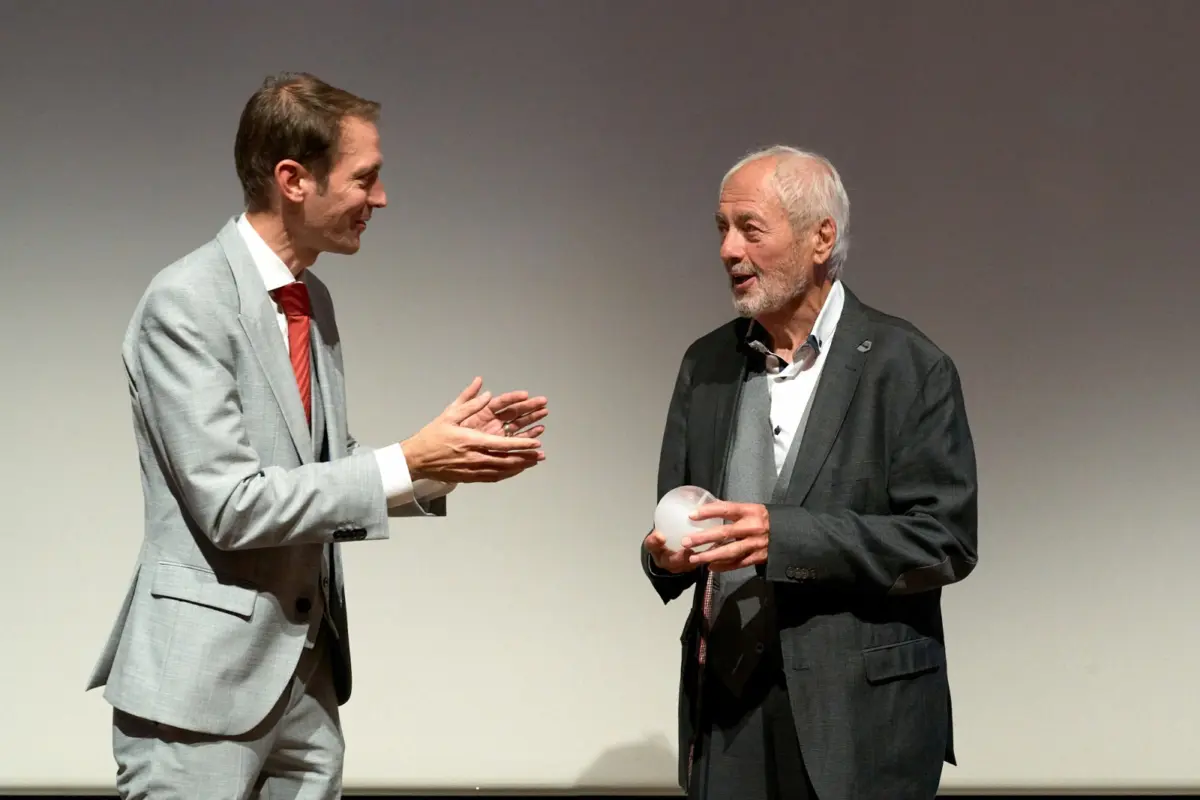
On September 17, 2026, the low murmur of nearly three hundred voices filled the Salle Hans Erni at the Musée international d’horlogerie in La Chaux-de-Fonds. Seated in the front row, directly adjacent to Edmond Capt, the energy in the hall was palpable. The audience, a distinguished cross-section of watchmaking legends, historians, jury members, and the general public, had gathered for the 2026 Prix Gaïa ceremony—widely regarded as the Nobel Prize of horology.
Régis Huguenin, Curator of the MIH and President of the Prix Gaïa Jury, stepped up to the microphone to kick off the festivities. Following the opening remarks, the floor turned to the formal laudatio, a six-minute distillation summarizing Mr. Capt’s remarkable five-decade career. While Mr. Capt is best known for the ubiquitous mechanical marvel that is the Valjoux 7750, he helped develop more than 30 calibres and numerous complex complications throughout his career, including perpetual calendars, minute repeaters, and tourbillons.

The long-anticipated moment arrived for Mr. Capt to receive his Prix Gaïa, and as applause echoed through the space, he approached the lectern to deliver his acceptance speech. The room quieted as Mr. Capt began by expressing profound gratitude toward former Prix Gaïa laureates André Beyner and Nicolas Hayek for the support and trust they bestowed upon him during his career. He then proceeded to reveal a secret held for nearly half a century—a hidden chapter known only to a tight-knit circle in Les Bioux as the "Histoire Occulte du Valjoux 7750." To understand the true weight of his confession, one must travel back 47 years to the spring snow melt of the Vallée de Joux in April 1979.
The Paper Trail
To appreciate why the Valjoux 7750 faced an official execution order in the spring of 1979, one must examine the desperate corporate boardrooms of Ebauches SA. The relentless, destructive advance of the quartz crisis had devastated the Swiss watch industry, forcing a sweeping wave of structural consolidation. This was formally codified on April 6, 1979, through a critical Ebauches SA procès-verbal that absorbed the Fabriques d’Ebauches Réunies (FER)—originally formed in 1975 with founding members Peseux, Unitas, Fleurier, and Valjoux, and joined by Tavannes in 1978—directly into Fontainemelon SA (FHF).
This consolidation was intended as a pragmatic lifeline: a strategic effort to keep historic manufacturing entities commercially viable as the ground shifted beneath them. Yet, within this administrative restructuring, a fatal decision was made. Viewing traditional mechanical watch production as an exhausted and unprofitable chapter, Fontainemelon SA Managing Director and board member Denis Robert issued a direct order to destroy the 7750 production dies. It was a choice born of the prevailing panic of the era, when the perceived death of mechanical watchmaking seemed absolute, making the destructive order appear logical to him at the time, even if its folly would be exposed remarkably soon.
The sense of panic was hardly unique to Valjoux. Four years earlier, management from the Zenith Radio Corporation, which owned Zenith at the time, had issued a similar directive to cease production of the El Primero calibre 3019PHC, prompting Charles Vermot to secretly preserve its tooling and technical plans in the factory attic in Le Locle—a private act of defiance that came to light years later in 1984. What remains extraordinary about the Valjoux case is the operational vacuum surrounding Mr. Robert’s directive. The executive apparently informed no higher-ups at Ebauches SA, operating entirely outside formal corporate channels. More glaringly, he bypassed the industry’s standard after-sales service obligation: the mandatory requirement to maintain and supply 7750 spare parts for at least 15 years. By neglecting even basic after-sales obligations, the order was not just short-sighted; it was an administrative anomaly that set the stage for disaster.
The Unrecorded Directive
The directive that arrived in Les Bioux in April 1979 bore none of the formal hallmarks of corporate bureaucracy. There was no paper trail, no official memo filed in the archives of Ebauches SA, and no formal procès-verbal documenting the decree. Instead, it was delivered face-to-face. As Mr. Robert addressed the Valjoux workforce with assurances of plenty of new production work ahead, he also delivered a blunt, dismissive instruction regarding the 7750.

Jacques-Michel Rochat recalls the encounter: "He [Robert] says to us: ‘I’m going to tell you something. This mechanical watchmaking, it’s completely worthless now. It’s finished. You need to throw it all away. Your 7750 get rid of it! Just toss it out,’ he told us… ‘I don’t want to see any of it anymore, and I’m going to send people to check.’"
The immediate reaction among the workforce was sheer incredulity. The workers had spent years machining, tuning, and perfecting a movement that they knew was a mechanical masterpiece. Before open panic could fracture the room, René Maillefer stepped in to take control. Recognizing the grave danger of speaking out within the factory walls, Mr. Maillefer quieted the team with a clear directive: they were to discuss nothing on the premises. Instead, they were to meet that evening at 17:00 in the restaurant of Hôtel des Trois Suisses to determine their next steps. The executive order had been given, and the workforce had just taken its first clandestine step toward defiance.
The Pact
That evening at 17:00, as seven men gathered just 250 meters from the factory at Hôtel des Trois Suisses, there was no debate and not a single voice raised in favor of compliance. The only question on the table was how to successfully defy the order. As Mr. Maillefer later reflected on their mindset: "For us, it was a question of survival to continue the [7750] chronograph."
Among them was a colleague, Pierre Kohler, affectionately known by his nickname, KO. With a quiet smile, KO broke the tension, revealing that he knew exactly where the tooling could vanish. The factory complex in Les Bioux featured interconnected buildings with hollow architectural panels that could be unscrewed and removed. Within the dark dead space behind these walls lay an ideal, unmapped hiding place.
The plan was swiftly cast. They would isolate all dedicated Valjoux 7750 tooling and stamping dies—components that were not shared with any other movement line—and hide them away inside this dead space. Protecting precision steel from humidity demanded rigorous craftsmanship. Working strictly after hours in the dead of night, the seven men meticulously greased every surface of the heavy steel dies and packed them in sous-vide airtight packaging to guard against rust. They had no way of knowing how many years the equipment would need to remain entombed.

"Yes, because there are walls like that… this wide," Mr. Maillefer recalled, holding up his hands to show approximately 50-centimeter-wide walls. "I remember we put up shelving, racks, and then we stashed what was needed in there. Between the walls. We put up panels, plastered over everything. Done."
Once the dies were secured and the panels firmly screwed back into place, the team completed their subterfuge by applying a fresh layer of plaster crépi over the joints, seamlessly matching the surrounding wall texture so that no visual trace remained. For approximately one solid week, operating under the cover of darkness, the team executed their clandestine preservation until not a single dedicated 7750 die remained in the cabinets of the factory.
What to Save
In the clandestine operations of April 1979, René Maillefer and his team of six technicians did not prioritize hiding the factory’s paper technical drawings, since the true vulnerability lay in the physical hardware. Without the stamping dies and tooling required to press and cut plates, bridges, and mechanisms, the 7750 design could not be manufactured again without months of work and a colossal financial investment.
A high-level audit of the tooling inventory reveals the massive scale of what was hidden within the factory dead space. Approximately 300 distinct dies were required for the complex sequence of stamping, piercing, and blanking operations that brought the Valjoux 7750 chronograph to life. Each stamping die required high-grade tool steel acquisition, complex CNC or pantographic machining, and meticulous hand-finishing by master technicians. At an estimated average cost of CHF 5,000 per die in 1979, the total direct replacement value stood at CHF 1.5 million—equivalent to more than CHF 3 million in today’s terms.
Had management’s verbal directive been executed and the tooling destroyed, the trajectory of Swiss mechanical watchmaking would have fractured irrevocably. By the time corporate restructuring culminated with SMH completing the merger of SSIH and ASUAG, the 7750 might easily have been relegated to a forgotten footnote of industrial history. Fortunately, because seven technicians greased, packaged, and walled up the tools and steel dies, history never had to test whether corporate accountants would have deemed the movement worth saving.

"That’s what I find pretty extraordinary, that a group of people from the Vallée [de Joux] said, ‘No, we’re not going to do that. We’re going to resist, we’re going to rebel, because it’s not fair,’" Jacques-Michel Rochat reflected. Edmond Capt later summarized the sentiment with characteristic bluntness: "They’re all gangsters… Of course, it’s magnificent!"
The Unbroken Pipeline
The immediate fallout of the April 1979 destruction order cast Valjoux into a turbulent structural exile, subordinating the factory directly to FHF. The transition was far from seamless; FHF transferred a batch of substandard equipment to Les Bioux that fell well short of traditional Valjoux standards, requiring the full ingenuity of the factory’s technicians to overhaul and bring up to proper industrial grade.
FHF assigned Les Bioux the manufacture of Mini-quartz calibres 101 and 102, which were recognized at the time as the world’s smallest quartz watch movements. Mr. Maillefer noted that these projects were never profitable. They were also given Unitas calibres 6497 and 6498 to produce, alongside Peseux calibres 7000 and 7001. Yet, salvation lay in an unyielding external alliance. Valjoux retained its privileged status as one of the primary, indispensable partners to Rolex. Refusing to sever ties despite corporate restructuring, Rolex stood firm: no other manufacturer matched the uncompromising quality of Valjoux’s execution. This singular commercial loyalty guaranteed a steady 30 to 40 percent occupation of the Valjoux workforce, satisfying FHF’s obligations and keeping the factory’s pulse alive.
As spring rolled into summer, the bureaucratic machinery of the parent company made its inevitable audit. Two FHF inspectors arrived in Les Bioux to verify the execution of the destruction directive. In a calculated act of industrial subterfuge, the team piled ordinary scrap metal into the disposal bins, casually informing the inspectors that Denis Robert’s orders had been faithfully carried out. Mr. Maillefer long suspected that the inspectors knew precisely what they were looking at, yet diplomatic convenience won the day, allowing them to return to Fontainemelon with plausible deniability while the true tooling remained safely within the walls.
By August 1979, after returning from summer leave, Mr. Rochat overheard an incoming call from Ebauches SA Service des Fournitures to Mr. Maillefer in the open-plan office. When Ebauches SA enquired about the stalled line, Mr. Maillefer calmly informed them that 7750 production had been temporarily put on hold. Far from demanding an inquest, headquarters simply stated that they knew Mr. Maillefer and his team would find a solution, and a new commercial order for 7750 resupply was officially placed.

Even during the six-month production pause, existing inventories of parts allowed them to keep client supply lines open. Within weeks, the team quietly dismantled the plastered panels, extracted the stamping dies and precision tooling from the walls, and re-established full production capacity as if nothing had ever happened. Denis Robert never once asked Mr. Maillefer how they managed to resurrect the line so rapidly, nor did he ever reprimand the team for defying his explicit directive. The silence was mutual and tactical.
Legacy
Standing before the lectern in 2026 with the crystal Prix Gaïa in hand, Edmond Capt brought that remarkable history full circle. Addressing the 300 guests in the Salle Hans Erni, the master constructor did not claim sole ownership of the calibre’s survival. Instead, he used his national platform to publicly dismantle the myth once and for all.
"Allow me to mention here the hidden side of the history of calibre 7750, which I designed back then," Mr. Capt told the assembly. "When Valjoux was absorbed by Fontainemelon, orders were given to the management of the time to destroy the inventory and tooling for the calibre. Several articles claim that I was the one who disobeyed by hiding parts and tooling. In reality, I must render unto Caesar what is Caesar’s. It is thanks to René Maillefer and a small group of his close associates that the 7750 survived."
With Mr. Capt’s public acknowledgement, the one-man savior myth is forever shattered. In its place stands the verified truth: that due to the collective courage of seven technicians who chose silent rebellion over an unjust command, the Valjoux 7750 remains with us today. The full history of the movement that powered millions of chronographs has finally been spoken aloud in the nation’s horological sanctuary.