





In the intricate and often symbolic world of antique jewelry and historical design, terminology carries centuries of artistry, tradition, and precise craftsmanship. Among the many terms that bridge the gap between ancient heraldry and fine decorative arts is "addorsed," a concept deeply rooted in both linguistic history and visual composition. Derived from the French word adosse, which translates to leaning or resting against one another, addorsed describes a specific decorative motif in which animals, figures, or objects are placed back-to-back. While the term originated largely in the formal realms of heraldry and architecture, it has found a permanent and distinguished home in the history of fine jewelry, where master artisans have utilized the configuration for both symbolic resonance and distinct branding.
To understand the visual impact of the addorsed motif, one must look to its traditional applications in heraldic design. For generations, coats of arms, crests, and family insignia utilized addorsed placements to convey strength, symmetry, and duality. In these classical designs, pairs of heraldic animals—most notably lions, lambs, griffins, and eagles—were meticulously illustrated with their backs turned toward one another while their heads often faced outward or inward, depending on the specific narrative the crest aimed to tell. This configuration not only created a striking sense of visual balance and geometric harmony on a shield or banner, but it also imbued the objects with a sense of guarded
strength, as if the creatures were watching multiple directions at once.
Over time, the elegance and inherent symmetry of the addorsed layout naturally transitioned from parchment and stone into the realm of precious metals and gem-setting. Goldsmiths and jewelry designers recognized that the back-to-back arrangement offered an exceptional framework for ornamental balance, particularly in symmetrical pieces such as brooches, pendants, and clasps. The technique allowed artisans to achieve a seamless equilibrium, drawing the human eye naturally toward the center of a composition while letting the mirrored elements extend outward in a graceful, calculated rhythm.
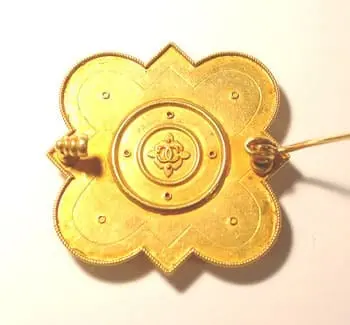
However, the application of the addorsed concept extends far beyond literal representations of fauna and flora. In the specialized study of antique jewelry marks, signatures, and trademarks, the term takes on a uniquely functional significance. Makers’ marks and hallmarks stamped onto the reverse of historical pieces frequently employed addorsed letters to create monogrammatic signatures that were both compact and visually memorable. These stylized letterforms turned simple initials into intricate works of graphic design long before modern corporate branding existed.
A premier historical example of this practice can be found in the storied legacy of the Castellani firm, the legendary nineteenth-century Italian jewelry house renowned for its archaeological revival styles. Founded in Rome by Fortunato Pio Castellani, the firm achieved international renown for reviving ancient Etruscan, Greek, and Roman goldsmithing techniques, creating pieces that captivated the elite, scholars, and collectors across Europe. As the firm’s reputation grew, establishing a distinct and reliable method of attribution became paramount.
To sign their exquisite creations, the Castellani family famously utilized a specialized trademark featuring addorsed letters—specifically, a pair of back-to-back capital C’s. Circa 1880, this distinctive maker’s mark became synonymous with the highest echelon of archaeological revival jewelry. By placing the two C’s back-to-back, the Castellani firm created an iconic monogram that mirrored the classical symmetry found in the ancient artifacts they so deeply admired and emulated. This addorsed signature not only served as a guarantee of authenticity and supreme craftsmanship but also transformed the maker’s mark into an integral decorative element of the jewel itself.
Today, antique jewelry historians and institutions, such as Wartski—the renowned London-based firm specializing in fine antique jewelry, Fabergé, and Renaissance works of art—continue to document and study these minute details. The identification of marks like the Castellani addorsed C’s relies heavily on a precise understanding of historical terminology and the subtle nuances of nineteenth-century goldsmithing. Recognizing whether letters or motifs are addorsed provides experts with crucial clues regarding a piece’s provenance, dating, and attribution.
As the study of antique jewelry continues to evolve, the terminology of the past remains an essential bridge connecting modern enthusiasts with the minds of master craftsmen. Whether observed in the proud stance of heraldic beasts rendered in gold wire or in the sophisticated, mirrored initials of a nineteenth-century master like Castellani, the addorsed motif stands as a testament to humanity’s enduring desire to find balance, meaning, and beauty in symmetrical design.