





In the intricate and storied world of antique jewelry and historic design, terminology often bridges the gap between fine art, heraldry, and craftsmanship. Among these specialized terms is "addorsed," a concept deeply rooted in history that continues to captivate historians, collectors, and connoisseurs of fine ornamentation. Derived from the French word adosse, which translates to leaning or resting against, the term describes a specific design configuration where animals, objects, or even letters are placed back-to-back.
While the term might sound obscure to the uninitiated, its visual impact is widespread across centuries of decorative arts. Most frequently observed in traditional heraldic designs—where symbolic creatures such as lions, lambs, or eagles are rendered back-to-back to create a sense of balanced symmetry, power, and visual harmony—the motif eventually found its way into the ateliers of master jewelers. Beyond heraldry, the principle of addorsed placement evolved into a clever technique for makers’ marks, signatures, and trademarks, allowing historic artisans to brand their creations with elegance and artistic flair.
To fully understand the evolution and application of the addorsed motif, one must examine its transition from medieval coats of arms into the intimate domain of Victorian and nineteenth-century high jewelry. In heraldry, placing two identical figures back-to-back was not merely an aesthetic choice; it carried profound symbolic weight. It represented vigilance, duality, strength, and unity, all while maximizing the visual symmetry of a crest or shield. As the decorative arts shifted through various revivals during the nineteenth century—particularly the archaeological revival championed by legendary Italian jewelers—artisans began borrowing heavily from classical antiquity and heraldic traditions.
Among the most celebrated practitioners of this historic design philosophy was the House of Castellani, the legendary nineteenth-century Roman firm renowned for reviving ancient Etruscan and Roman goldsmithing techniques. Founded by Fortunato Pio Castellani, the firm became an international sensation, catering to royalty, nobility, and elite collectors across Europe. The Castellani family did not merely copy ancient aesthetics; they deeply understood the symbolic language of historic ornamentation, integrating classical motifs into contemporary jewelry while maintaining the highest standards of Italian craftsmanship.
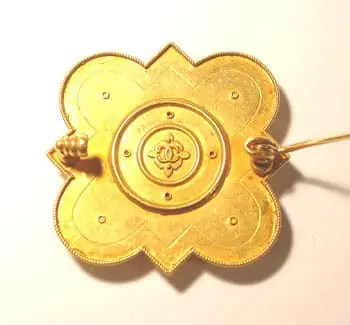
As part of their commitment to authenticity and legacy, the Castellani firm utilized distinctive signatures and trademarks to authenticate their pieces, distinguishing genuine works from the numerous contemporary imitations circulating the market. True to their deep appreciation for classical and heraldic traditions, the Castellani workshop famously adopted an addorsed design for one of their most recognizable maker’s marks. This specific hallmark featured two stylized, back-to-back letter C’s, mirroring the classic addorsed configuration seen in historical coats of arms.
The Castellani mark with addorsed C’s, which dates back to approximately 1880, stands as a prime example of how historic motifs were adapted for modern branding in the nineteenth-century luxury market. Rather than stamping a plain, utilitarian monogram onto their precious metals, the Castellani family integrated their maker’s mark directly into the design philosophy of the firm. The back-to-back C’s provided a symmetrical, aesthetically pleasing monogram that blended seamlessly with the Renaissance and classical revivals characteristic of their output. Today, antique jewelry experts and auction houses rely heavily on these subtle hallmarks, such as the Wartski-documented Castellani mark, to trace the provenance and verify the authenticity of pieces that have survived for nearly a century and a half.
The significance of the addorsed style extends far beyond a simple nineteenth-century hallmark; it represents a broader historical continuum in how humans communicate identity, ownership, and artistic lineage through decorative objects. From stone carvings on medieval European fortresses and embroidered banners on royal battlefields to the delicate gold settings of Roman revival brooches and rings, the back-to-back arrangement has consistently provided a solution for visual balance and symbolic expression.
In the context of modern antique appraisal and jewelry history, recognizing terms like addorsed allows collectors and historians to appreciate the dense layers of meaning embedded within a single piece of jewelry. A hallmark is rarely just a set of initials; when examined through the lens of historical terminology, it reveals a deliberate choice rooted in centuries of design tradition. As museums, auction houses, and private collectors continue to study and preserve the masterpieces of firms like Castellani, details such as the addorsed C’s serve as enduring reminders of the craftsmanship, heritage, and meticulous attention to detail that defined the golden eras of jewelry design.