Warm, moody colors dominated the bustling aisles of Cersaie 2026 and the windows of almost every storefront across Bologna this autumn. Marking its 43rd edition, the premier international exhibition for ceramic tile, architectural surfaces, and bathroom furnishings brought together manufacturers, architects, and designers for five days at the end of September. The annual trade show once again served as the global epicentre for surface design innovation, drawing more than 90,000 visitors to explore cutting-edge ceramic and porcelain materials presented by 600 exhibitors hailing from 24 countries.
Danielle McWilliams, principal at Novità, the communications agency for Ceramics of Italy, noted that the overarching aesthetic shift was immediately apparent both inside the exhibition halls and throughout the host city. Just as in contemporary fashion, Italian tile manufacturers used the international stage to debut collections drenched in deep burgundy, luxurious browns, earthy terracottas, and vibrant shades of red and yellow. Beyond this striking return to saturated color, the 2026 edition highlighted major advancements in large-format slabs, tactile textures and dimensions, intricate digital printing technologies, and strikingly realistic natural material effects.
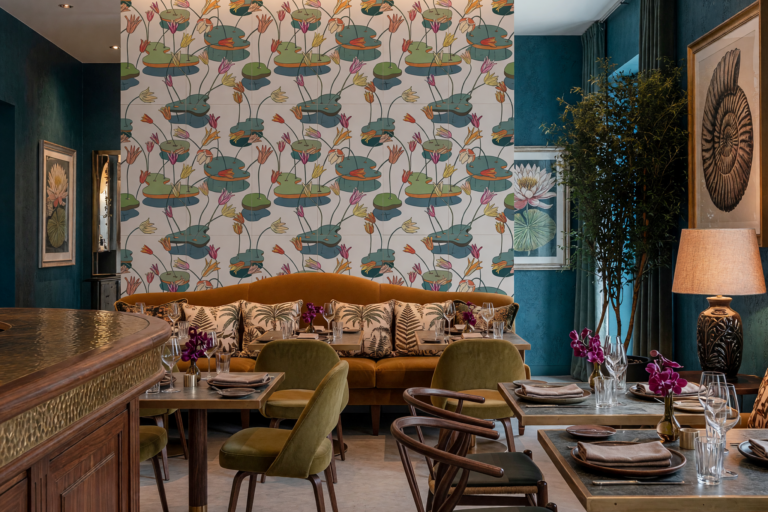
There was a palpable energy to this year’s fair that extended far beyond the sheer volume of attendees. That vibrant buzz resonated directly within the temporary showrooms, where brands rolled out bold, imaginative products that pushed the boundaries of how ceramic surfaces can be utilized in modern architecture and interior design.
Color Makes a Comeback
While stark white and minimalist neutral tiles remain permanent staples of modern interior fashion, ceramic makers boldly embraced richer, highly saturated hues during this year’s exhibition. Benedetta Borghi of external affairs at Atlas Concorde observed a renewed confidence in color across the industry, noting a much greater willingness among designers to incorporate stronger chromatic choices into the core architectural palette.

Combining these bright, saturated hues with warm whites and neutral backdrops offers a refreshed aesthetic for contemporary spaces. Atlas Concorde’s Boost Hux collection pairs warm natural tones with striking accents of green, red, blue, and ember, while its Vivia line features vivid glazed colors directly inspired by traditional Italian ceramics. For Atlas Concorde, color is increasingly evolving into a fundamental design tool rather than functioning merely as a decorative accent.
Cristina Faedi, a renowned tile trend expert, consultant to Confindustria Ceramica, and founder and art director of Infinite Possibilità, corroborated this industry-wide shift. She pointed out that several prominent Italian companies have effectively doubled the color options within their product ranges, while others have introduced multiple density variations of a single hue to grant designers unprecedented creative control.

Green Takes Root
The sweeping popularity of rich-colored tiles may represent a natural design pendulum swinging back after years of muted tones and understated neutrals dominating the market. However, experts like Faedi also see the broader, more chaotic state of the global landscape subtly influencing contemporary tile palettes. Drawing parallels to the traditional seven chakras, which correspond to the colors of the rainbow, Faedi highlighted how specific shades are chosen for their psychological resonance—such as green, which symbolically represents empathy and emotional healing.
It is hardly surprising, therefore, that green is experiencing such a profound moment in surface design. Faedi described green as a color that instills a deep sense of calm while drawing direct inspiration from the natural world. It serves as a visual narrative of diverse landscapes, wild herbs, thermal waters, and rolling oceans. Alongside lush shades ranging from deep forest greens to pale, soothing sage, grounded earthy palettes featuring terracotta and other organic tones stood out prominently across the exhibition.

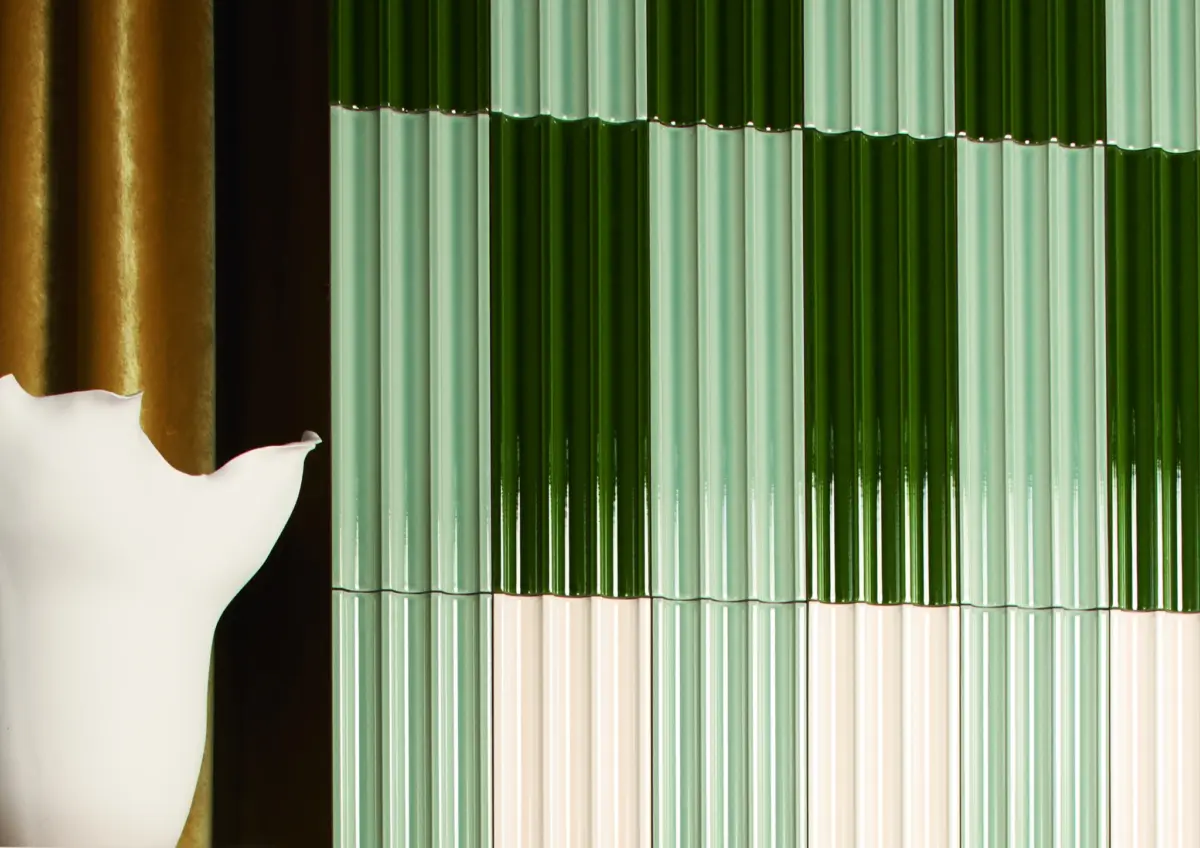
Glossy finishes further amplified these rich colors, giving them an arresting vibrancy and depth. The Plinth collection from Sartoria—a brand under the Terratinta Group—showcases this trend in shades of Moss and Stone Green, utilizing a three-dimensional surface structure that adds tactile dimension and visual intrigue to interior walls.
Playing with Perception
The evolution of ceramic engineering has fundamentally transformed the material’s role in the built environment. As Borghi emphasized, ceramic is no longer simply reproducing another material; the surface itself is rapidly becoming an independent architectural element.

Marca Corona demonstrated this shift with its Multiforme Mira wall tiles, designed to complement the brand’s concrete-effect porcelain floor tiles. The collection’s Tassello decorative variant features small, three-dimensional tesserae arranged meticulously to create the appearance of a continuous mosaic, contrasting glossy and luster-glazed details against a matte background.
Similarly, Moooi Ceramic Surfaces collaborated with ABK as part of The Nesting Room collection to introduce Hypnotic Owl. This innovative floor and wall tile features a tactile, three-dimensional relief surface achieved through ABK’s proprietary 3DTECH technology, a specialized digital process that applies glazes and textures directly onto porcelain stoneware at varying depths.

Gruppo Bardelli’s Appiani brand pushed perceptual boundaries even further with Lamiere, part of its Pastelli Strutture collection. Inspired by industrial sheet metal, these through-body ceramic tiles utilize a sophisticated chiaroscuro effect to trick the eye into perceiving a three-dimensional surface while remaining completely flat to the touch. The interplay of light and reflectivity across these surfaces offered a mind-bending demonstration of modern ceramic capabilities.
Nature, Reimagined
When authentic stone or marble proves cost-prohibitive or lacks the necessary structural durability for demanding architectural projects, high-end ceramics continue to bridge the gap by offering the aesthetic richness of natural materials paired with the superior performance of porcelain. While stone-look ceramics have populated the market for years, continuous technological leaps have rendered these effects virtually indistinguishable from the real thing.

Faedi described this category as an exercise in controlled chaos. Modern manufacturing techniques empower technology to replicate the intricate, seemingly chaotic interplay of colors, hues, and organic shapes found in nature, delivering an exceptional visual impact.
Gruppo Romani brand Verde introduced Essenziale, a glazed porcelain stoneware line that faithfully captures the complex materiality of limestone. Utilizing Contour Tech 3D printing, the manufacturer colors the ceramic body at varying depths to accurately mimic the natural irregularities and sedimentary characteristics of genuine stone.

Meanwhile, Del Conca’s Marble Boutique collection achieves an astonishing resemblance to luxury marble and onyx. Available in Shine, Natural, and Structured finishes across six distinct material options with enhanced coloration and veining, the collection caters directly to current design preferences by offering large-format slabs measuring an impressive 48 by 110 inches.
Sizing Up
The trajectory toward larger formats continued to dominate the exhibition landscape, even as oversized tiles have maintained a steady presence in the industry for years. Borghi noted that large slabs are increasingly utilized by architects to establish seamless visual continuity across various elements of a spatial design, extending effortlessly from floors and walls to kitchen countertops, expansive islands, and bespoke furniture pieces.

European manufacturers, particularly in Italy and Spain, first revolutionized the market in 2001 by introducing advanced pressing techniques that surpassed traditional 12-by-12-inch tile dimensions. In the United States, the American National Standards Institute officially codified large-format tile in January 2025, defining it as any tile featuring a facial dimension of 23 inches or greater. At Cersaie, numerous exhibitors showcased extra-large formats that far exceeded these baseline measurements. Among them was Cotto D’Este’s Solaris collection, which offers expansive formats reaching up to 24 by 128 inches.
From Paint to Pixels
Among the most captivating displays at the trade show were intricate decorative tiles that successfully bridged the gap between high-tech digital manufacturing and age-old artisan traditions. The seamless juxtaposition of cutting-edge production methods and meticulous hand-painting underscored the industry’s dynamic versatility.

Ceramica Bardelli presented Tulipani, a collection designed by Ronald van der Hilst that features delicate floral motifs executed through a range of advanced technologies, spanning cold digital printing and precision laser engraving. The brand also debuted Searcus, designed by Riccardo Capuzzo, featuring whimsical patterns inspired by the sea and the circus, brought to life through advanced cold digital printing techniques.
In direct contrast to these digital innovations, Ceramica Francesco De Maio presented Three Elements, One Matter, a collection designed and hand-painted by celebrated architect Kengo Kuma. Explaining his artistic intent, Kuma noted that he sought to let nature emerge directly through the human hand, ensuring every individual tile carries a continuous human gesture—at times as light as falling rain, as soft as mist, or as grounded as earth—thereby quietly unifying material, movement, and landscape.

Drawing on over 25 years of industry experience, interior design journalist Danine Alati continues to cover the forefront of global design and architecture.