






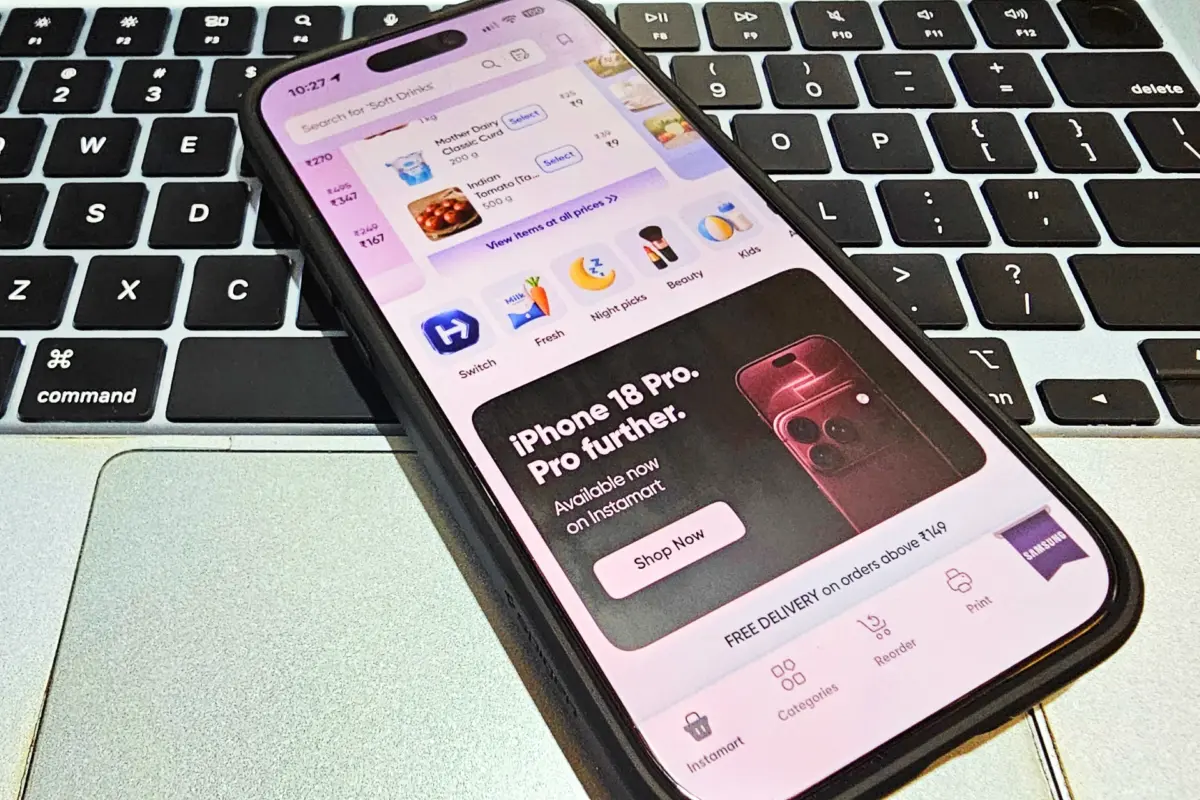
For a growing number of tech enthusiasts and eager consumers in India’s major urban centers, getting their hands on Apple’s brand-new iPhone 18 Pro or iPhone 18 Pro Max did not require lining up outside a brick-and-mortar storefront at dawn or waiting anxiously for days for a standard online delivery to arrive. Instead, securing the tech giant’s latest flagship devices required nothing more than a few casual taps on a smartphone screen, resulting in a uniformed courier delivering the high-end smartphone directly to their doorstep in roughly ten minutes.
As Apple’s latest Pro lineup officially went on sale across the country on Friday, major quick-commerce platforms—including Blinkit, Zepto, Swiggy’s Instamart, and BigBasket—stepped into the fray. While these apps are predominantly recognized by Indian consumers for delivering groceries, fresh produce, and everyday household essentials in mere minutes, they have increasingly added high-value electronics to their inventories. Of course, the new iPhones remained readily available through Apple’s traditional sales channels as well, encompassing its official flagship retail stores, authorized third-party electronics retailers, and mainstream online e-commerce marketplaces.
The phenomenon of purchasing a brand-new iPhone through a 10-minute delivery app is not entirely unprecedented in the Indian market. Quick-commerce platforms have previously capitalized on major tech launch days by offering Apple’s latest devices almost instantaneously, reflecting a broader, steady expansion beyond their grocery roots into lucrative non-food categories such as consumer electronics, beauty supplies, and fashion items.
However, the underlying market driving these rapid-fire deliveries is expanding at an extraordinary pace, reshaping how urban consumers shop for luxury and discretionary goods. According to a recent report by Redseer Strategy Consultants, India’s booming quick-commerce sector reached approximately $9 billion in gross merchandise value during the first half of 2026 alone. Furthermore, the ecosystem has experienced an exponential surge in consumer adoption, with the number of active monthly users climbing to more than 60 million, a massive leap from just 8 million users three years prior. Independent estimates from Google and Deloitte project that the broader Indian e-commerce and quick-commerce market could skyrocket to an astonishing $50 billion by 2030, with non-food categories like electronics, fashion, and beauty expected to account for nearly 45% of total consumer spending.
Launch day figures underscored robust consumer demand for the rapid delivery model. BigBasket reported that it successfully delivered more than 300 units of the iPhone 18 Pro and iPhone 18 Pro Max within the very first hour of sales going live. Meanwhile, Swiggy’s Instamart noted that Bengaluru led the country in terms of iPhone 18 Pro-series order volume on its platform, closely followed by the nation’s capital, Delhi. Among individual preferences, the Burgundy colorway in the 256GB storage configuration emerged as Instamart’s most popular variant, single-handedly accounting for nearly a third of all iPhone orders processed through the platform.
Nonetheless, the frantic pace of demand meant that availability quickly became patchy within hours of the official launch. A review of various platforms found that the iPhone 18 Pro models had sold out entirely on certain quick-commerce applications and in specific neighborhoods, while units occasionally remained available for rapid dispatch in other pockets of major metropolitan hubs like Delhi and Bengaluru.
Tarun Pathak, research director at Counterpoint Research, observed that these high-speed launch-day deliveries effectively demonstrate that quick commerce can successfully function as a viable retail channel for premium smartphones within India’s largest cities, even if the absolute sales volumes remain relatively modest when compared against the broader, aggregate volume of total nationwide iPhone sales.
The capability to seamlessly fulfill high-value, luxury smartphone orders provides a crucial "early proof of concept" for these ultra-fast logistics networks, Pathak explained. However, he noted that the central uncertainty moving forward is whether this initial, launch-driven wave of consumer demand can successfully translate into sustained, regular smartphone purchases through quick-commerce platforms over the long term.
Navkendar Singh, associate vice president at IDC, pointed out that India currently stands out on a global scale for pioneering this unique style of quick-commerce delivery. He noted that the domestic market is particularly well-suited for such high-value purchases because urban consumers have steadily built a deep sense of trust in these platforms by relying on them daily for routine grocery shopping. Furthermore, official marketing tie-ups and direct partnerships between major global brands and these rapid-delivery platforms have significantly bolstered consumer confidence when buying expensive electronics through mobile apps.
For a luxury consumer product like the Apple iPhone, Singh added that much of the appeal boils down to pure "instant gratification." This model allows buyers to completely bypass the physical inconvenience of waiting in long queues outside retail stores or enduring a multi-day wait for a traditional parcel delivery.
Even so, Singh offered a note of caution, emphasizing that quick commerce has not yet matured into a primary, foundational sales channel for smartphones as a category. Instead, its prominent role surrounding major new iPhone releases functions largely as a high-profile "launch-day marketing phenomenon" that successfully generates positive public buzz and media attention around the product rollout.