





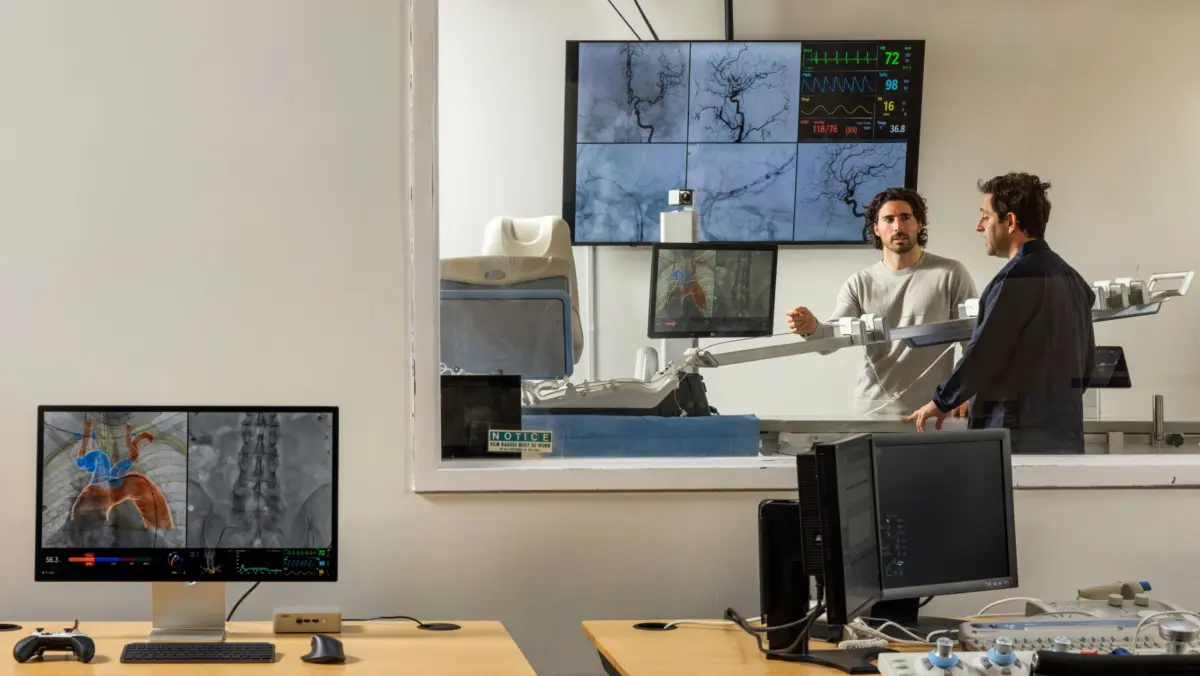
At Remedy Robotics, a prototype console awaits its operator in one room, while cofounders Jake Sganga and David Bell oversee the surgical robot in an adjoining space. Operating a brain surgery on a patient lying six meters away, out of sight and reach, a clinician presses a foot pedal to activate a hand controller, carefully steering a thin, flexible tube called a catheter through the patient’s blood vessels. Tracking progress on a live X-ray feed while heading toward the brain, the stark reality of stroke care remains front and center: every minute a stroke goes untreated, millions of brain cells suffocate, swell, and die.
The patient under the X-ray is not flesh and blood, but a plastic container holding long branches of silicone tubing, and the hand controller is borrowed from an Xbox. Yet the surgical robot itself is entirely real. The Remedy N1 system is designed for emergency operations, including mechanical thrombectomy, the standard brain operation for acute ischemic strokes caused by blood clots. Ischemia, which involves a dangerous restriction of blood flow, is the most common cause of stroke globally.
"We want it to feel a bit like a video game—a bit easy," says David Bell, a clinician and former cardiac-surgery trainee from Australia who cofounded San Francisco-based Remedy Robotics. "But we don’t want to dehumanize it as if there’s just another ‘game over.’" Alongside a dedicated team of engineers, Bell developed the robotic catheter and its accompanying software to help ischemic stroke patients in remote and rural areas who routinely lose crucial hours while being transferred away from facilities incapable of providing specialized care. According to 2025 data, at least 5 million people around the world suffer ischemic strokes every year. In the United States, stroke remains the fourth leading cause of death.
When testing the system on the silicone model, the movements feel remarkably smooth and precise—precisely the talking point one might expect from a surgical robotics company. However, Bell quickly offers a grounded correction. "Smoothness and precision are not clinical outcomes," he notes. "Neither is a surgeon’s ergonomics." For Bell, the only outcome that truly matters is whether the robot can successfully deliver emergency stroke treatment to patients who otherwise would not receive it in time. Today, only about one in ten patients eligible for a mechanical thrombectomy actually receive one. This clinical gap represents where the long-unrealized promise of telesurgery finally meets an urgent, life-threatening problem.
Can putting a robot in one hospital and a surgeon somewhere else actually close that gap? Remedy has already taken a preliminary step by remotely testing its system on a small group of patients. "The remote stroke need is well known," says Jake Sganga, who cofounded Remedy with Bell and leads the technology side of the venture. "It’s just a hard problem to take on." Making telesurgery a practical, everyday part of stroke care will require far more than a capable robot; it depends heavily on robust communications infrastructure, hospital resources, streamlined clinical workflows, and definitive evidence that patients genuinely benefit.

Why Telesurgery Starts With Stroke
As recently as the early 1990s, physicians who treated stroke struggled against what was widely described as "therapeutic nihilism." A 1991 editorial by two lamenting neurologists expressed hope that a successful drug therapy for stroke would eventually emerge to reverse this clinical pessimism. Five years later, the arrival of clot-busting drugs revolutionized acute stroke treatment, followed about a decade later by mechanical thrombectomy, a procedure in which a blood clot is physically removed from a blocked artery.
In a standard thrombectomy, a surgeon snakes a flexible wire through a small opening in the patient’s groin. This guide wire sets the route for a fine, hollow tube known as a catheter to travel through the complex network of blood vessels up to the brain, where specialized instruments capture and remove the clot. Suddenly, a severe stroke was transformed from a near-certain sentence of profound disability or death into a highly treatable event.
Yet decades later, traditional thrombectomies remain inherently blind expeditions. The surgeon must stand directly beside the patient, physically pushing these lines forward inch by inch. The only visual feedback comes from a live X-ray, which cannot image soft tissues like blood vessels. To navigate, surgeons inject brief puffs of contrast dye through the catheter to temporarily illuminate the path ahead. A nimble operator can avoid scraping or piercing delicate artery walls while bending the guide wire’s rounded tip around tight corners. However, even these directional turns are far from intuitive. The guide wire can twist unpredictably inside the body, and because the surgeon sees only a flat, two-dimensional silhouette, steering left may actually cause the guide wire to rotate to the right.
If the procedure goes according to plan, the doctor reaches the brain, advances instruments through the catheter to dislodge the clot, and carefully pulls everything back out. Bell vividly remembers what traditional thrombectomies felt like when he performed them. "I’m one and a half meters away from my catheter tip. I’m not in control of it. I can’t see where the blood vessels are. I thought, what is the ideal way to do these procedures? It’s certainly not what I’m doing now."
Sganga and Bell designed their robots to accomplish two primary goals: see what human surgeons cannot see, and be present where human surgeons cannot be. Remedy’s robotic arm utilizes motorized cartridges equipped with actuators that use small gears to grip threadlike instruments, moving them smoothly in and out of the body. These instruments include expandable wire-mesh tubes called stents, which are used to grab and yank clots backward out of the vasculature. It is all standard stroke operation equipment, save for the proprietary catheter.

Remedy’s catheter is uniquely steerable, eliminating the need for a traditional guide wire to pave its path. Outside the body, a robotic arm advances the catheter while tiny internal wires tug its leading tip in any direction, allowing it to navigate the narrow branches of the bloodstream with exceptional agility. When Sganga toggles on a computed tomography (CT) scan to overlay onto the live X-ray feed, the surgeon suddenly sees the bright, three-dimensional routes of blood vessels along a path that was previously invisible on a standard X-ray.
Observing the catheter closely reveals a pattern of small markings along its surface. Sganga explains that these are not meant for the surgeon, but for a computer-vision algorithm that continuously tracks the catheter’s rotation inside the body. If an operator wants to steer right, Remedy’s software automatically translates that human intention into the correct mechanical action. Instead of squinting at a flat silhouette and mentally compensating for every twist, the surgeon simply inputs the intended direction, and the Remedy system adjusts the catheter accordingly.
This innovative system grew out of ideas that Bell and Sganga were pursuing when they first met at Stanford University in 2019. Already a practicing physician completing an MBA, Bell enrolled in a robotics class hoping to meet an engineer who shared his vision for medical robotics. The professor connected him with Sganga, a bioengineering doctoral student who was developing pathfinding algorithms for an FDA-approved robotic bronchoscope used to navigate human lungs.
Sganga’s engineering background had exposed him to various surgical robotics companies that ultimately failed because they had not targeted a sufficiently valuable clinical problem. He sought a medical challenge where a robotic solution could prove its worth well before complex human trials, and acute stroke immediately stood out. "It’s an already verified clinical need," Sganga says. "Time." When he and Bell met for coffee, they immediately matched each other’s intense energy, diving straight into reviewing medical images of blood vessels stored on Bell’s phone.
About a year after leaving Stanford, Bell and Sganga rented a two-car garage in Southern California and reinforced it with lead lining to make it X-ray-proof. "We called it the bunker because it had exposed lead on all sides, including the ceiling," Sganga recalls. "It was just big enough to fit a bed and this rickety old C-arm X-ray machine." There, they test-drove a prototype of their steerable catheter through silicone arteries—initially controlling the robot on-site from an adjoining room, and later from a laptop situated hundreds of kilometers away. "We were trying to get an initial sign of life," Sganga says. "And it was that moment that we realized that this could work."
Telesurgery’s Second Act

Dreams of remote surgery significantly predate modern stroke care innovations. In the 1980s and 1990s, companies like Computer Motion and Intuitive developed bedside robots to assist operating surgeons. Then, in 2001, French surgeon Jacques Marescaux and Canadian surgeon Michel Gagner famously removed a patient’s gallbladder from more than 6,000 kilometers away. Operating from New York City, Marescaux used a computer connected via high-speed fiber optics to control a Computer Motion robot stationed in Strasbourg, France. Known as the Lindbergh Operation, this historic milestone was completed safely with zero complications.
However, telesurgery did not experience an immediate commercial boom following the Lindbergh demonstration. Instead, the medical industry heavily invested in robotic systems operated by surgeons physically standing in the same room. Computer Motion and Intuitive merged in 2003, and robotic surgery steadily entered the medical mainstream. Today, thousands of surgical robots operate in hospitals around the world, assisting in roughly 22 percent of all surgeries. In 2023 alone, more than 2 million procedures were performed using da Vinci, Intuitive’s flagship platform.
In the summer of 2025, telesurgery appeared to regain considerable momentum when surgeons near Orlando, Florida, successfully removed the prostate from a man 11,000 kilometers away in Luanda, Angola. Around the same time, Intuitive demonstrated what it termed telecollaboration, allowing two surgeons on different continents to operate together on a tissue model. Meanwhile, India-based SS Innovations has been testing cardiac telesurgery, and Texas-based medical robotics company XCath has tested a steerable guide wire for thrombectomies in Panama. These ventures build upon rapid advances in computer vision and machine learning, yet remote robotics remains a complex frontier.
"The first procedures are going to be those procedures where time is critical," says Brad Nelson, who develops surgical robots at ETH Zurich and is unaffiliated with Remedy. Last year, Nelson coauthored a report in Science Robotics arguing that telesurgery’s future success hinges on identifying emergency operations where patients cannot reach human specialists in time, including stroke, heart attack, and fetal interventions.
Surgeries conducted entirely within blood vessels present an attractive proving ground for emergency teleoperation. "If you have a hiccup, the nice thing about vascular procedures is nothing bad can happen other than the thing stops moving," Nelson explains. These procedures involve neither a large open surgical cavity nor the frantic choreography required during organ transplants. If a surgeon loses connection to the robot while the catheter is safely inside a blood vessel, the operation can simply pause in place without causing tissue damage. Nelson’s laboratory is also developing its own stroke solution in partnership with the Mayo Clinic in Arizona, building microscopic robots the size of coffee grains that are steered using external magnetic fields to dissolve clots.
When Surgery Depends on the Network

Following their preliminary success in the garage, Sganga and Bell turned their attention to the hospital environment where the Remedy N1 would ultimately reside. Practicing doctors and nurses advised them to improve the live audio and video feeds, emphasizing that any surgery is a coordinated team effort requiring uninterrupted communication. They were also urged to streamline setup times, equipment maintenance, and sterilization protocols, while initiating critical conversations regarding secure communication channels and cybersecurity.
Aside from potential cybersecurity threats, the most prominent challenge facing telesurgery is latency. Experts measure latency—or lag—in terms of the milliseconds it takes for a data packet to reach its destination and ping back to the source. In a major metropolitan area with robust 5G or fiber-optic internet, latency often measures in the tens of milliseconds. In rural areas, however, lag can easily exceed 100 milliseconds.
Noticeable lag is not necessarily a dealbreaker for experienced operators. When Japanese researchers analyzed five years of surgical simulations and demonstrations, they reported that surgeons naturally adapted to connection speeds by pausing and moving more deliberately. Remedy has observed similar behaviors during internal test runs. "We’ve actually found that operators are quite resilient to latency," Sganga notes.
Even so, Remedy targets a round-trip latency threshold of no more than 150 milliseconds, comfortably below the average human reaction time of 200 milliseconds. Whenever latency creeps above that strict threshold, the system automatically pauses all surgical actions. Bell and Sganga note that they have tailored their software to function reliably even with the slower internet connections common in rural areas, claiming they recently operated their system from across the Pacific Ocean using a simple mobile hotspot.
Yet sorting out these technical engineering details raises deeper questions about how telesurgery might fundamentally alter surgical practice over the long term. Bell admits he worries about potential negative consequences, such as the gradual erosion of hands-on surgical skills, trainees becoming overly dependent on specific proprietary platforms, or scheduling conflicts if two patients require immediate care from the same remote specialist simultaneously. "Is the person suffering a stroke in America necessarily more important than the person suffering a stroke in India? No," Bell says. "So how do you figure that out? That’s something I think about a lot."
Where Telesurgery Could Work Best

During an ischemic stroke, a sudden brain blockage triggers severe neurological symptoms within seconds or minutes. The subsequent hour is known as the golden period for salvaging brain tissue before the risk of permanent, irreversible damage escalates dramatically. "Every minute wasted or delayed, 2 million brain cells are going to die," says neurologist Archit Bhatt of Providence Medical Group in Portland, Oregon. "You really need to act fast." Yet decades after the invention of thrombectomies, one in five Americans still lives more than an hour away from a hospital that offers the procedure.
Medium and small community hospitals frequently lack the round-the-clock surgical teams, clinical experience, or specialized equipment required for thrombectomies, forcing them to transfer acute stroke patients to major medical centers. Consequently, standard stroke care remains heavily concentrated in urban environments. For instance, Alaska’s only two thrombectomy centers serving the entire state’s population are both located in Anchorage, leaving more than half of the state’s residents entirely out of range.
Paradoxically, the locations most in need of telesurgery are often the most difficult places to deploy it. Remote facilities frequently lack the high-quality network connections demanded by remote surgery. Last June, experts from five major robotic corporations coauthored a set of technical standards defining "surgical-grade networks." Mike Teodorescu, an information systems researcher at the University of Washington, notes that while experts generally consider 100 milliseconds a safe threshold, his team recently reported that many rural communities—and even entire nations—struggle to meet that standard.
Connectivity is merely one piece of the puzzle. The smallest and most remote hospitals often lack other critical support systems required for safe thrombectomies, including on-site neurologists, specialized catheterization teams, advanced CT scanners, and dedicated intensive care units. "It’s an infrastructure problem," Teodorescu emphasizes.
Medium-size regional hospitals may represent a more viable near-term target. Although they rarely perform thrombectomies independently today, many already possess the necessary foundational support, clinical experience, and patient volume. "There is a window for a thrombectomy center in a reasonably sized town where there is a stable economy," neurologist Bhatt suggests.
Telesurgery could ultimately do far more than simply project a distant specialist into a rural operating room. Jasdeep Bahra, an emergency medicine physician and lecturer in Kilifi, Kenya, expresses concern that telerobotics could concentrate elite expertise even further within wealthy cities, potentially widening the skill gap between urban centers and impoverished towns. While the thrombectomy access crisis is undeniable, Bahra suggests that lower-income communities might derive greater long-term benefit if telesurgery platforms could simultaneously treat patients while helping train local clinicians on-site. Sganga affirms that this vision aligns closely with Remedy’s core mission.

"Digital operating rooms where you have surgeons that are over your shoulder as a mentor," Bahra says. "If that’s what we’re talking about in telesurgery, that is the future for me."
Measures of Success
If smoothness and precision do not constitute definitive clinical outcomes on their own, what metrics should define true success? One primary target is safety. In more than 1 percent of traditional thrombectomy operations, surgeons unintentionally puncture or slice open a blood vessel—a feared and occasionally fatal complication that Bell believes advanced robotics can help prevent.
In September 2025, Bell traveled to Toronto for Remedy’s initial human clinical tests. Ten patients had consented to undergo nonemergency procedures utilizing Remedy’s robot. A neurosurgeon operating a laptop would perform procedures on six patients in an adjoining room, two elsewhere within the same hospital, and two at an entirely different hospital across town. Years of prior experimentation on silicone models, coupled with preclinical tests on lab animals, suggested that Remedy’s robot collided with blood vessel walls less frequently and completed procedures significantly faster than human operators.
In the lead-up to the Toronto procedures, the engineering team meticulously measured internet latencies, hoping their rigorous bench testing would translate seamlessly to human patients. "You’re never sure of how that leap is going to look, and it’s actually really hard to test," Bell acknowledges. The night before the first operation, Bell barely slept.
The procedures—which involved recording diagnostic angiograms from within patients’ blood vessels—proved successful and were completed nearly twice as quickly as the prevailing clinical standard. "I cannot explain the relief," Bell says. Remedy views operational speed as a vital measure of success because efficiency directly enables doctors to treat a larger volume of patients in critical windows.

A few months following the site visit, Remedy announced US $62 million in fresh venture funding to support upcoming clinical trials. A portion of that investment stems from the University of California system, which will host clinical studies within the year, according to Bell. Remedy’s initial trials will focus on on-site elective procedures, such as treating unruptured aneurysms, before eventually expanding to remote surgeries in Australia or across the University of California hospital network toward the end of 2027.
Sganga emphasizes that these on-site trials are far from a mere stepping stone. He has come to believe that Remedy’s long-term success relies fundamentally on improving everyday operations even when the surgeon is physically present in the room. "The remote solution—it’s very flashy, it’s very obvious what that patient need is—but in order to get there, we believe you have to solve a meaningful problem on-premise," he explains. "Otherwise, doctors simply won’t use the system, and if they don’t use the system, they’re not going to gain the expertise required to operate remotely."
The steerable catheter and advanced computer-vision algorithms represent core features designed to improve thrombectomies regardless of whether the procedure is local or remote. As clinical trials ramp up, Sganga notes that the team will evaluate broader operational factors beyond raw safety and surgical speed. "How quickly are doctors picking up on this new technique? How smoothly are the bedside interactions going? How quickly are folks able to set up the draping and interact with the tools?" Bell has even considered adding a display of the patient’s face to the surgeon’s workstation monitor to help preserve the essential human and emotional stakes of surgery.
These grand ambitions pull Bell and Sganga’s 25-person company into uncharted medical waters. Aside from isolated technical demonstrations, no robotics company has yet secured full regulatory approval for telesurgery, and no patient has ever been operated on remotely within the United States. Remedy hopes to change that landscape. Decades after pioneering stroke research successfully dismantled the therapeutic nihilism that once defined the medical specialty, Remedy aims to use telesurgery to bring life-saving thrombectomies within reach of everyone who needs them, no matter how remote their location may be.