





At the Adobe MAX conference in Miami Beach, a single photograph of a panda lounging lazily on a tree branch transformed into an immersive virtual space where a camera could move freely. Rather than simply zooming in and out or panning left and right, the virtual lens floated fully above, below, and behind the subject. This remarkable demonstration was part of "Sneaks," the conference’s annual showcase of bleeding-edge research in progress, which highlighted 10 groundbreaking projects. Among them, Project Sight Span inferred enough depth and context from a single flat photograph to let a virtual lens wander and reframe the shot.
This vision of post-production flexibility arrived just a day after Adobe recast Firefly as its comprehensive, artificial intelligence-first hub. In this newly reimagined ecosystem, AI agents can assemble entire creative campaigns, models from rival laboratories seamlessly share a single subscription, and characters or products maintain their exact likeness from one shot to the next. Together, these developments signal a fundamental shift in digital media, suggesting that form, details, light, and perspective are no longer locked at the moment of capture, but are instead fluid decisions that can be revisited during post-production with seemingly flawless effect.
A Multifaceted AI Strategy Unveiled on Day One
The conference’s opening keynote laid out a strategic approach that addresses AI from multiple distinct directions simultaneously. Inside familiar, industry-standard desktop applications like Photoshop, Premiere, and Illustrator, chat-driven agents and generative tools now sit comfortably alongside traditional precision controls. Throughout the presentations, Adobe repeatedly emphasized that every AI feature is strictly opt-in, a deliberate and necessary nod to the lingering tensions and complex emotions felt across the wider creative community.
Meanwhile, Firefly has evolved far beyond its origins as a simple image generator. It now functions as an AI-first creative studio, gathering proprietary Adobe models alongside technologies from Topaz Labs and external partners such as Google and Kling under one unified subscription. By absorbing capabilities directly from established apps and casting off decades of legacy software muscle memory, Firefly has adopted a fundamentally different look and feel. Its new Firefly Design space, which remains in beta testing, places illustration, image editing, animation, three-dimensional modeling, and print production onto a single, cohesive canvas.
To demonstrate how this ecosystem functions in a real-world professional scenario, surrealist artist and Adobe senior evangelist Elise Swopes walked the audience through a mock brand campaign. For a hypothetical fragrance client, Swopes dragged her approved pitch deck into the AI agent alongside several reference assets. She instructed the tool to create "Elements"—reusable, consistent stand-ins for a character, object, or setting—representing herself and the perfume bottle.
The agent promptly generated her exact likeness across a variety of new expressions and poses, subsequently building both still images and sound-laced video clips set within the pitch’s lemon courtyard, giant flower garden, and towering sky. Swopes noted that these extra angles are exceptionally valuable for maintaining character consistency across different scenes. When a red outfit failed to pop against the background, she simply dropped in four reference photos of herself wearing blue, prompting the software to instantly revise the Element and every single shot that utilized it. Such a comprehensive revision, she observed, would have traditionally required an entirely new, costly reshoot.
Extending Control to External Platforms
Adobe’s third major AI front faces outward toward the broader software ecosystem. The company announced native support for the Model Context Protocol within its desktop creative applications. This emerging technical standard allows AI assistants to operate external applications directly, meaning that a creator who prefers to start their workflow inside conversational tools like Claude or ChatGPT can seamlessly call upon Adobe’s specialized tools and skills from within that conversation. Adobe confirmed ongoing partnerships with Anthropic, Google, OpenAI, and Slack, with integration for Microsoft Copilot slated to follow.
Inside the Sneaks Laboratory
While shipping products outline Adobe’s immediate commercial trajectory, the Sneaks showcase offers a glimpse into the distant horizon, with the engineers and designers themselves presenting their experimental lab bench creations. Yiwei Hu, the Adobe researcher leading Project Sight Span, introduced the panda demonstration by noting the practical limitations of wildlife photography, observing that getting dangerously close to a wild animal just to secure a new camera angle is rarely a sound idea.
Using Sight Span, the software generated a coarse three-dimensional preview from a single JPEG image, allowing Hu to reposition and aim the virtual camera freely in roughly 10 to 20 seconds. Once a desired composition was locked in, an upscaling step reconstructed the new view from the original file, cleverly recovering hidden textures like the bark of the tree behind the animal. Hu emphasized that the entire process originated from nothing more than a single flat image.
Further illustrating the technology, Hu swung a portrait around a subject’s head to reveal both profiles and the architectural background, while the upscaled output faithfully preserved intricate details like the tattoo on the man’s arm. For the grand finale, he loaded a digital reproduction of Johannes Vermeer’s classic painting The Milkmaid and explored the scene from an array of unprecedented angles. Acknowledging that humans cannot physically step inside a centuries-old oil painting, Hu demonstrated how the software could nevertheless achieve that illusion, restoring details while impeccably preserving the original painterly style. According to Adobe Labs documentation, Sight Span evolved from earlier research focused on rotating individual objects within an image, a capability that, when scaled up to an entire environment, forces the algorithm to intelligently invent whatever the original photographic frame never actually recorded.
Revolutionizing Video Continuity with Scene Sweep
Moving from still photography to moving pictures, Project Scene Sweep tackles one of the most persistent logistical hurdles in filmmaking. Co-leads Hyeonho Jeong and Yuqian Zhou demonstrated how the tool analyzes a multi-shot video sequence to automatically determine where cuts occur, identify who appears in each frame, and map the physical rooms the subjects traverse.
During the live demo, a female character walked from an entrance hall through a corridor and gallery out onto a terrace. The software dressed her in a plum-colored blazer that maintained absolute consistency across all seven of her shots, applying lighting that gave the leather fabric a distinct, realistic sheen compared to the black turtleneck she originally wore. Simultaneously, a second character’s curly hair was transformed into a neat blond crew cut across every appearance, while a background painting on the wall was swapped out for artwork featuring actor Terry Crews, one of the evening’s co-hosts.
Crews, drawing on his extensive television and film production background, immediately grasped the industry implications, remarking that continuity is a constant battle on traditional sets. Adobe pitches Scene Sweep as a revolutionary solution for recasting characters, altering narrative locations, and modifying wardrobes entirely in post-production without organizing costly reshoots. Like Sight Span, the project currently offers only an online sign-up page for future updates.
Physically Decomposed Layers and Tactile AI Editing
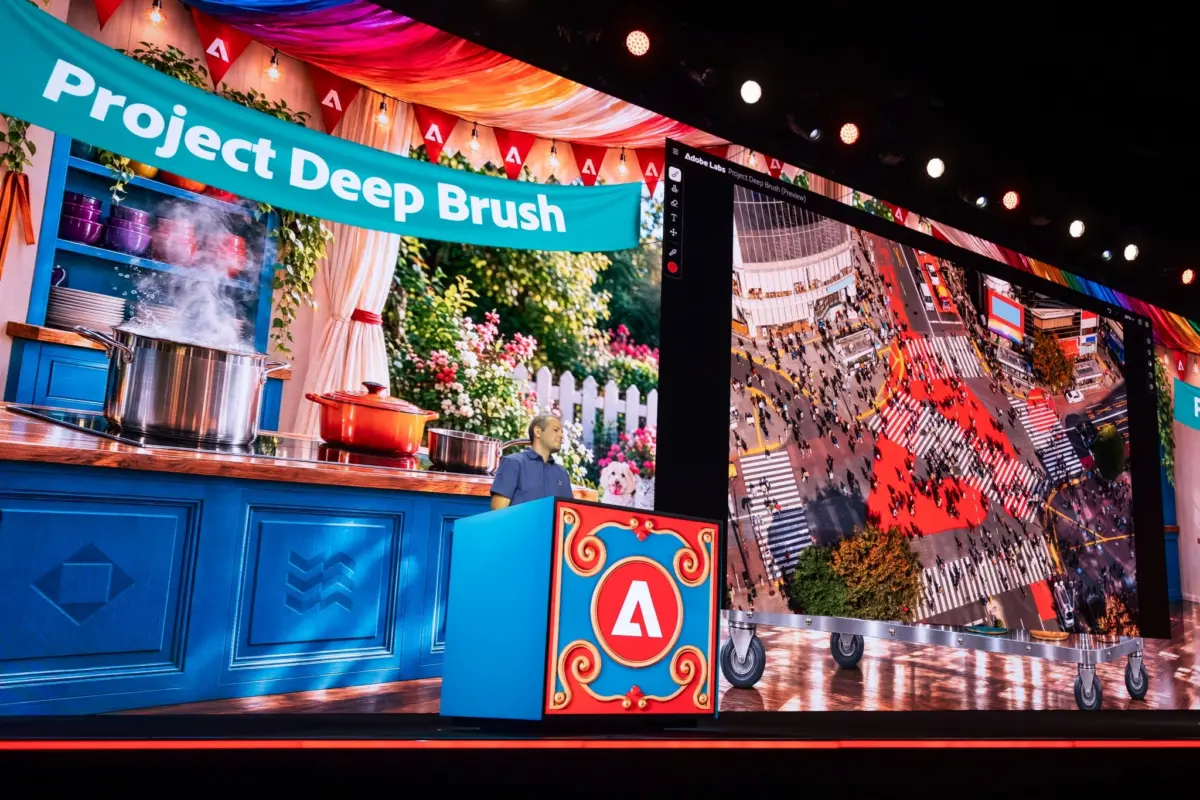
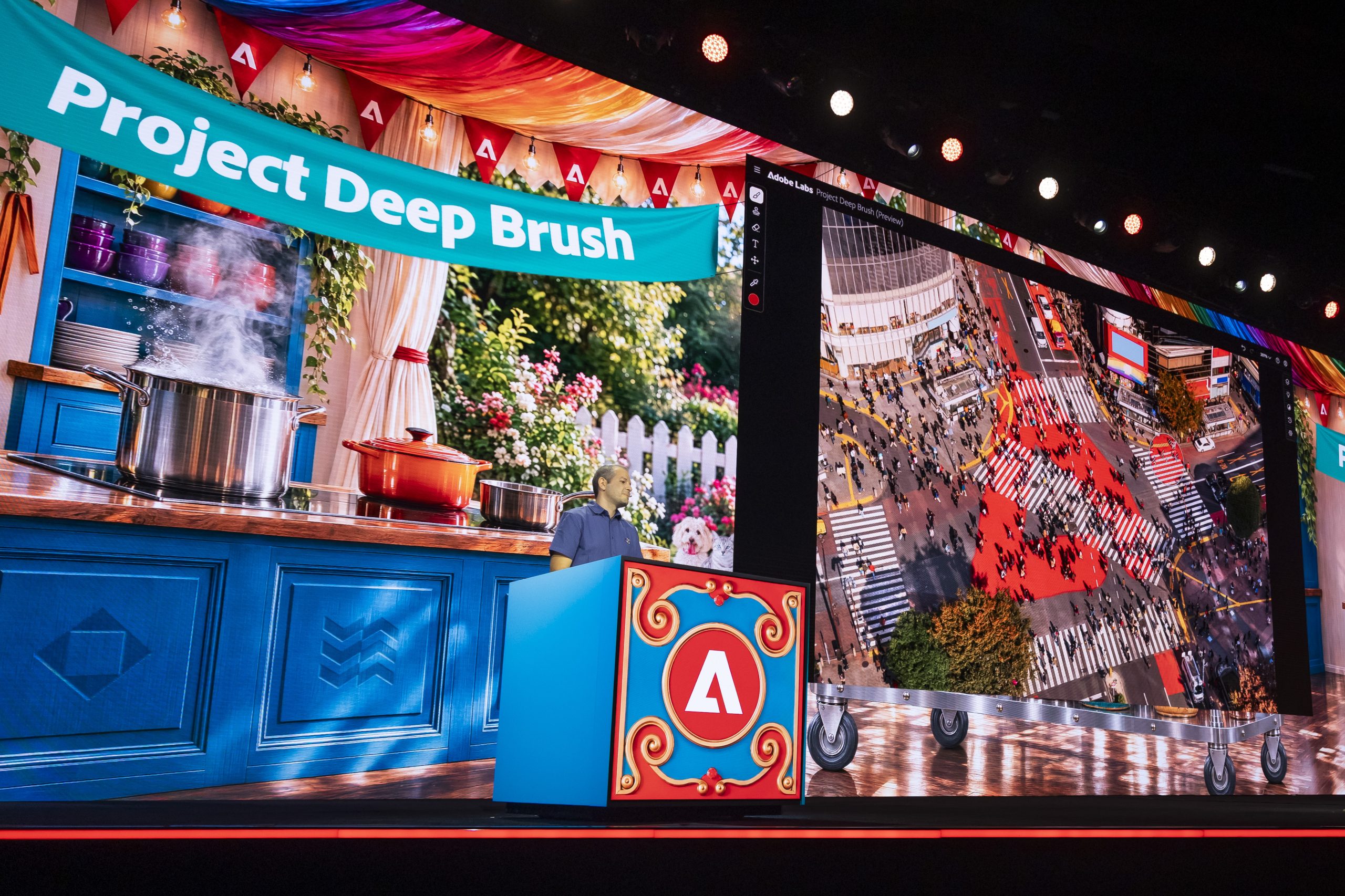
Iliyan Georgiev, leader of Project Deep Brush, demonstrated the limitations of conventional digital tools by opening a parkour action shot inside Photoshop. Explaining that a regular digital brush only perceives flat pixels and fundamentally lacks an understanding of physical structures, Georgiev introduced a tool that perceives underlying scene geometry, intrinsic color, and environmental lighting.
By separating a surface’s native hue from the shadows and highlights falling across it—a concept Adobe terms "physically decomposed layers"—Deep Brush allows creators to paint directly onto a concrete wall while preserving its original shading, smart masks, and curved forms. Georgiev even tested the software by digitally inking a tattoo onto a photograph of his own arm, noting it as a painless alternative for someone who intensely dislikes needles. He concluded by demonstrating that the tool can paint not only color but light itself, washing a realistic ambient glow directly across the new digital ink.
The evening’s final presentation introduced Project Hands On, designed to eliminate the friction of text prompting. Co-host Kelsey Slay framed the tool by asking the audience if they had ever struggled to find the exact words to describe a visual concept. Led by Adobe researcher Celso Gomes, Hands On automatically identifies discrete objects within a photograph, proposes suitable geometric properties for each, and overlays draggable control points directly onto the image. This allows a user to pull a shape into a diamond, lengthen a piece of furniture, or reposition a model’s arm purely through direct manipulation rather than typing text prompts.
Gomes demonstrated the system by stacking multiple edits onto a photo of his cousin, effortlessly filling a beer glass, enlarging a burger, and turning a head using a rapid three-dimensional mesh in a single pass. Adobe traces the underlying mechanics of Hands On to a property-suggestion feature currently integrated into Firefly’s Edit Object tool, signaling a broader industry shift toward more intuitive, graphical interfaces.
From Laboratory Experiments to Public Hands-On Access
Many past Sneaks have successfully transitioned into shipping commercial software. Slay pointed to Relight, a feature that adds and adjusts digital light sources, which debuted as a Sneak at the previous year’s conference. Following an enthusiastic public reception, Relight was integrated directly into Photoshop, becoming generally available just ahead of the conference. However, creators are continually reminded that not every experimental prototype is guaranteed to become a commercial product, with public enthusiasm acting as a primary filter for graduation.
This year, Adobe took the unprecedented step of opening two Sneaks to public testing on the very night they debuted, allowing users to experiment directly with Deep Brush and Hands On through Adobe Labs. Sight Span currently remains limited to an email notification sign-up, reflecting the experimental and evolving nature of these technologies.
Reflecting on the broader implications of these advancements, fashion photographer Lindsay Adler, a member of the Adobe Creative Collective advisory group, observed that clean, bold, graphic lighting and saturated color palettes are precisely the elements most easily targeted by generative AI. Yet, she noted that her commercial commissions derive their ultimate value from human craftsmanship, asserting that for a campaign built around the intricate artistry of a professional makeup artist, the reality of the human touch remains essential.
As synthetic image generation grows increasingly accessible and visually convincing, evidence of deliberate human imperfection—a blended eyelid, a chosen split-second moment, or a physical brushstroke—threatens to become an increasingly scarce and valuable currency. At the same time, demonstrations like Hu’s virtual exploration of The Milkmaid illustrate the coin’s other side: software capable of generating a convincing perspective that a master painter never actually produced, leaving behind a compelling artistic vision that lacks only the original artist.