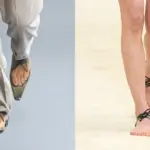




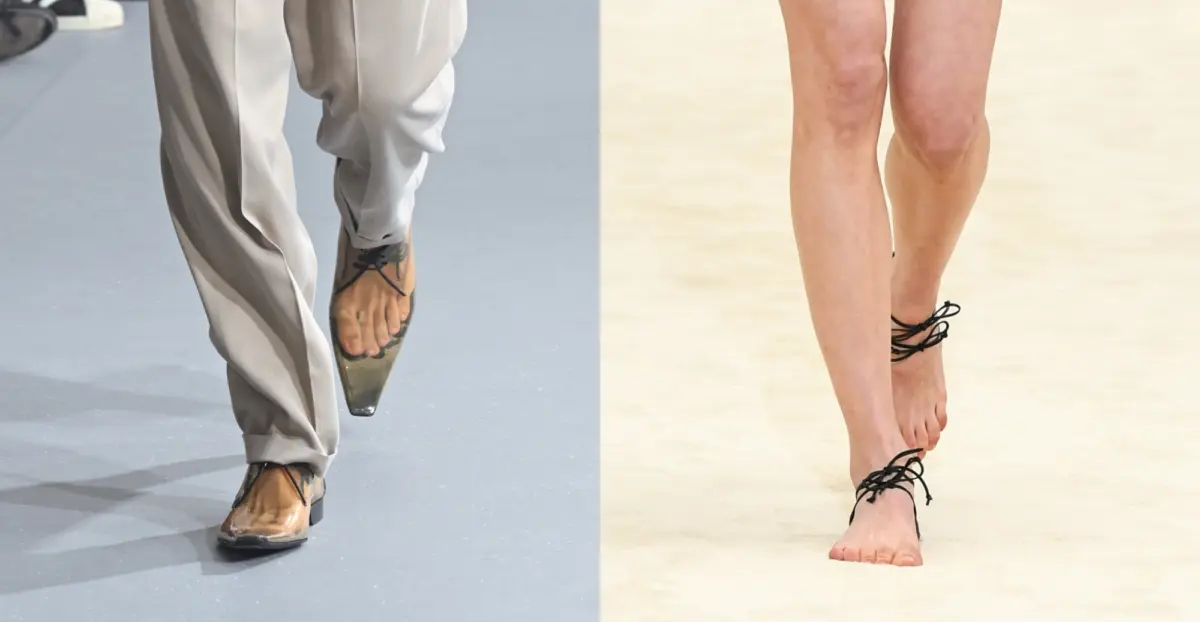
Have freaky shoes officially gone mainstream? Looking at recent fashion runways and star-studded red carpets, where the controversial barefoot shoe trend is visibly on the rise alongside a wave of other nontraditional styles, one might certainly think so. The fashion industry has fully embraced the bizarre, the experimental, and the outright unconventional. Yet, step onto the bustling streets of New York City, and the average pedestrian might look at you blankly when you mention the phrase that has recently taken over the global fashion conversation.
Fashion writer and analyst Mandy Lee, widely known on social media as @oldloserinbrooklyn, is credited with coining the term “freaky shoes,” a concept that went viral and took off on TikTok. Her widely viewed videos showcasing an eclectic personal collection of unusual footwear—ranging from 1990s-era Vivienne Westwood animal paw boots to Marni loafers accented with hoop piercings—inspired countless followers and fellow creators to follow suit, either by styling their own statement pieces or hunting down rare, strange shoes of their own.
If the trend seemed remarkably popular last fall, this year feels even more intense, with a larger number of major design houses and fashion editors jumping firmly onto the freaky shoe bandwagon. But what do everyday pedestrians and real-world consumers think? Footwear News took to the streets to conduct some on-the-ground research, gauging public opinion on the broader trend as well as the buzziest unconventional shoe styles emerging from top luxury brands. While not every person interviewed was familiar with the exact phrase “freaky shoes,” many immediately recognized the controversial Chanel heel-cap cruise shoe, an item that completely dominated internet discourse due to its extreme interpretation of the barely-there footwear aesthetic.

Alice, a 28-year-old from London who was spotted wearing studded Gimaguas ballet flats during her time in the city, offered a candid critique of the Chanel runway shoes. “These are crazy,” she said. “I would not wear these myself because I also live in a city and I dread the consequences of wearing those shoes.”
Conversely, Jonathan Fodi, a 28-year-old resident of the East Village wearing casual Adidas slides, was entirely on board with the divisive Chanel design. “I would wear those, those are sick,” he noted. “As you can tell, I’m trying to be as barefoot as I possibly can right now.”
Nikolay, a 25-year-old from Bulgaria who typically opts for comfortable Nikes when he is out and about, shared a more skeptical view of both the Chanel style and the broader, highly divisive concept of overtly exposed feet. “I don’t mind feet outside, but I don’t think that’s a shoe or anything,” he remarked, noting the immense luxury price tag likely attached to such a design.

Despite the hesitation from some, the Chanel shoe successfully found another enthusiastic fan downtown.
“I actually kind of love it,” said 18-year-old Fia Iris from Los Angeles, who was wearing Marc Jacobs fall 2024 animal print flats at the time. “For spring [and] summer, it’s super fun. I would totally wear that, I don’t know [about] out on Washington Square, but on the beach, I’d love it.”
Addressing the wider, polarizing trend of footwear that intentionally exposes the wearer’s bare feet, the Californian added, “It’s kind of chic. I feel like flip-flops have really come back this summer and I’m super into that. The clear shoe is super fun. Honestly guys, bring the primal way back. Bring the feet back.”

Meanwhile, Saint Laurent’s spring clear dress shoe for men—which actor Alexander Skarsgård notably wore on a prominent red carpet—proved to be just as divisive among everyday consumers. Fodi, the East Village resident, did not completely approve of the Saint Laurent execution. “It kind of looks like a plastic bag on your shoe,” he observed. “But I like the shape and I like the laces. Maybe if they were covered I would wear them.”
Nikolay from Bulgaria admitted he would “probably not” wear the Saint Laurent shoes himself, though he conceded, “But they’re cool, I like them.”
For Londoner Alice, the Saint Laurent design was “a hard no,” though she expressed admiration for the actor wearing them. “To be fair, I do love [the outfits] he wears, but that is a lot.”

On the other side of the spectrum, 34-year-old JB from Oakland, California, emerged as an avid fan of the Saint Laurent creation. “I really like those actually,” JB said. “Those I would consider wearing.”
It is safe to say that two of the runway’s most controversial and talked-about styles proved just as divisive on the unpredictable sidewalks of New York City as they were online. While it may take considerably more time for the general public to fully embrace the absolute freakiest end of the footwear spectrum, it is clear that the needle has decisively shifted. When asked about the weirdest shoes they personally owned, interviewees pointed to an array of eccentric items, including sporty lace-up pumps, original Russian bath mesh flip-flops, classic Birkenstock clogs, footwear from The Art Company, and distinctive Tabi mary janes.
Reflecting on the surging popularity and cultural resonance of this unusual footwear movement, “freaky shoes” pioneer Mandy Lee shared her perspective on why designers are pushing boundaries so aggressively. “I think fashion causing shock and awe is more or less a thing of the past,” Lee noted. “The bar for what disturbs and moves us as humans has been raised so high that brands don’t really have a choice other than experimentation to stand out.”