





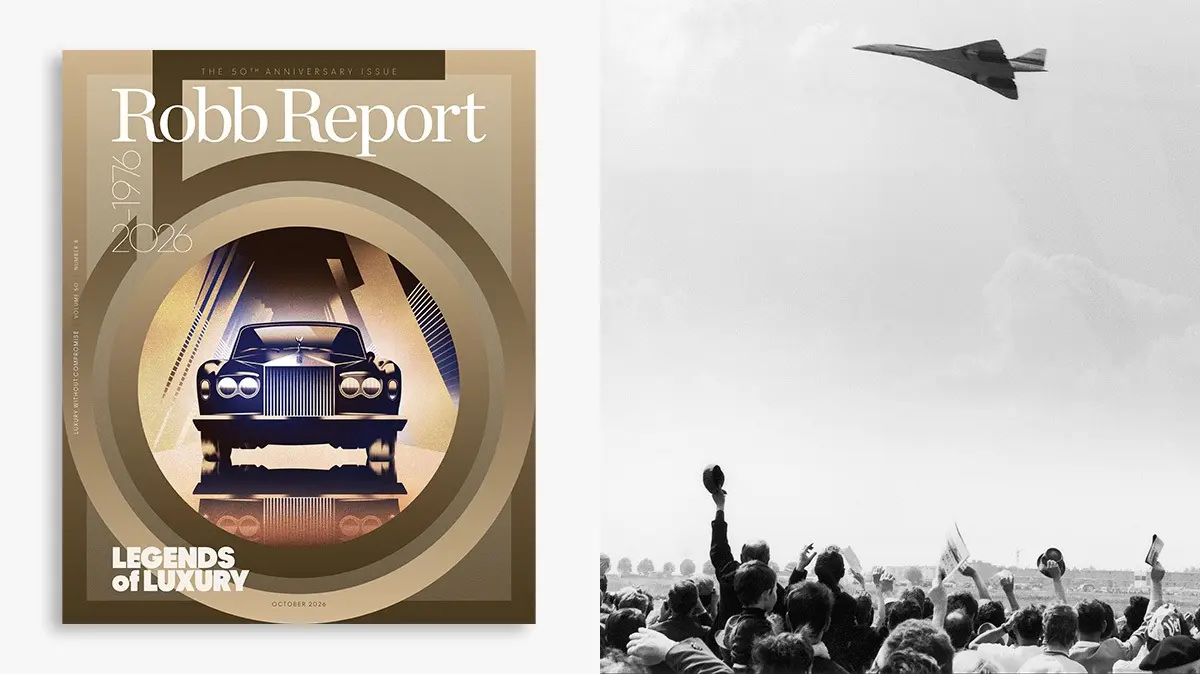
On January 21, 1976—the very year Robb Report was founded—the Concorde began flying commercial passengers across the Atlantic at twice the speed of sound, cutting travel times down to roughly three and a half hours. While it is tempting to attribute this timing to grand cosmic design, it stands as a fitting coincidence. Just as the supersonic jet was suddenly shrinking the globe, a new publication emerged to chronicle an era defined by daring feats of engineering, innovation, and high-end lifestyle pursuits.
Half a century later, Robb Report marks its 50th-anniversary issue. Any media outlet that remains a vital cultural fixture after five decades has certainly earned the right to indulge in a bit of retrospection. When the editorial team began assembling "Legends of Luxury," the commemorative feature at the heart of this milestone issue, the objective was initially straightforward: create a sprawling retrospective filled with nostalgia and fond memories. However, sifting through five decades of history revealed something far more compelling. The 74 distinct objects, influential figures, iconic places, and transformative experiences selected for the feature did not merely represent the pinnacle of their respective times; they served as undeniable precursors to the modern world, predicting how society would eventually communicate, dress, travel, dine, and seek out new thrills.
The Evolution of Status: From Rare Novelties to Everyday Essentials
Consider, for instance, the Motorola DynaTAC 8000X. When the world’s first commercial handheld cellular phone debuted in 1984, it came with a staggering price tag of just under $4,000—equivalent to roughly $12,000 today—and weighed nearly two pounds. Owning one was an extraordinary status symbol, a privilege reserved for the financial elite and ambitious trailblazers who made certain everyone around them saw them using the heavy device. Immortalized on the silver screen by fictional corporate raider Gordon Gekko, the device affectionately known as "The Brick" paved the way for a hyper-connected society. Today, its sleek smartphone descendants have surpassed televisions in global ubiquity, transforming what was once an exclusive luxury into an absolute modern necessity.

Yet, structural innovation does not always rely on microchips, software, or telecommunications infrastructure. In the late 1970s, legendary Italian designer Giorgio Armani executed a quiet revolution in menswear by stripping the heavy internal structure away from the traditional business suit. By softening the shoulders and loosening the trousers, Armani created a silhouette that was simultaneously louche and deeply sophisticated—a radical departure from convention that Hollywood quickly embraced for its most impeccably dressed characters. At the time, the deconstructed suit felt avant-garde and transgressive. Today, that relaxed elegance is simply foundational to the modern man’s wardrobe, demonstrating how high fashion frequently transitions from elite rebellion to mainstream standard.
Other visionary concepts disrupted their respective fields more dramatically, sometimes flaming out after permanently altering the landscape. At El Bulli, the temple of avant-garde cuisine on the Costa Brava of Spain, chef Ferran Adrià utilized modernist science to completely upend diners’ expectations of what a meal could physically and sensorially be. Though subsequent bad imitations eventually reduced the broader movement of molecular gastronomy to a pop-culture punch line centered on fleeting foams, mysterious fogs, and controversial culinary additives, the core philosophy endured. The finest elements of Adrià’s culinary experiments permanently influenced an entire generation of elite chefs, changing the trajectory of global fine dining.
Redefining Exploration and Mobility
The changing definition of luxury is equally visible on the water and the open road. When Octopus—all 414 feet of her—was delivered in 2003, the mega-yacht commissioned by the late Microsoft co-founder Paul Allen and built by Lurssen redefined maritime architecture. By pairing traditional super-yacht luxury with the rugged capabilities of a serious oceanographic expedition ship, the vessel proved that ultimate wealth could be directed toward genuine discovery. It could navigate remote, icy waters just as easily as it could anchor off a sun-drenched coast for leisure. That seamless blend of opulence and exploration proved prophetic; today, explorer yachts are a staple offering across nearly every major shipyard’s global lineup.

Looking back across fifty years of publishing, it would be easy to claim absolute foresight regarding which innovations would conquer the market and which would fade into obscurity. In reality, predicting the future is remarkably easy only in hindsight. The editorial staff at Robb Report knows this firsthand, having once confidently declared the internal-combustion engine entirely dead—only to watch it stubbornly persist as a beloved cornerstone of automotive engineering. Conversely, other supposedly inevitable cultural shifts vanished almost as quickly as they materialized. The fleeting craze surrounding Bored Ape Yacht Club non-fungible tokens serves as a humbling reminder that the future frequently outsmarts even the most astute observers.
Looking Ahead to the Next Half-Century
As the magazine looks toward the horizon, the cycle of innovation continues unabated. It is entirely possible that one of the extravagant objects, technologies, or experiences highlighted in the pages of this anniversary issue will, in twenty years, become as commonplace as the handheld smartphone is today. Alternatively, another might vanish entirely, leaving behind a singular, transformative idea that outlives the physical product itself. While no one can definitively predict which luxuries will endure and which will fade into historical footnotes, fifty years of observation have provided one enduring certainty.
Every so often, the future reveals itself for the very first time disguised as an exclusive luxury. And as Robb Report enters its next half-century, the publication remains as endlessly curious as ever to discover what the future brings next.