





Now in their third year, the IEEE TryEngineering educator sessions continue to empower preuniversity teachers with specialized professional development programs focused on advanced engineering topics and classroom-tested lessons. Administered by IEEE Educational Activities, the initiative aims to bridge the gap between complex modern technologies and foundational classroom education by providing teachers with the tools, resources, and confidence they need to inspire the next generation of engineers, scientists, and innovators.
This year’s sessions, held across the United States, have focused heavily on educating teachers about artificial intelligence and semiconductor technology, alongside broader engineering principles. While the bulk of the programming has taken place on university campuses across America, the initiative has also maintained a strong international presence, highlighted by a successful session held in Egypt. In all, 54 dedicated educators have directly benefited from the program this year, diving deep into the engineering design process and discovering new ways to bring cutting-edge concepts into their preuniversity classrooms.
Participants received a comprehensive overview of TryEngineering resources, including specialized curricula such as the "Making of a Microchip" and "Train Your Tree" lesson plans. These materials are specifically designed to demystify advanced technical concepts, transforming abstract industrial processes and computational logic into engaging, hands-on classroom activities. Following the success of the current year’s schedule, additional workshops are already planned for later this year in Greece and Guatemala, signaling continued growth for the global outreach effort.
A network of host universities
Central to the educator session program’s ongoing success is its robust network of host universities. Major research institutions and campuses welcome teachers into their specialized facilities, allowing educators to experience advanced environments firsthand. During these visits, university faculty provide essential background information about the technologies being taught, while also outlining potential engineering career paths and emerging job opportunities that teachers can relay back to their students.
This year’s sessions actively involved educators in hands-on projects designed to simulate real-world problem-solving. Facilitators at each location were carefully selected based on their extensive experience in engineering education, working closely with the TryEngineering staff to tailor presentations to the specific needs of preuniversity teachers.
In Cairo, Egypt, a session was hosted at GEMS International School, drawing 16 teachers from nine different schools. The event was facilitated by Marwa Soudi, an IEEE member, and Senior Member Stamatis Dragoumanos, both of whom are past chairs of the IEEE preuniversity coordinating committee. According to the facilitators, GEMS provided outstanding STEM facilities that allowed participants to fully immerse themselves in the curriculum. During the session, teachers received a thorough overview of the "Working With Wind Energy" and "Tall Tower Challenge" lesson plans, equipping them with fresh ideas for renewable energy and structural engineering modules. Additional educator sessions are scheduled to take place in the region later this year.
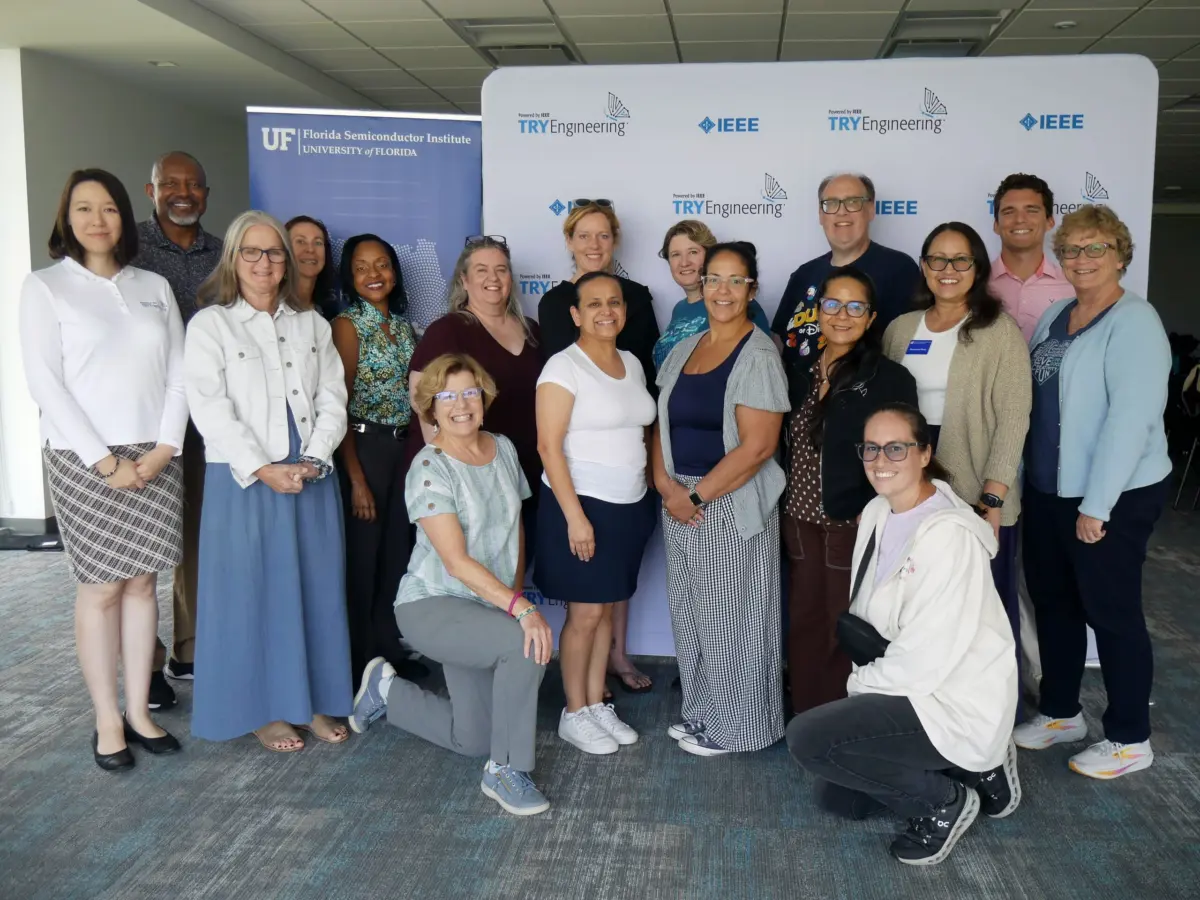
In the United States, the University of Florida served as a major hub, gathering educators from across the state at the university’s Florida Semiconductor Institute, headquartered in Gainesville, and FSI’s NeoCity high-tech manufacturing campus near Orlando. The two-day experience was hosted by Roseanne Perez, an FSI workforce development program specialist, and Sophia Watson, FSI’s assistant director of workforce development. The immersive program offered an exclusive inside look at microelectronics through a guided tour of a SkyWater Technology chip manufacturing facility.
Engineering instructor Mary Acken facilitated hands-on lesson demonstrations for the 15 attending teachers, bridging industrial applications with classroom pedagogy. Reflecting on the workshop’s profound impact, one participant noted that the SkyWater tour was excellent, the instructors were exceptionally knowledgeable, and the teachers thoroughly enjoyed the rare opportunity to collaborate and learn alongside like-minded educators.
Meanwhile, Arizona State University welcomed 11 Arizona teachers to its Tempe campus. The welcoming remarks were delivered by Michael Kozicki, an IEEE member, and Stefan Myhajlenko, both from the university’s engineering school. The session itself was expertly facilitated by Janet Hartkopf, an Arizona school leader and a former TryEngineering educator session participant herself. Hartkopf emphasized the vital importance of collaborative learning, the necessity of bringing diverse perspectives into engineering education, and the myriad career paths available in the tech sector.

The participating teachers received detailed instruction on how to seamlessly implement hands-on lessons within their own classrooms. As part of the campus experience, they toured the university’s NanoFab facility to observe active microelectronics research in real time.
The enthusiasm among the participants was palpable. "This training was amazing!" said one participant who leads an elementary after-school STEM club. "I loved the hands-on lessons and e-books, which I will definitely be using with my students. I am excited to explore all the resources on the TryEngineering website. The experts from ASU were great."
Further north, the University of Minnesota hosted 16 STEM educators at the institution’s International Institute for Biosensing in Minneapolis. Patricia Khashayar, an IEEE member and director of the institute, introduced the participants to the advanced capabilities of the university’s Supercomputing Institute and Nano Center.
Under the expert guidance of Claire Dietz, an education and outreach coordinator, and Pam Schumacher, an instructor at St. Paul College, the teachers completed classroom-ready lessons. This included a specialized photonics experiment utilizing the sophisticated equipment housed within the Nano Center. Schumacher’s presence as an instructor was a testament to the program’s continuity, having attended last year’s TryEngineering educator session as a participant.
Sarah Swisher, director of the Nano Center and an IEEE senior member, provided participants with an authoritative overview of semiconductor operations. She also highlighted the rapidly growing job opportunities awaiting the state’s young people in the high-tech sector. The inspiring experience moved all 16 participating teachers to begin planning student field trips to the Nano Center for the upcoming academic year.
"Great class!" one participant remarked. "I’m excited to bring some of the TryEngineering materials back to our school."
This year’s robust slate of sessions built directly upon the momentum generated last year. With essential financial support from Onsemi’s Giving Now program, nearly 80 teachers attended sessions across five U.S. states and Mexico during the previous cycle. Driven by the resounding success of those initial programs and the escalating global demand for high-quality teacher training, the IEEE Educational Activities Board has continued its strong backing. Upcoming international sessions are expected to significantly expand the program’s global footprint, reaching new educators and students around the world.
Reflecting the sentiment shared across all host sites, one teacher noted, "I appreciated the time to collaborate with peers on how to implement hands-on lessons." Many participants expressed intentions to maintain professional relationships with the academic experts they met, planning follow-up classroom visits and future campus tours.
Those interested in learning more about the TryEngineering educator sessions can contact the program directly by emailing [email protected].