




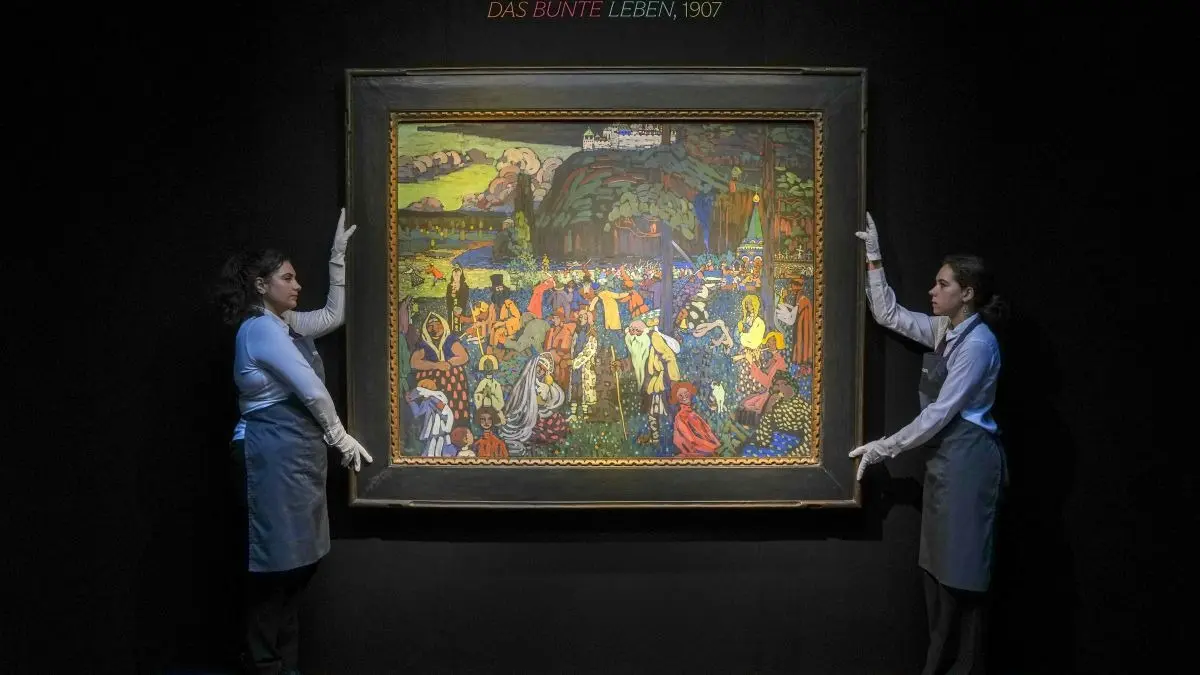
A masterpiece by Russian avant-garde artist Wassily Kandinsky, which was forcibly seized from a prominent Jewish family in Amsterdam during the Second World War, has been sold at Christie’s auction house in London for £27 million, equivalent to approximately €32 million. The high-profile sale marks another major chapter in the ongoing and complex recovery of Nazi-looted art, shedding light on the wartime displacement of invaluable cultural artifacts and the decades-long efforts of heirs to reclaim their rightful heritage.
The painting at the center of the recent auction is Das bunte Leben—translated as The Colourful Life—a vibrant and historically significant work that Kandinsky painted in Paris in 1907. Long before its turbulent journey through the hands of the Nazi regime and subsequent decades of museum display, the painting was acquired by Emanuel and Hedwig Lewenstein. The couple were prominent figures in Amsterdam’s business and cultural community, running a successful sewing machine factory situated on the central Dam square. Alongside their commercial success, the Lewensteins were passionate and discerning art collectors, assembling an impressive collection that featured works by celebrated masters such as Jan Toorop, Jozef Israëls, and Jean Metzinger.
The peaceful enjoyment of their collection was shattered following the German occupation of the Netherlands in the early 1940s. Under the shadow of brutal Nazi persecution, the Lewenstein family’s assets were targeted, and Das bunte Leben was auctioned off shortly after the occupation began. Historical records trace the painting’s immediate wartime path to Sal Slijper, a Jewish collector who purchased the work during the chaotic and coercive conditions of the period. Slijper’s family later parted with the painting, transferring ownership to the Bayerische Landesbank. Following this corporate acquisition, the bank placed the Kandinsky on permanent loan to the Lenbachhaus museum in Munich, where the vivid canvas hung on public display for decades, largely detached from the tragic circumstances of its displacement.
The true history of how the painting left the Lewenstein family remained obscured for many years until extensive provenance research brought the disturbing facts to light. Investigations revealed that in 1940, an employee of an Amsterdam museum, acting on behalf of an unidentified individual, had the valuable artwork transported by courier to the auction house where it was sold off. Researchers examining the paper trail concluded that there were numerous, undeniable indications that the painting had been unlawfully seized under the auspices of the Nazi occupation regime, fulfilling the criteria for forced displacement and persecution-induced loss.
The turning point for the painting’s modern restitution arrived in 2023. Following a thorough review, the German public prosecution department officially classified Das bunte Leben as looted art. Prompted by this legal and historical determination, the bank holding the painting returned the masterpiece to the rightful heirs of Emanuel and Hedwig Lewenstein, rectifying a historical injustice that had spanned more than eighty years. The successful restitution paved the way for the recent high-stakes auction at Christie’s in London, where international collectors competed for the canvas before it ultimately fetched the multi-million-pound sum.
The landmark sale of Das bunte Leben is part of a broader, ongoing reckoning regarding lost art from the Lewenstein estate. The same year the family secured the return of the 1907 masterpiece, the heirs successfully sold another significant Kandinsky work, titled Bild mit Häusern, for a staggering sum exceeding €60 million. That particular transaction followed a protracted and arduous legal battle with municipal authorities in the Netherlands. Amsterdam city council ultimately agreed to return Bild mit Häusern after a years-long dispute, bringing to an end a contentious chapter during which the painting had hung prominently in the Stedelijk Museum until February 2022.
The recovery and subsequent multi-million-euro sales of these two Kandinsky masterpieces underscore the enduring legal and moral complexities surrounding Nazi-looted art. As provenance research continues to uncover hidden histories across European museums and private collections, cases like that of the Lewenstein family demonstrate both the slow wheels of international justice and the lasting impact of wartime plunder on cultural heritage.