





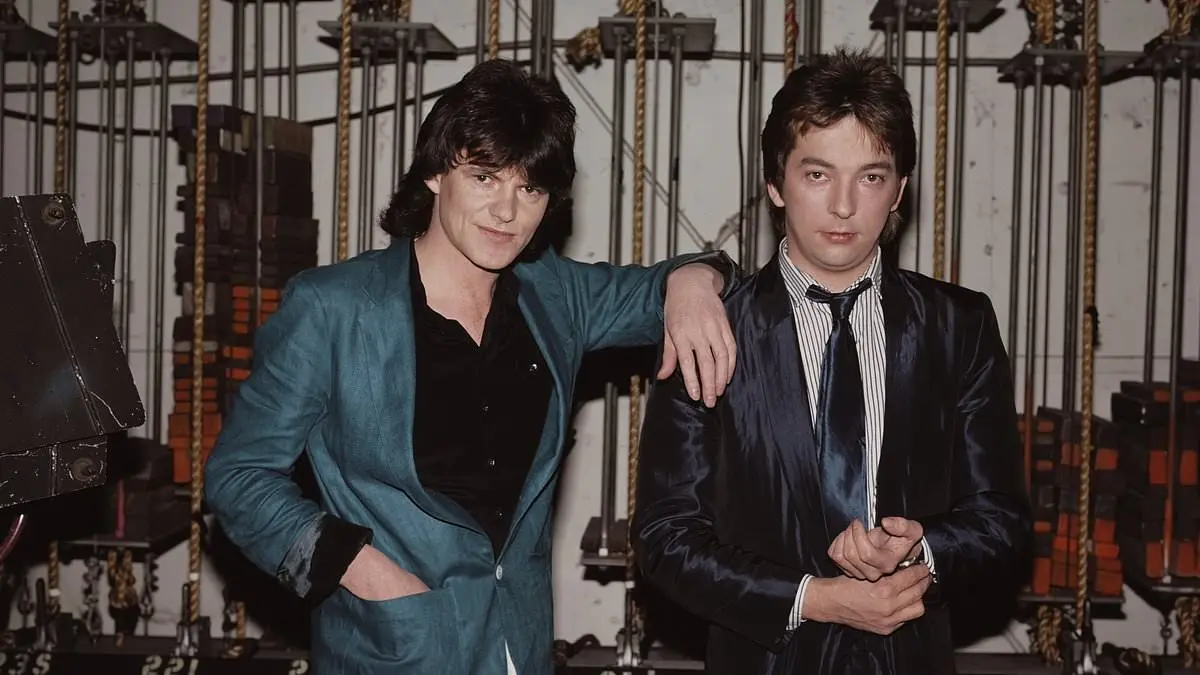
The musician’s death was officially announced on the band’s website, which shared that Byrne died peacefully on September 14 following a brief illness. Over the course of a career that spanned several decades, Byrne left an indelible mark on the international music scene, transitioning from the foundational years of the late-1970s British post-punk and New Wave movements into a lasting legacy as a beloved recording artist and collaborator.
Although Byrne became the most visible face and voice of Naked Eyes, his journey into the upper echelons of pop music charts was built on a foundation of lifelong friendships and creative partnerships. Hailing from Bath, England, Byrne and his late co-founder and keyboardist, Rob Fisher, were university friends before they began performing together professionally.
Before they formed Naked Eyes in 1982, Byrne and Fisher were integral members of an earlier band named Neon, playing alongside two other future titans of 1980s New Wave: Curt Smith and Roland Orzabal. That initial collaboration, which lasted from 1979 to 1982, directly connected Byrne to the creative core of Tears for Fears, establishing deep roots within the era’s vibrant musical ecosystem.
When Byrne and Fisher struck out on their own to form Naked Eyes, their creative vision immediately captured the public imagination. The newly minted British New Wave outfit was active for a relatively brief initial window, forming in 1982 and ultimately disbanding just two years later in 1984 after releasing two studio albums. Yet, despite the brevity of this initial run, the group managed to carve out a permanent place in the soundtrack of the decade.
Their breakthrough moment arrived in January 1983 with the release of a synth-pop cover of Burt Bacharach and Hal David’s classic composition, "(There’s) Always Something There to Remind Me." By filtering the timeless songwriting through a thoroughly modern, synthesizer-driven sensibility, Byrne and Fisher turned the track into a major international success, securing a spot in the top 10 of the music charts.
Building on that explosive debut, Naked Eyes quickly established themselves as radio staples. The duo went on to record three more top-40 hits that defined the mid-1980s airwaves: "Promises, Promises," "When the Lights Go Out," and "(What) In the Name of Love."
Following the massive success of their introductory singles, the band released their debut album, Burning Bridges, in March 1983 to a receptive audience. However, the pressures of the fast-paced music industry soon caught up with the duo as they prepared their sophomore follow-up.
In September 1984, Naked Eyes released their second LP, Fuel for the Fire. Despite containing the US hit "(What) In the Name of Love," which managed to break into the Billboard Hot 100 at number 39, the album ultimately failed to live up to the commercial heights of its predecessor. The record struggled to generate significant momentum and failed to chart altogether in the United Kingdom.
Shortly after the disappointing release and commercial underperformance of their second album, Byrne and Fisher made the joint decision to disband Naked Eyes and pursue separate creative paths. Ironically, despite generating multiple massive radio hits and building a dedicated following across the globe, fans never had the opportunity to experience the band on a traditional concert tour. Byrne and Fisher were never able to successfully translate the complex, nuanced in-studio production style of their recordings with a functional road band before their initial partnership came to an end.
Adding to the historical significance of the group, Rob Fisher passed away in 1999 following complications from cancer surgery, cementing the duo’s early catalog as a poignant, finite snapshot of 1980s pop innovation.
Following the dissolution of Naked Eyes and years spent largely away from the intense glare of the public spotlight, Peter Byrne eventually returned to his musical roots. In 2001, he released a solo album titled The Real Illusion, signaling a renewed passion for songwriting and performance.
By 2006, Byrne officially revived the Naked Eyes moniker as a solo project, breathing new life into the classic repertoire. The following year, the reconstituted act released a third album titled Fumbling with the Covers, which featured Byrne delivering fresh renditions of various cover songs alongside beloved Naked Eyes classics.
Perhaps most notably for longtime fans, Byrne returned to the studio to record Disguise the Limit in 2021. The release marked the first album of completely new material under the Naked Eyes banner in an astonishing 37 years, proving that Byrne’s distinct vocal talents and melodic sensibilities had remained sharp across the decades.
Beyond his work with Naked Eyes and his solo ventures, Byrne established a quiet yet impressive resume as a sought-after collaborator and songwriter within the broader entertainment industry. In 1985, he lent his celebrated vocals to superstar Stevie Wonder, singing backing vocals on the iconic hit single "Part-Time Lover."
Demonstrating his versatility across different media landscapes, Byrne also achieved the unique distinction of writing a song for child stars Mary-Kate and Ashley Olsen, contributing the track "I Am the Cute One" to their 1993 project.
Peter Byrne is survived by his siblings—Eileen, Sandy, Carol, and Steve—as well as his children, Merlin, Dylan, and Chloe, and his ex-wife, Elena. In accordance with the family’s wishes following the announcement of his passing, a private memorial service is currently planned to celebrate his life and enduring musical legacy.