





Contemporary jewelry has long been associated with traditional notions of beauty, personal wealth, and social prestige. However, a new generation of makers is actively challenging these conventional boundaries, treating the body not as a pedestal for luxury, but as a site for psychological exploration and conceptual provocation. Among the vanguard of this radical movement is Marie-Caroline Locquet, whose provocative wearable sculptures have earned her recognition as a finalist for the prestigious Young Artist Award, supported by Karen and Michael Rotenberg.
The Young Artist Award, presented biennially by the Art Jewelry Forum (AJF), shines a spotlight on exceptional promise, innovation, and individuality in the work of emerging jewelry artists aged 35 or younger. By honoring boundary-pushing talents like Locquet, AJF aims to support exciting, forward-thinking practices that will inspire future developments within the global field of art jewelry. For Locquet, this recognition validates a grueling and uncompromising artistic trajectory that deliberately tests the limits of what adornment can be, say, and inflict.
Growing up in the north of France, Locquet developed an early and acute awareness of how clothing and adornment function as tools for social signaling, conformity, and camouflage. Rather than cultivating an aesthetic affinity for conventional finery, she approached jewelry as a subject of critical study. Her perspective shifted dramatically during her foundational art studies when she encountered the radical, unsettling works of pioneering artists such as Bernhard Schobinger and Dorothea Prühl.
Instead of offering comfort or visual pleasure, these artists presented objects that felt strange, uneasy, and inherently dangerous—bottlenecks and jagged forms that shattered traditional understandings of wearable art. Inspired by this fearless approach, Locquet began formulating the core question that would drive her entire career: Why make and wear jewelry that appears deeply disturbing at first glance, and what does it mean to create something deemed fundamentally "unwearable"?

This exploration of unwearability evolved into a rigorous conceptual practice. Locquet’s pieces abandon seduction and representation in favor of disturbance, violence, vulnerability, and confinement. Rather than functioning as shiny showcases of wealth and power, her works operate as physical confrontations within public and private spaces. She crafts intricate restraints and defensive weapons, transforming each creation into a unique wearing experience that forces both the wearer and the observer to confront our shared human fragility.
Her pieces maintain a tense, perpetual dialogue between social discomfort and the unsettling temptation of an embrace. By utilizing materials pushed to their absolute limits, Locquet bares their true nature through forms that simultaneously evoke deep desire and the shadow of death.
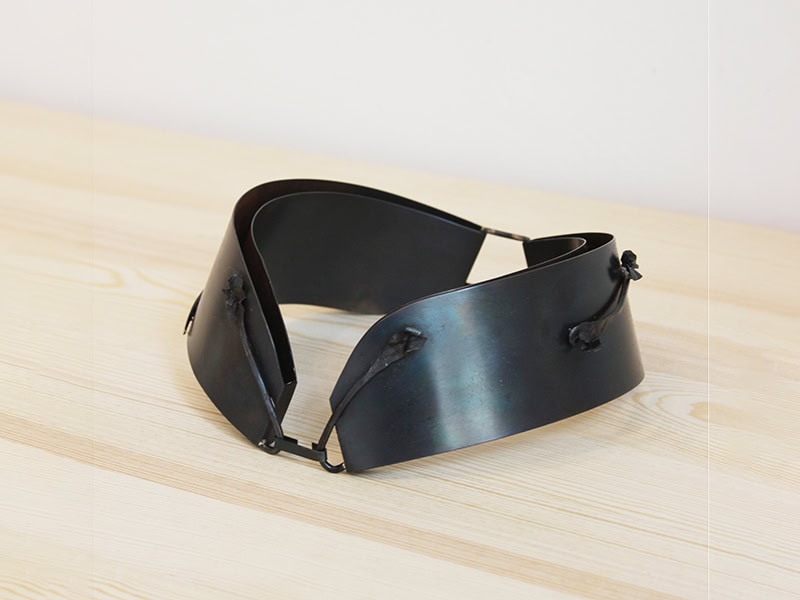
This thematic exploration draws deeply from historical and cultural artifacts of subjugation and labor. Locquet’s research has frequently engaged with historical objects such as the collier d’appartenance—a collar historically bestowed by an individual upon a submissive partner—and the "slave collar," rooted in 19th-century Norman and Auvergnat traditions as a marital token of possession. She has similarly examined animal labor implements, such as the heavy equine collar, translating their oppressive geometry into contemporary bodily constraints.
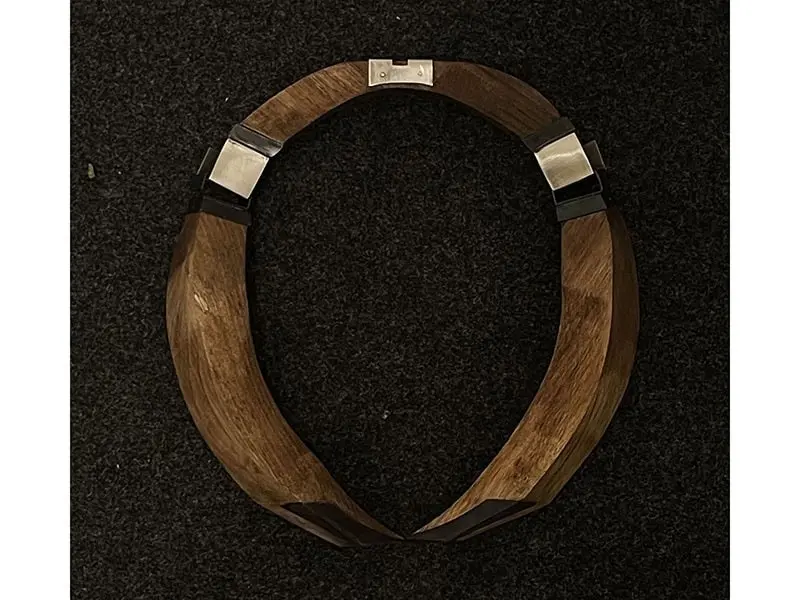
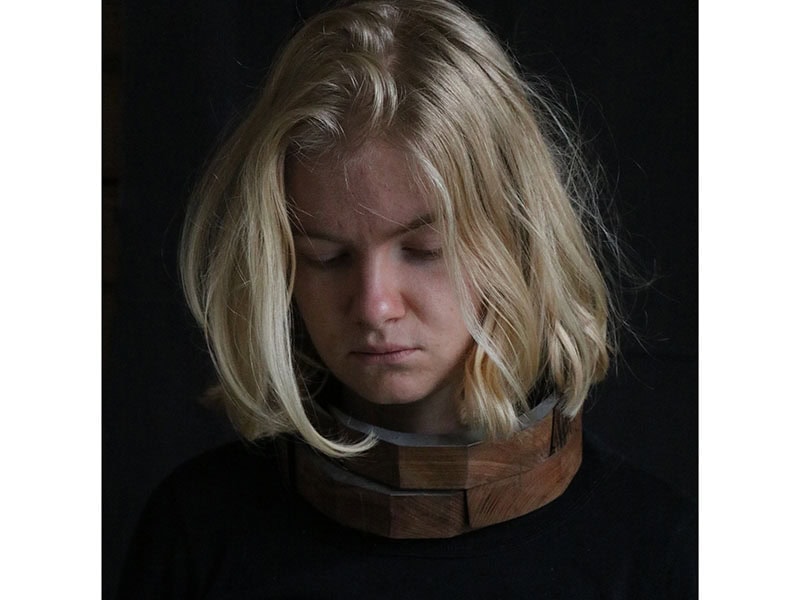
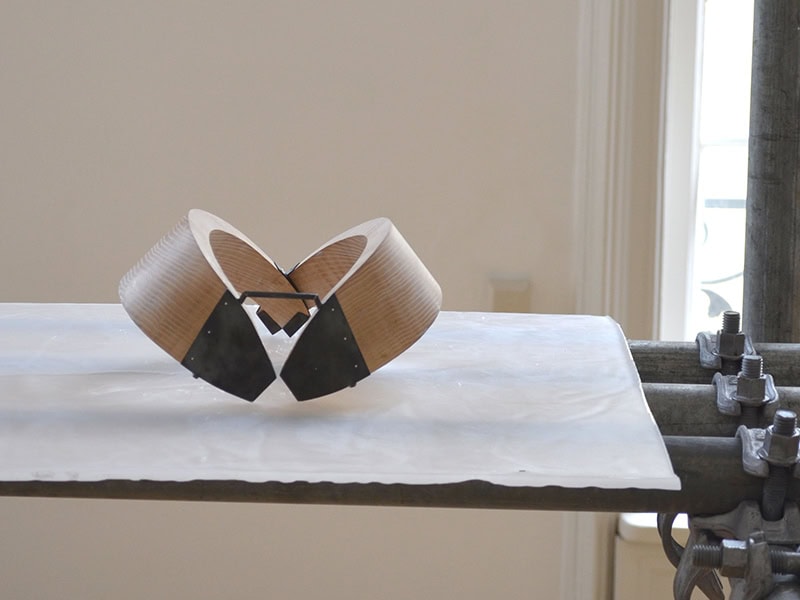
Her application for the AJF Young Artist Award heavily featured these conceptual concerns, highlighted brilliantly by her 2024 neckpiece, Hands. Constructed from elm wood, zinc-plated steel, and silver, Hands serves as a masterclass in Locquet’s obsessive research into mechanical systems, complex clasps, and the fluid border separating jewelry from independent sculpture. The piece dramatically unfolds and aggressively occupies surrounding space before curving inward to close around the neck with the chilling intimacy of an act of strangulation. It stands as perhaps her most complex and psychologically charged work, perfectly articulating themes of confinement and physical dominance.
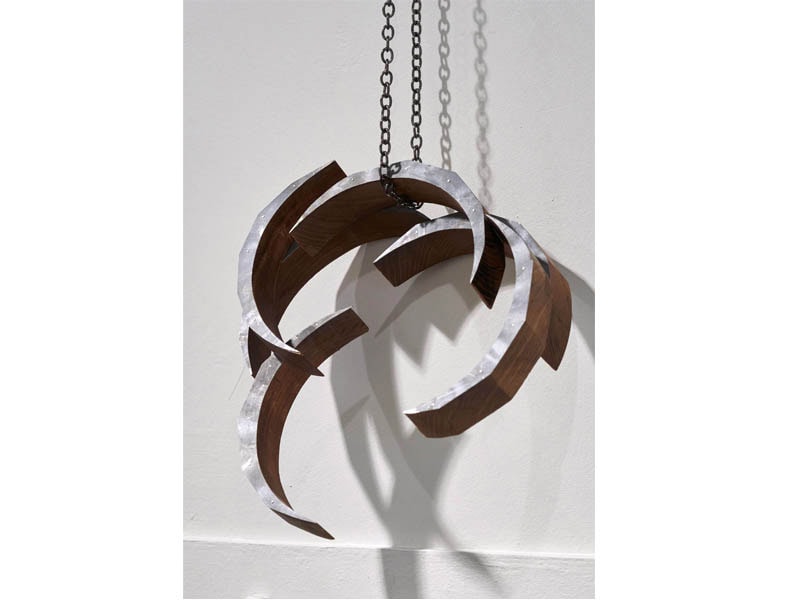
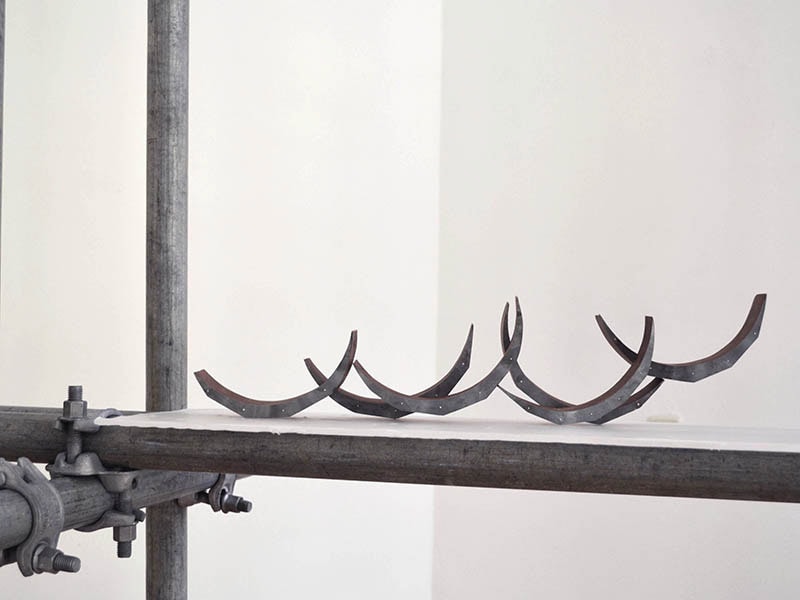
Locquet’s expanding portfolio also includes other striking creations, such as Armor I, a forged steel neckpiece produced during her artist-in-residence program at the Estonian Academy of Arts (EKA) in Tallinn, and Panicroom Vector I, a 2025 installation piece incorporating iron, elm wood, silver, and rubber, recently exhibited at Tallinn’s A-Galerii. Her work has similarly captivated international audiences through solo and group exhibitions, including her Importable/M.A.Y.A presentation at the Institut Français München during Munich Jewelry Week.
Beyond crafting individual objects, Locquet is fascinated by how body ornamentation constructs and reflects the broader image of society. She maintains an extensive iconographic collection and ongoing research project examining both wearable and unwearable items under the guiding premise that adornment is inherently impure, makeup often obscene, and disguise an abomination. Through this lens, she investigates how worn objects constantly oscillate between the deeply private realm of intimacy and the critical exposure of public space.
Despite the vibrant intellectual discourse surrounding contemporary art jewelry, Locquet remains acutely aware of the systemic challenges facing the medium. Reflecting on her student days, when she and her peers curated an exhibition titled Jewelry Is Still a Risky Business during Munich Jewelry Week—a nod to a seminal work by Paul Derrez—she firmly believes that the discipline must retain its capacity for risk.
She frequently encountered skepticism within French fine art academic circles, where jewelry was occasionally dismissed as superficial, niche, or lesser than other fine art mediums. While she views this outsider status as a profound strength that allows the medium to forge entirely new ways of looking and thinking, she acknowledges a lingering distance between the specialized art jewelry community and broader public audiences. This gap explains why some of her recent works incorporate more literal, narrative entry points, serving as conceptual keys that invite viewers into the deeper layers of her practice.
Being named a finalist for the Young Artist Award serves as a powerful confirmation that her uncompromising artistic path is resonating within the broader cultural landscape. Looking toward the future, Locquet intends to build upon the momentum of the past five years, expanding her spatial installations and continuing her rigorous material research. She also harbors a strong desire to enter academia, viewing teaching and artistic research as the ultimate environment to push the collective boundaries of body ornament and persistently question the evolving definition of jewelry.
As she looks ahead to upcoming exhibitions, international residencies, and collaborative projects, Locquet expresses profound gratitude to everyone who has supported her vision, trusting entirely in an artistic process that promises to keep challenging, provoking, and redefining the parameters of art jewelry for years to come.