






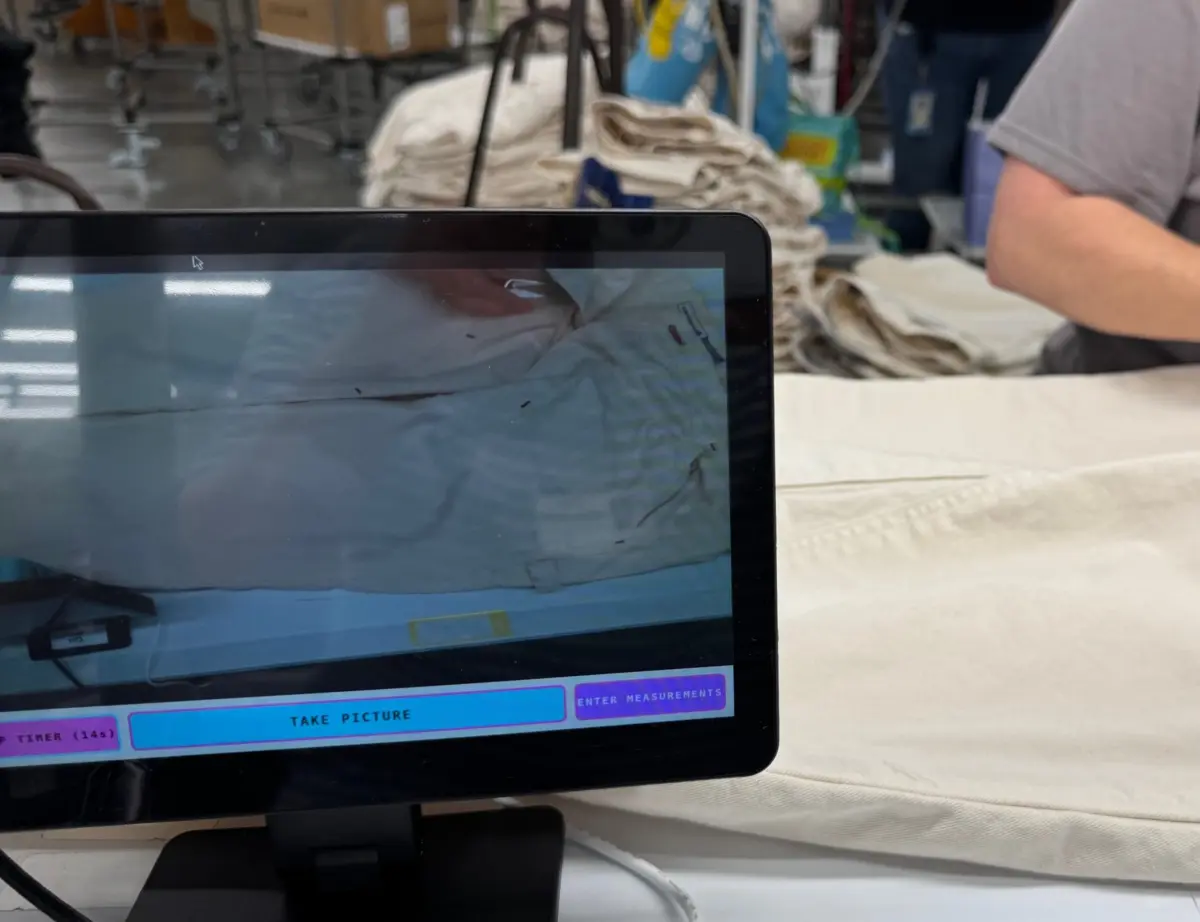
Kyle Valade, the founder of Rust Coast Manufacturing Technology, describes his venture as a next-generation manufacturing quality platform designed to save apparel companies millions of dollars by ensuring that correctly sized products are consistently shipped to markets around the globe. In an industry long plagued by manual, paper-and-pencil inspection processes and staggering e-commerce return rates, Rust Coast offers a turnkey solution that promises to reshape how brands monitor production quality right on the factory floor.
The company’s technology relies on cameras installed strategically across manufacturing facilities to capture high-resolution images of garments during production. These images are immediately processed through visual AI algorithms to automatically measure the clothing made by suppliers, comparing them in real-time against precise digital design specifications.
The resulting photos and operational data are then transmitted to a centralized application, where they undergo more intensive processing. This generates deep analytics and actionable alerts that flow directly into a brand’s dedicated portal. According to Valade, the overarching goal is to capture a visual and numerical record of every single piece of clothing throughout the entire manufacturing process. Because the cameras operate passively, they capture critical measurements without disrupting the daily workflows of the people working on the factory floor.
Bridging the Gaps in Traditional Garment Manufacturing
To understand the inspiration behind Rust Coast, one must examine the persistent gaps in traditional garment manufacturing quality control. Valade notes that the platform was built to automate quality inspections for garments, starting fundamentally with precise measurements. Before zeroing in on measurements, Valade originally founded the company around the broader concept of digitizing manual processes within the factory ecosystem. Despite the presence of highly advanced, digital machinery in modern production facilities, a surprising number of foundational processes still rely heavily on paper-and-pencil methods.
Valade’s journey into the sector began by analyzing the manufacturing lifecycle of seemingly simple items like beanies. On the surface, a beanie is perhaps one of the easiest garments to manufacture. However, a closer examination reveals a multi-step process where every single action must be executed with precision or the entire product is ruined. The yarn must be knit correctly, the fabric cut, folded, and sewn, and the label attached securely. At the final stage, measurements must be exact, labels cannot be crooked, and all machinery must be properly calibrated to prevent skipped stitches or structural flaws.
Drawing from his prior experience working on large-scale data infrastructure at electric vehicle manufacturer Rivian—where he helped pull in and organize petabytes of vehicle data to monitor performance, inspect components, and detect issues before consumer complaints arose—Valade recognized an industry-wide parallel. Other advanced manufacturing sectors routinely utilize automated inspections to safeguard quality. Rust Coast is now building that exact capability for the global apparel industry.
The apparel supply chain presents unique operational hurdles. Millions of garments are produced across diverse factories spanning multiple countries, utilizing an immense variety of machinery. Brands and factories often struggle to ensure that these distributed operations consistently adhere to original design specifications. While tech packs and manual inspections exist, they involve a multitude of variables. Manual measurements, in particular, take a significant amount of time to perform by hand.
These measurements tie directly into garment fit, a factor of paramount importance to both brands and consumers. When a consumer tries on a pair of pants, it becomes immediately clear whether they fit properly. If the fit fails, the garment is almost certainly returned. In fact, fit issues account for more than half of all retail returns. For apparel brands, determining the root cause of these discrepancies has historically been a guessing game. It is extraordinarily difficult for brands to ascertain whether fit issues stem from shifting consumer preferences or structural errors originating on the factory floor. Rust Coast was established precisely to close that data gap.
The Heavy Operational and Financial Toll of Manual Sampling
Apparel brands today face severe operational and financial challenges when relying on standard manual sampling rates and delayed defect reporting. From an operational perspective, the primary battles are consistency and quality control. As global supply chains grow increasingly complex, maintaining uniform standards across tens or hundreds of disparate factories becomes an expensive and elusive goal, largely driven by a fundamental lack of real-time data.
In the current paradigm, a consumer might return a product because it does not fit as expected. Simultaneously, the manufacturing facility may look back at its records and submit a quality report certifying that all measurements strictly adhered to the tech pack. Lacking granular production data, the brand has little evidence to determine whether the returned item was a rare outlier that slipped past human inspectors or an indicator of a systemic manufacturing failure.
Compounding this problem is the reality of delayed discovery. Order lead times often span months. If a defect or measurement error is discovered late in the manufacturing cycle, it can severely disrupt inventory levels, delay shipments, and compromise seasonal sales targets.
Financially, returns are a massive drain on corporate profitability. Approximately one-quarter of all e-commerce items are returned, with fit serving as the primary driver. According to data from Coresight Research, the end-to-end operational cost of processing a single return can amount to two-thirds of the product’s original manufacturing cost.
Traditional sampling rates are rooted in the assumption that inspecting every single garment is simply too expensive. Consequently, factories inspect only a small fraction of total output—typically one to two percent, or even less. Brands and factories gamble that this small sample accurately represents the entire batch, accepting the inherent risk that defective items will evade detection.
Rust Coast aims to alter this economic equation by reducing the cost of garment inspection. The system is not intended to replace human inspectors entirely, but rather to augment their capabilities. When integrated inline within factory workflows, the technology has the theoretical capacity to inspect one hundred percent of manufactured garments. While the automated inspection may not be as exhaustive as a manual check in every single aspect, it provides vastly superior oversight compared to inspecting virtually nothing at all.
Non-Disruptive Hardware and Real-Time Computer Vision
Defects become exponentially more expensive to fix the further they travel through the manufacturing lifecycle. Identifying that a pair of trousers is cut too tight immediately after the sewing stage is far cheaper than allowing the garment to proceed through finishing, packaging, and shipping, only to fail inspection at a distribution center or arrive as a costly return at a consumer’s doorstep.

Despite this clear financial incentive, measuring garments manually remains cost-prohibitive because of the time involved. Fully measuring a single pair of pants by hand can take up to twenty minutes. Rust Coast’s visual AI can accomplish the same task in a matter of seconds.
This real-time feedback loop grants factories unprecedented operational flexibility. For instance, if an automated inspection reveals that a batch of pants is closer to the specifications of a different size than originally intended, the facility has options. They can potentially relabel the pants for the correct size, perform targeted repairs, or reject the batch before incurring expensive international shipping fees.
Many existing measurement solutions on the market require factory lines to fundamentally alter their established workflows. Introducing a new step into a fast-paced manufacturing environment incurs significant additional costs, and because many factory floor workers are compensated based on output volume, workflow-disrupting technologies are frequently abandoned or ignored.
Rust Coast is engineered to operate either with or without direct human interaction. This flexibility allows the platform to execute quality checks across multiple stages of manufacturing with minimal disruption to existing routines, enabling facilities to audit products at every station where they are handled.
By catching defects earlier in the production cycle, factories unlock substantial cost-saving opportunities while drastically cutting down inspection times. Furthermore, every inspection station generates a continuous stream of data. This data can be leveraged immediately to pinpoint the exact source of manufacturing defects and lay a robust foundation for future artificial intelligence initiatives across the supply chain.
Curbing Return Rates and Enhancing Supply Chain Visibility
The overarching value proposition that Rust Coast offers brands centers on reducing high return rates, increasing measurement accuracy, and providing unprecedented supply chain visibility. With approximately a quarter of all e-commerce purchases ending up returned—and fit accounting for half of those returns—reducing return rates by even ten percent can yield millions of dollars in direct savings for major apparel enterprises.
While traditional quality inspectors might spend twenty minutes taking manual measurements on a tiny fraction of a sample batch, the Rust Coast system evaluates all visible points of measurement in seconds. Independent testing demonstrates that the platform’s automated measurements achieve accuracy within one-eighth of an inch of a manual inspection more than ninety percent of the time, with ongoing optimization focused on achieving absolute precision. By comparison, trained human quality auditors measuring the same garment often display variances of up to one-quarter of an inch from one another.
The inspection stations are designed to require minimal training. Teaching quality inspectors how to operate the system takes roughly five minutes, and the hardware can be seamlessly positioned across a wide array of factory workstations.
Currently, brands operate with minimal visibility into their products once production begins, relying instead on consumer returns, online reviews, and high-level summary reports provided by suppliers. Rust Coast changes this dynamic by delivering comprehensive visual records and statistical data for every tracked item. Because corporate quality assurance teams are often stretched thin and cannot physically oversee operations across a dozen different countries simultaneously, they can offload routine inspection verification to Rust Coast’s automated platform. This allows quality professionals to pivot away from repetitive measurement tasks and focus instead on proactive process improvements.
Ultimately, tracking garments through each stage of production builds toward an end-to-end digital record for every item across its lifecycle.
Transforming Quality Assurance Through Data Integration
Integrating real-time production data with modern digital product passport capabilities stands to fundamentally change how fashion and apparel executives manage quality assurance across global supply networks. Rather than depending solely on static quality summaries provided at the discretion of the factory, brands gain direct, transparent visibility into product quality as it happens. This granular data can be fed directly into supplier scorecards to objectively evaluate manufacturing partners.
When integrated with retail return data, the platform unlocks complete lifecycle visibility. For example, a brand can take the purchase order number from a returned garment’s sewn-in tag, enter it into the application, and instantly view high-resolution production images and specific measurement data from the exact manufacturing batch.
Connecting production data with return data allows companies to accurately calculate the blast radius of any defect flagged by consumers. Brands can determine whether a complaint represents an isolated incident, a localized flaw within a specific production batch, or a widespread issue across an entire stock keeping unit throughout the global supply chain.
Armed with this level of insight, quality teams can identify emerging problems—such as unexpected fabric shrinkage during washing for a specific color of denim—and communicate corrective adjustments to suppliers before additional defective inventory is produced. This data-driven transparency empowers quality assurance professionals to stop manufacturing defects before they ever reach the consumer, shifting the industry paradigm from reactive damage control to proactive prevention.