





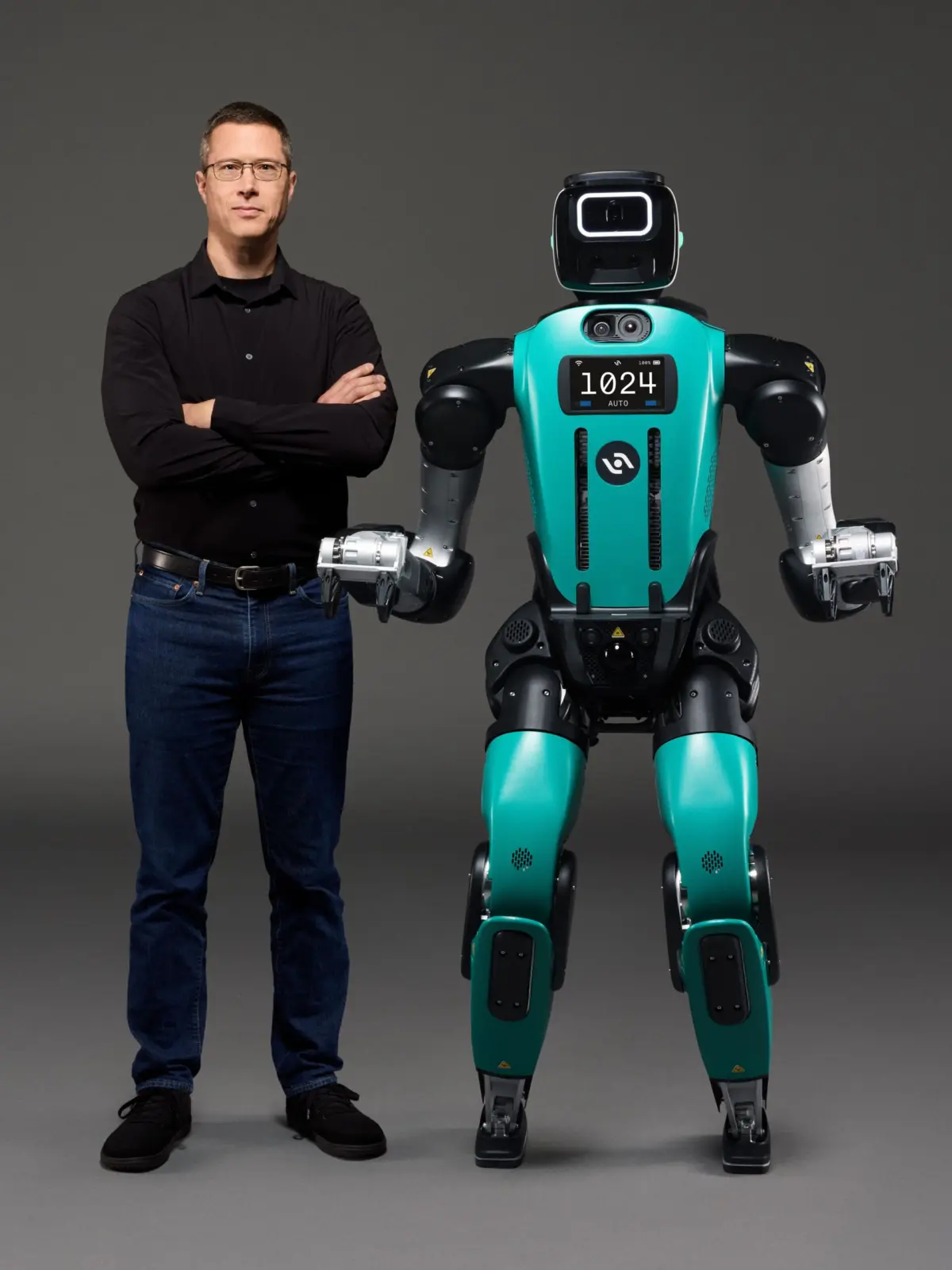
When Jonathan Hurst co-founded Agility Robotics out of his robotics lab at Oregon State University in 2015, he envisioned a future of graceful, agile humanoid machines moving seamlessly through the world. Over a decade later, that vision has collided with the demanding realities of the commercial marketplace. Agility Robotics has officially launched Digit 5, designed to be the first humanoid robot capable of safely, economically, and reliably performing useful labor at industrial scale.
Engineered to lift 23-kilogram bins onto high shelves and equipped with a battery that runs for 90 minutes on a quick 9-minute charge, Digit 5 is built to handle heavy warehouse tasks shift after shift. It fills a critical labor gap in roles that are physically stressful or too repetitive for human workers. Yet, as Hurst candidly admits, the robot is heavy, bulky, and lacks the fluid, natural motion of its predecessors. It stands far from the dream he originally set out to build, illustrating the difficult compromises required to transform academic research into a viable commercial product.
From ATRIAS to Cassie and the Birth of Digit
Hurst’s long-standing dream has always been to build robots that combine locomotion and manipulation, navigating the physical constraints of the world with elegance. When he launched the Dynamic Robotics Laboratory at Oregon State in 2008, his team began with a foundational biomechanical theory: a simple "spring-mass" model—a body supported by spring-like legs—should be capable of replicating every known walking and running gait observed in animals.

To test this theory, the laboratory built ATRIAS, an acronym for "Assume The Robot Is A Sphere," referencing a classic physics joke about reducing complex systems to their simplest forms. ATRIAS resembled a large microwave oven mounted on stilts because its sole purpose was to demonstrate the fundamental physics of human bipedal movement. Despite its utilitarian appearance, it displayed a surprisingly natural, almost lifelike gait.
Encouraged by this success, Hurst and his co-founders, Damion Shelton and Mikhail Jones, took the leap from academic research to commercial enterprise. Driven by ambition and a healthy dose of naivety, they focused on building their first tangible product: Cassie.
Cassie became the first dynamic bipedal robot available for purchase by researchers, utilizing active, fluid balancing rather than rigid, deliberate steps. Featuring ostrich-like legs shaped strictly by performance metrics rather than biomimicry, Cassie lacked a torso, arms, or head. Agility Robotics sold ten of these units to elite research institutions including Harvard, Caltech, the University of Michigan, and UC Berkeley, effectively saturating the US$250,000 academic market.

Cassie proved pivotal because its hardware enabled a shift in the research frontier toward control software. Utilizing reinforcement learning—where a simulated robot learns through trial and error via neural networks—researchers unlocked dynamic behaviors. Cassie learned to recover from stumbles on stairs, run five kilometers across the Oregon State campus, and even set a robot world record for the 100-meter dash.
However, achieving true utility required manipulation. After exploring various configurations, Agility added an upright torso and two upper arms to Cassie’s foundational legs, creating Digit 1. This marked the company’s first mobile manipulation robot and an important stepping stone toward commercial viability.
Finding Purpose in Warehouse Bins
As Agility explored potential applications for early versions of Digit, industry partners routinely raised fundamental questions: Why legs? And why a humanoid form factor? For Hurst, these inquiries exposed a critical business reality. Solving academic science problems elegantly mattered far less to the company’s survival than solving actual operational problems for paying customers.

Through years of engagement with industry partners, Agility identified a clear initial market in warehouses and manufacturing facilities: moving storage bins. Bin handling is a well-defined task requiring two arms to lift heavy containers onto high shelves, while legs provide the necessary balance to navigate narrow, constrained spaces. Because these tasks vary significantly across different deployments, single-purpose automation had failed to adequately address them, leaving an economically viable niche for Digit.
Between 2019 and 2024, Digit progressed through successive iterations in real-world environments. Working with the Ford Motor Company, Digit 1 demonstrated package delivery from autonomous vans to front porches. Subsequent versions collaborated with global logistics providers on sorting cardboard boxes. Amazon tested Digit 4 on moving and stacking bins, and the robot eventually achieved history as the world’s first commercially deployed humanoid at logistics provider GXO, subsequently earning a spot on the cover of Time magazine in 2024.
Despite these commercial milestones, friction quickly emerged between Hurst’s academic vision and customer demands. Unlike patient university labs, commercial customers demand uptime; if bins stop moving, they lose money. Agility spent immense effort maintaining early deployments, while Hurst faced the daunting realities of running a business—managing supply chains, shipping, customer support, fleet-management software, and continuous fundraising.

Commercial Pressures and the Evolution of Digit 4 EVT
Recognizing that Agility needed to prioritize products over pure research, Hurst relinquished significant control, bringing in an executive team with commercialization experience. This leadership transition sparked immediate, necessary, and often painful changes.
The next major revision, Digit 4 EVT (Engineering Validation and Test), was originally conceived as a minor upgrade. However, Agility’s new leadership insisted the platform lacked critical features required for a true commercial product. The team implemented major system-wide updates under a compressed timeline, including larger batteries and rigorous safety and regulatory compliance mechanisms. These additions added substantial mass, visibly altering the robot’s appearance and capabilities.
For Hurst, watching these design choices unfold was gut-wrenching. Aesthetics and graceful movement were repeatedly sidelined in favor of brutal functionality. Yet, these deployments provided crucial data. By mapping the first ten specific use cases Digit needed to perform, Agility laid the groundwork to design Digit 5 entirely from scratch.

Digit 5 represents Agility’s transition into general-purpose robotics, shaped heavily by regulatory realities such as European CE compliance, North American UL electrical safety certifications, and Federal Communications Commission radiation limits.
Safety, Power, and the Design of Digit 5
Safety emerged as the single most critical barrier to scaling operations. During Digit 4 deployments, regulatory and insurance demands required the robots to operate behind physical safety barriers, completely separated from human coworkers. To eliminate these restrictive cages and maximize usefulness, enabling Digit 5 to operate safely alongside humans became a primary two-year engineering goal.
Digit 5 utilizes a comprehensive sensor array to detect nearby people. When a human approaches, the robot is programmed to halt its task, set down its payload, sit down on the floor, and cut power to its motors before a human can make physical contact. This conservative approach verifiably minimizes risk in shared workspaces.

However, accommodating human coexistence introduced profound design complexities. Weighing over 120 kilograms, Digit 5 is a massive machine. To meet National Institute for Occupational Safety and Health guidelines, it must repeatedly lift 23-kilogram bins, reach shelves 1.75 meters high, and operate for up to 20 hours a day—demanding immense motor power, torque, and precision.
To sustain this performance, Digit 5 incorporates a large battery and an autonomous rapid-charging dock. The dock delivers 240 amperes at 48 volts, generating magnetic forces strong enough to make thick charging cables visibly wiggle, while internal fans channel cooling air through the torso to prevent overheating. The battery and cooling system occupy roughly 75 percent of the robot’s torso, enabling 90 minutes of continuous operation followed by a rapid 9-minute recharge.
These functional demands permanently altered the robot’s form. The svelte, athletic silhouette Hurst originally envisioned became physically impossible, leading him to observe that Digit 5 resembles a forklift more than a graceful humanoid. Furthermore, the distinctive ostrich-like legs of earlier models were replaced by traditional humanoid configurations to ensure stable squatting mechanics when lifting heavy objects from floor level.

Looking Beyond Digit 5
Despite the aesthetic compromises, Hurst views Digit 5 as an essential inflection point for scaling Agility Robotics. While initial deployments will center on bin handling, the product roadmap expands toward individual item picking, machine tending, assembly preparation, and eventually direct manufacturing work. Interchangeable tool interfaces and modular design will allow gradual hardware upgrades over time.
While Hurst may struggle to personally embrace the bulky, heavily armored aesthetic of Digit 5, he recognizes that customer requirements did not ruin his vision—they simply exposed what his initial vision was missing. Achieving commercial success and real-world impact is a necessary precursor to fulfilling his ultimate scientific dream.
With Digit 5, Agility Robotics has engineered a machine capable of performing genuine, practical work in the human world. As deployment scales, Hurst plans to return his focus to the long-term challenge of refining the machine’s form, ensuring that future iterations grow progressively lighter, more graceful, and better equipped to navigate human environments safely and naturally.