





As the international contemporary jewelry community turns its attention to the Portuguese capital for the opening of the 3rd Lisbon Contemporary Jewellery Biennial, a look back at the origins of the movement provides essential context. Organized by PIN—the Portuguese Association for Contemporary Jewellery, this year’s biennial runs from September 19 to 27, 2026. Its overarching theme, Coexistences, directly derives from the final section of the pivotal 2024 exhibition Madrugada: A joalharia e a política da Esperança (Daybreak: Jewellery and the Politics of Hope). By examining the newly released Madrugada catalog, critics and enthusiasts alike can retrace the theoretical framework and artistic sparks that laid the groundwork for the current biennial.
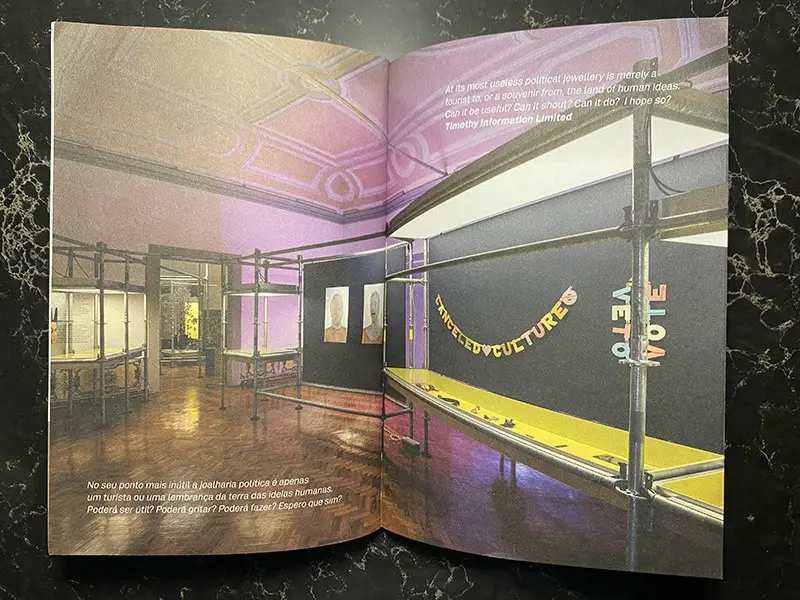
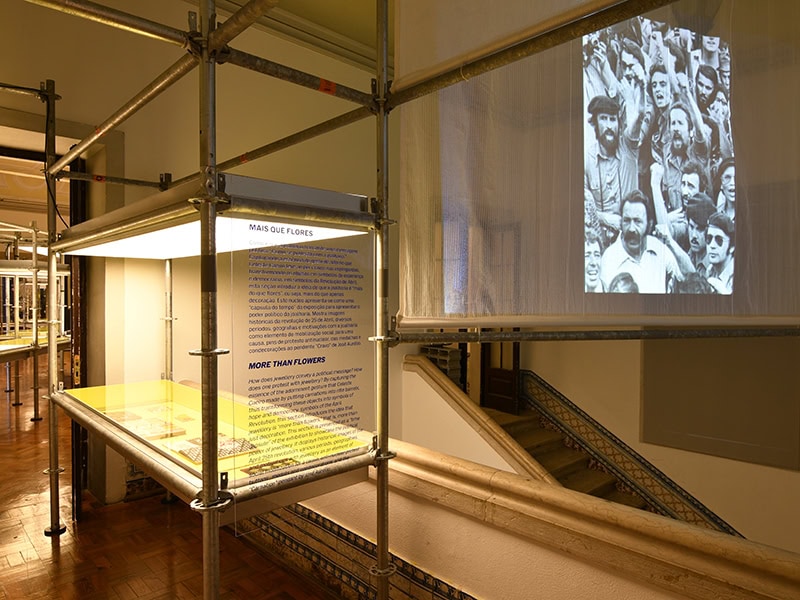
The word madrugada translates poetically from Portuguese as “daybreak” or the early hours of morning. Madrugada. Jewellery and the Politics of Hope served as the flagship exhibition of Lisbon’s second contemporary jewelry biennial, transforming the vacant historic Calheta Palace—in collaboration with MUDE Museu do Design, the leading institution for Portuguese contemporary design—into a cavernous showcase of political craft. Inspired by the 50th anniversary of Portugal’s landmark 1974 Carnation Revolution, the exhibition brought together works by 90 jewelers hailing from 34 different countries.
The curated selection took direct aim at pressing global injustices, confronting systemic issues ranging from hostility and violence against migrants to deteriorating queer rights and toxic beauty standards. Rather than indulging in passive optimism or succumbing to cynical pessimism, the jewelry on display embodied a rugged, resilient brand of hope. It was a hope that willingly endures uncertainty while keeping hands free to do the necessary, ground-level work of social change. The curators actively sought out pieces capable of carrying both instant, visceral rage and an enduring sense of possibility.
Primarily for the Initiated
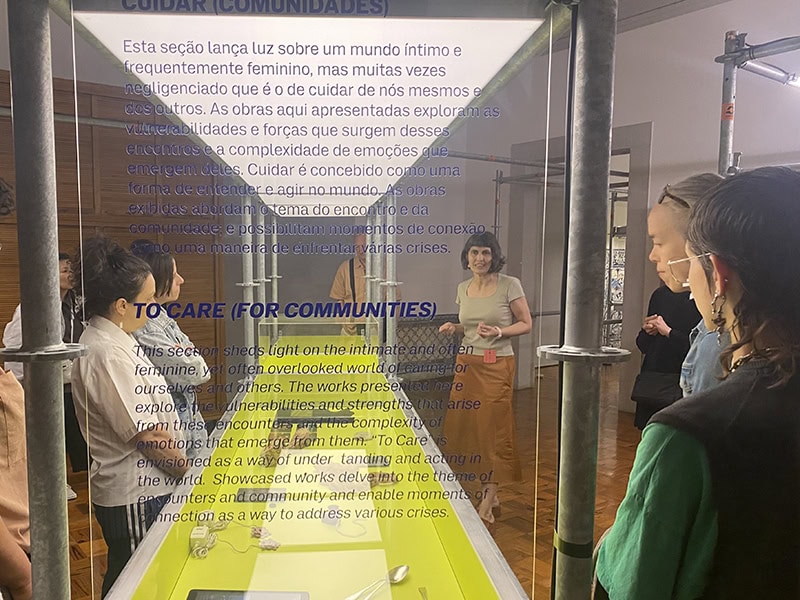
Evaluating the physical exhibition presented a unique challenge, as the curators chose to accompany the works with only the sparest of labels, restricted mostly to basic facts such as the maker’s name, piece title, and materials used. Viewers fortunate enough to tour the galleries alongside curators Mónica Gaspar and Patrícia Domingues, or in the company of participating artists, were treated to vital layers of context.
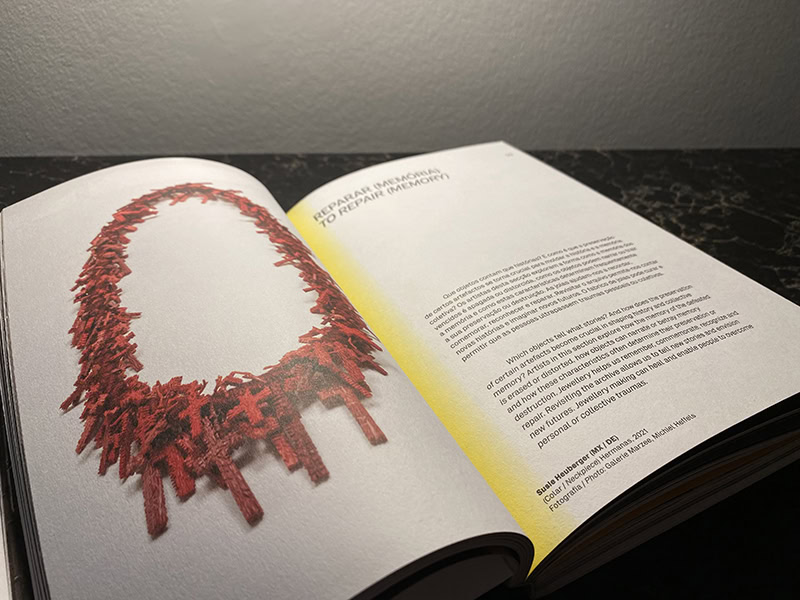
For instance, artist Nanna Melland illuminated the concept of a defensive swarm behind her fragile aluminum planes, while Johanna Zellmer brought her personal migration story to bear on her passport-inspired works. Similarly, Susie Heuberger revealed that the striking pinkish-red crosses in her neckpiece Hermanas were conceived to commemorate Mexican women killed in ongoing conflicts.
For returning observers, encountering familiar pieces—such as Ana Escobar Saavedra’s recreation of a baby’s maternity ward ID band in stone, which highlights how identity construction begins at birth—provided moments of recognition. Yet, the exhibition also introduced countless unfamiliar voices. By intentionally challenging their own blind spots, the curators elevated young and underrepresented creators who are actively finding new ways to react to contemporary crises through personal adornment.
The works were thoughtfully organized into eight thematic actions, including "To protest (voices)," "To empower (tools)," and "To reimagine (coexistences)." Each section was introduced by a mini-essay. While these texts proved somewhat difficult to read on the transparent panels installed throughout the sprawling rooms and narrow passages of the Calheta Palace, they can be leisurely absorbed and studied within the pages of the accompanying catalog.
A Practice of Curatorial Care
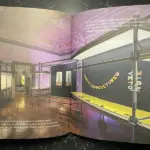
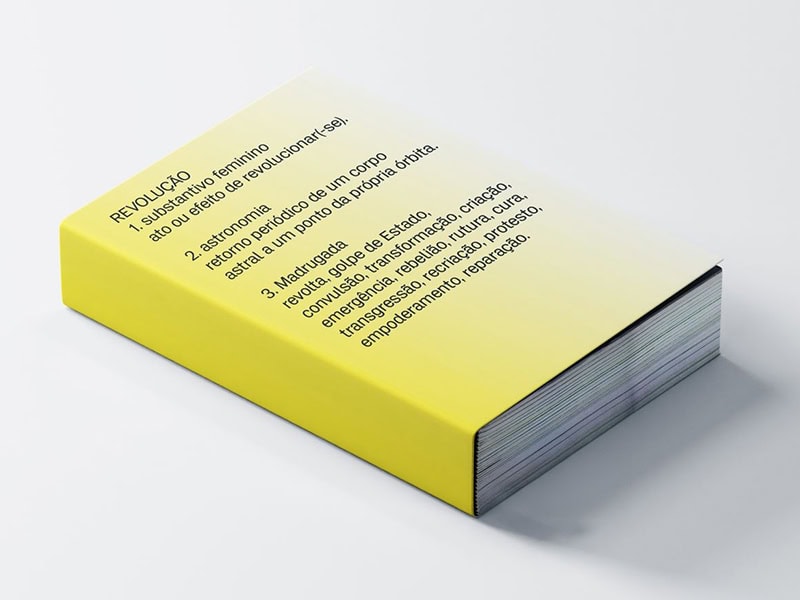
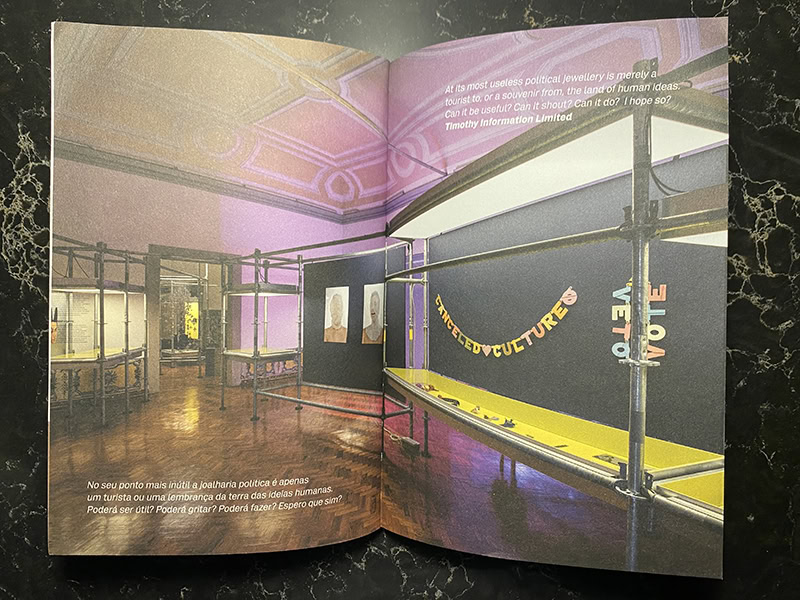
The publication, distinguished by its unmistakably bright yellow cover, acts as a deliberate mechanism to tend to the exhibition’s afterlife once the temporary scaffolding has been dismantled and the loaned works returned to their makers. Nearly all the images featured in the book were captured in situ, preserving the atmosphere of the historic palace alongside close-up documentation of works resting behind glass cases clouded by the hazy glow of the dominant yellow partitions.
During an appearance at Schmuck, Gaspar and Domingues discussed how the catalog itself functions as a practice of "care," ensuring that the conceptual sparks generated by the project remain active well beyond the life of the physical exhibition. In an interview conducted by art critic Elena Karpilova within the book, the curators explain that they deliberately avoided providing a comprehensive 200-page explanatory manual. Instead, they opted for a minimalist approach featuring a limited number of QR codes, expressing a hope that visitors and readers would feel curious enough to self-initiate acts of micro-research. While this restraint risked leaving certain complex pieces open to misinterpretation, it invited a deeply personal engagement with the objects.
Avoiding Labels and Embracing Ambiguity
The catalog offers slightly more background than the exhibition itself, incorporating select maker quotes and historical footnotes. For example, Auli Laitinen’s Nobel Bow references a scandal involving the secretary of the Swedish Academy, who frequently wore blouses with distinctive neck bows. Her male colleagues ultimately forced her tenure to a premature close to avoid #MeToo embarrassments. Wearing such a necklace demands courage, particularly in a political climate where authorities worldwide increasingly target accessories like watermelon brooches under broad definitions of "subversive" protest.
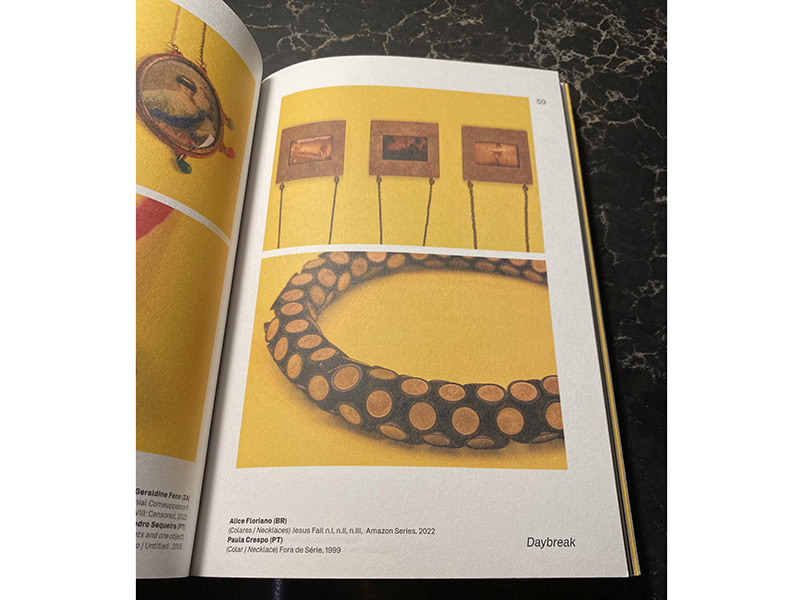
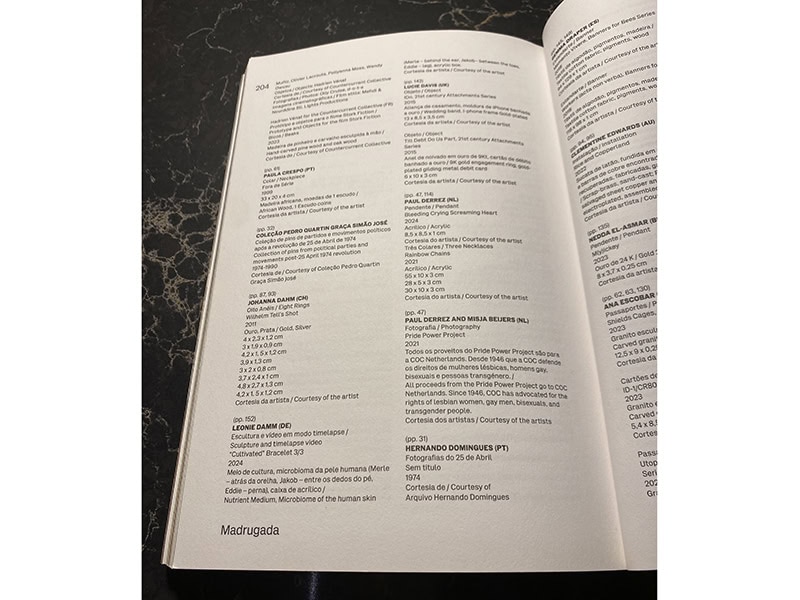
Elsewhere, encountering Paula Crespo’s necklace Fora de Série within the "To repair (memory)" section prompts immediate visual curiosity. The piece incorporates mysterious round disks that, upon consulting the index at the back of the book, are revealed to be made of African wood and 1-escudo coins—an allusion to the complex legacy of timber extraction in former Portuguese colonies. Operating without the immediate crutch of descriptive gallery labels forces viewers into a state of productive unease, oscillating between curatorial gatekeeping and the absolute freedom to observe without preconceived narratives.
Similarly, works like Clementine Edwards’s installation Rice and Copperland or Conversation Piece’s ammonite-like pendant Black Box gain profound depth through catalog quotes addressing historical extraction, technological obsolescence, and conflict minerals. By pairing these scarce textual fragments with material lists that blend traditional media like jet and shell with manufactured components like ferrite, the publication empowers viewers to construct their own critical backstories.

Jewelry as Protest
Rather than debating whether jewelry serves as a suitable vehicle for protest or hope, the catalog asserts that it inherently does. Objects like José Aurélio’s 1974 medal bearing the inscription Arte é Revolução é Arte underscore the revolutionary lineage of political adornment. Midway through the volume, a quote from Timothy Information Limited cuts to the heart of the matter: "At its most useless, political jewellery is merely a tourist to, or a souvenir from, the land of human ideas. Can it be useful? Can it shout? Can it do? I hope so?"
The featured works answer this call through various methodologies. Some sound direct alarms, while others sketch utopian or dystopian alternatives. Patrícia Domingues notes that exploring dystopia can itself function as a methodology, acknowledging a broken reality while carving out space to imagine the contrary. Other projects capture hope in its most active form, such as the Makers Move collective—comprising Josephine Winther and Gitte Nygaard—who invited passers-by on the streets of Lisbon to rapidly fashion wire jewelry centered around the concept of freedom.
The inclusion of two-dimensional works, paintings, video stills, and phone filters—such as Helen Britton’s raw, ink-and-acrylic cry Shame Australia Shame—frequently disrupts the traditional cadence of standard jewelry formats like brooches and pendants. By integrating unambiguous textual statements alongside ambiguous, poetic wearable objects, the exhibition and its catalog map out the multifaceted ways political jewelry continues to make its voice heard.
Ultimately, Madrugada captures a vital moment in contemporary adornment, documenting an exhibition that grappled with the limits of traditional display while making a permanent addition to the archive of jewelry literature.
The original Madrugada exhibition ran from June 28 to September 22, 2024, curated by Marta Costa Reis, Patrícia Domingues, and Mónica Gaspar. The catalog features work by an extensive roster of international artists and creators, including Ada Chen, Adeela Suleman, Alice Floriano, Ana Escobar Saavedra, Anna Avits, Artificial Intelligems, Auli Laitinen, Benedict Haener, Ben Lignel, Beverley Price, Bruno Nogueira, Carla Castiajo, Caroline Broadhead, Catarina Silva, Catherine Blackburn, Chequita Nahar, Christoph Zellweger, Clementine Edwards, Conversation Piece, Corrina Goutos, Countercurrent Collective, Damara Inglês, Daniel Ramos, David Bielander, Deganit Stern Stocken, Diana Silva, Eija Mustonen, Felieke van der Leest, Fernanda Fragateiro, Paula Paour, Filomeno Pereira de Sousa, Florence Tebbutt, Frank Tjepkema, Gemma Draper, Geraldine Fenn, Gisbert Stach, Gonçalo Camboa, Helen Britton, Kiseno, Johanna Dahm, Johanna Zellmer, Jonathan Boyd, José Aurélio, Joyce J. Scott, Lauren Kalman, Leonie Damm, Leonor Hipolito, Lin Cheung, Lisa Walker, Lucie Davis, Lucy Ganley, Luisa Kuschel, Luis Torres, Makers Move, Manuel Vilhena, Maria Ignacia Walker, Marilia Maria Mira, Masoumeh Rezaeilouyeh, matt lambert, Mengyin Sun, Miles Robinson, Naama Levit, Nanna Melland, Nedda Al-Asmar, Paul Derrez, Paula Crespo, Paulo Mendes, Pedro Sequeira, Pio Abad, Frances Wadsworth Jones, Pouya Bakhshi, Ramon Puig Cuyàs, Reka Lorincz, Ruudt Peters, Samantha Vincent, Sophie Hanagarth, Susie Heuberger, Ted Noten, Teresa Milheiro, Timothy Information Limited, Timothy Veske-McMahon, Valerie Oi Ying Ho, Vhils, Viktoria Bulgakova, Vivi Touloumidi, and Yotam Bahat, alongside historical archive materials from Velvet da Vinci Gallery and the Pride Power Project.