





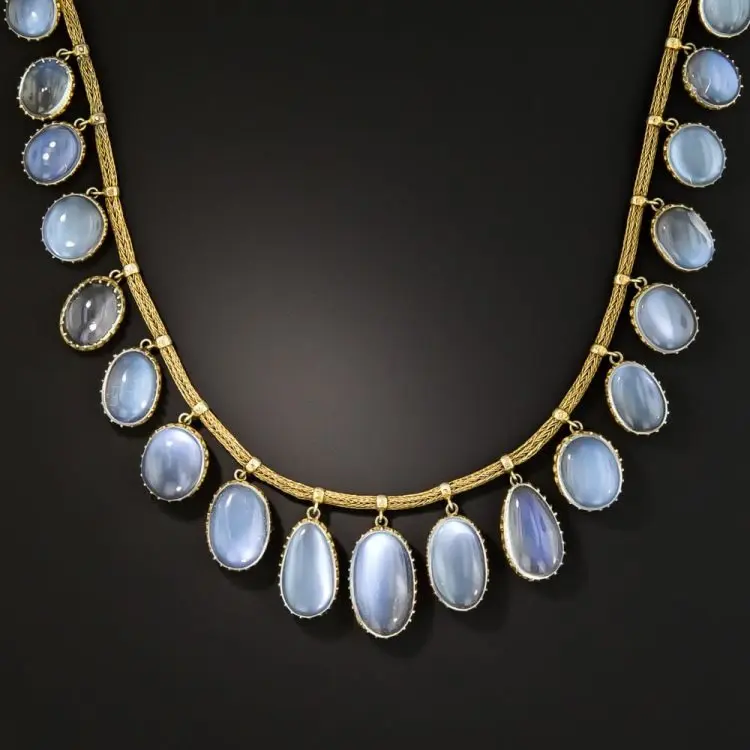
The world of fine antique jewelry and mineralogy has long been captivated by rare optical phenomena, none perhaps quite as ethereal as the characteristic glow displayed by the historic Victorian Moonstone Fringe Necklace. At the heart of this fascination lies a mesmerizing visual effect known to gemologists and mineralogists as adularescence, an occurrence frequently celebrated simply as the "moonstone effect."
When examining a piece like the Victorian Moonstone Fringe Necklace, observers are immediately drawn to the way the gemstones seem to capture and diffuse light from within. Adularescence is an optical phenomenon specifically applied to feldspar, most commonly orthoclase, which, when meticulously cut and polished into a smooth, rounded cabochon shape, reveals a floating, billowy bluish or white light that appears to shift and dance across the surface as the stone is turned in the hand.
While the general public and antique enthusiasts often use the romantic term "moonstone effect" to describe this visual magic, professionals within the scientific community know the characteristic by another name. Mineralogists formally refer to this internal play of light as schiller. This precise scientific term describes the shimmering or luminous reflection that emanates from below the surface of the mineral, adding a layer of profound geological wonder to the artistic beauty of period jewelry pieces.
The appearance of schiller in orthoclase feldspar is not merely a surface-level trait; it is deeply rooted in the internal micro-structure of the mineral itself. As the feldspar cools during its formation deep within the earth, microscopic intergrowths of two different types of alkali feldspar—orthoclase and albite—form alternating layers. When light enters the stone, it scatters across these ultra-thin, layered lamellae. This light scattering is what creates the billowing, cloud-like sheen that appears to hover just beneath the polished dome of the cabochon.
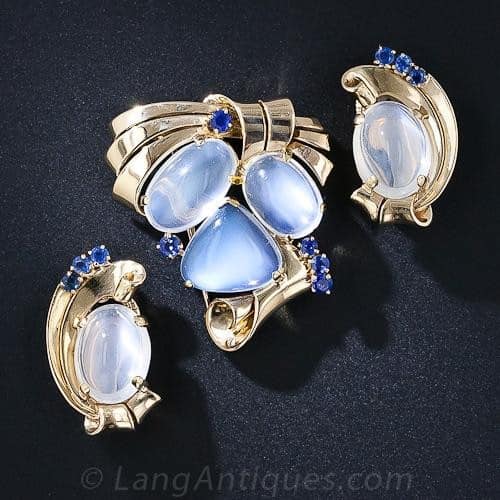
Historically, this unique interplay of light and mineral composition made moonstones exceptionally popular during the Victorian era, inspiring master artisans to design elaborate pieces such as fringe necklaces that showcased multiple cabochons working in unison. In a fringe necklace, each individual moonstone dangles or rests in a graduated sequence, allowing the adularescent glow to catch the light from various angles as the wearer moves. The collective effect is a dynamic, living display of bluish and white illumination that has enchanted collectors for generations.
The craftsmanship required to properly highlight adularescence demands a high degree of skill from lapidaries. Because the optical phenomenon relies entirely on the precise orientation of the internal layers, a cutter must align the cabochon’s dome parallel to the micro-structure layers. If the stone is cut even slightly off-axis, the floating billowy light can be significantly diminished or lost entirely, turning a potentially luminous gem into an ordinary, milky stone. This necessity for precision explains why antique jewelry featuring well-matched moonstones displaying strong, uniform adularescence remains so highly prized in the modern collector’s market.
Beyond its aesthetic appeal in Victorian adornments, the study of adularescence continues to bridge the gap between art history and mineralogical science. Gemological institutions and museums regularly study pieces featuring orthoclase feldspar to better understand the geological conditions that produce such striking optical effects. As contemporary admirers continue to study and preserve exquisite items like the Victorian Moonstone Fringe Necklace, the phenomenon of adularescence stands as a timeless reminder of the intricate natural processes that occur beneath the earth’s surface, manifesting as wearable works of art that continue to glow with an otherworldly brilliance.