




At the turn of the last century, the global automotive industry was an untamed frontier, evolving at a blistering pace with no clear victor in sight. In 1898, the United States was home to roughly 50 carmakers, a number that swelled fivefold just a decade later. Production figures underscored this explosive growth: in 1901, American companies manufactured a modest 7,000 vehicles, but by 1910, that annual output had skyrocketed to 181,000.
For several decades, electric cars vied fiercely with steam-powered carriages and internal combustion engines. At the dawn of the 20th century, nobody was certain which technology would ultimately dominate the marketplace. Steam power carried the legacy of heavy locomotive engineering, yet it came with a persistent risk of fire and could make the passenger cabin exceedingly hot depending on the placement of the boiler and steam piping. Meanwhile, both gasoline and electric vehicles faced profound logistical challenges regarding range. Drivers constantly grappled with a fundamental question: How far could you travel without refueling or recharging?
While a motorist driving a gasoline vehicle could easily throw an extra can of fuel into the back seat, charging an electric battery required meticulous planning. The necessary infrastructure for long-distance travel simply did not exist. Furthermore, before the invention of the electric starter in 1911, gasoline-powered engines required considerable physical strength to crank by hand. Once running, they were loud, temperamental, and emitted noxious fumes. Fully electric vehicles offered a stark and appealing contrast: they were remarkably easy to start with the simple turn of a main battery switch, often operated by a key, and they produced no foul exhaust.
Sensing a lucrative market opening, electric car manufacturers sought ways to differentiate their products from the noisy, dirty gasoline competition. They decided these clean, quiet, and easily manageable attributes made electric vehicles absolute perfection for women. At the same time, electric cars were cleverly marketed to doctors, allowing them to make emergency house calls in the middle of the night without waking sleeping neighbors with a sputtering engine crank.

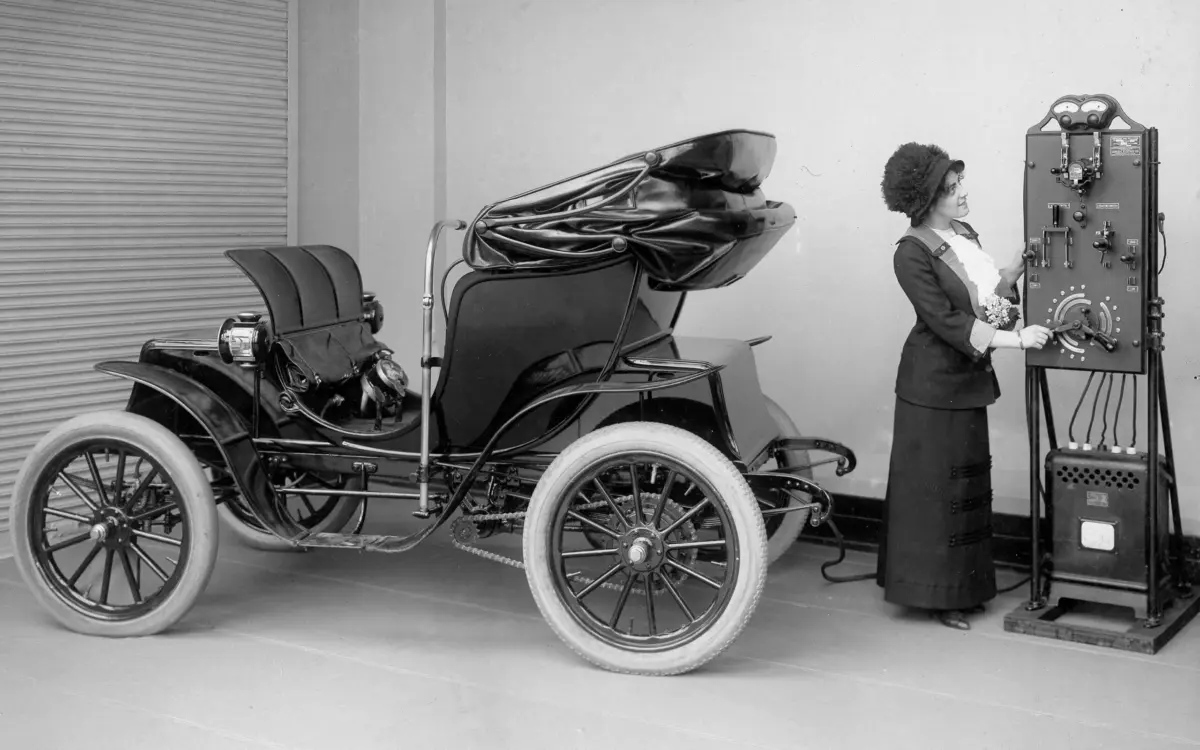
Major corporations leaned heavily into this demographic positioning. General Electric, which manufactured vehicle chargers based on mercury-arc rectifiers, became so captivated by the idea of women driving electric cars that the company launched a dedicated series of advertisements. These marketing campaigns featured stylishly dressed women effortlessly plugging in their automobiles and posing gracefully with their home charging stations.
Among the early adopters of this nascent technology was a young woman named Fannie Goodnow. Living as a well-to-do resident in the Boston area, Goodnow had her pick of more than half a dozen automobile producers. She ultimately chose a 1908 Bailey Victoria Phaeton—an open, elegant two-seater that strongly resembled a horseless carriage—and utilized a GE mercury-arc rectifier to keep its batteries charged at her family’s summer home.
Who Invented the Mercury-Arc Rectifier?
The technological backbone that enabled early electric vehicle charging was the mercury-arc rectifier, an innovation generally credited to electrical engineer Peter Cooper Hewitt. During the first decade of the 20th century, Hewitt secured multiple U.S. patents for electric lamps and sophisticated apparatuses designed for transmitting and utilizing electric currents. His foundational work was further advanced by U.S. patents granted to Percy H. Thomas, who served as the chief electrician for the Cooper Hewitt Electric Company. Hewitt had cofounded the firm alongside industrialist George Westinghouse specifically to manufacture and market his pioneering electric lamps.
Functioning essentially as an early solid-state diode, the mercury-arc rectifier played a critical role in Goodnow’s garage setup. In a car charger, the device converted alternating current (AC) drawn from the municipal power grid into the direct current (DC) required to charge the vehicle’s battery safely. The mechanism involved a small amount of liquid mercury sealed inside a glass tube, which would vaporize and emit a distinct glow as electricity passed through it. Working in tandem with carbon anodes, this vaporized mercury ensured that electrical current could flow in only one direction. Despite its ingenuity, the unit was slow by modern standards, taking approximately 12 hours to fully recharge a drained battery.

A Carriage Maker Pivots to Electric Cars
While historical records do not explicitly detail why Fannie Goodnow opted for an electric car over a steam or gasoline alternative, her status as a wealthy Bostonian afforded her access to the finest engineering of the era. She selected her vehicle from S.R. Bailey & Co., based in Amesbury, Massachusetts.
According to automotive historian Galen Handy, who maintains the Early Electric Vehicles website, Samuel Robinson Bailey began his career in the carriage and sleigh manufacturing trade as a teenager. His craftsmanship earned him a best-in-show prize at a carriage exhibition in Portland, Maine, in 1855. Over the decades, Bailey developed a strong reputation as an inventor, engineering streamlined manufacturing processes for his vehicles before launching his own independent business in 1882. Just over a decade later, one of his traditional carriages captured a gold medal at the prestigious 1893 World’s Columbian Exposition in Chicago.
Bailey’s son, Edwin, attended the Chicago exposition, where he encountered a compelling vision of the future: the Morrison electric wagon. This six-passenger, battery-powered vehicle served as a novelty transport, ferrying visitors and VIPs around the fairgrounds. Within years, the rise of the automobile began eating aggressively into the traditional carriage trade. Recognizing the writing on the wall as the carriage industry began to collapse, S.R. Bailey & Co. officially announced in December 1906 that it was pivoting entirely to the production of electric vehicles.
Thomas Edison Designed a Bad Battery
Bailey’s inaugural automotive model, the Victoria Phaeton, was originally designed to run on an Edison alkaline battery. Inventor Thomas Edison had spent years since the 1890s working to develop a lighter, more reliable, and more powerful battery tailored specifically for the burgeoning auto industry, announcing his breakthrough with great fanfare in 1903. Unfortunately for Bailey and other forward-thinking carmakers who rushed to adopt it, the early iteration of Edison’s battery proved deeply flawed: it leaked corrosive fluids and struggled to hold a charge.

Faced with mounting complaints, Edison was forced to halt production and return to the drawing board. By 1910, he successfully brought an improved battery to market, but by that time, his close friend Henry Ford had already mass-marketed the Model T, firmly cementing the internal combustion engine’s dominance over the broader market.
While Edison labored to refine his technology, Bailey adapted by sourcing alternative power storage from the Gould Storage Battery Company of Depew, New York. Gould was a major industrial supplier, providing heavy-duty batteries for railroads, municipal utilities, subways, passenger elevators, and farms. Goodnow’s Victoria Phaeton relied on a 30-cell lead-acid battery housed within a wooden box suspended securely beneath the chassis. This standard battery configuration provided a driving range of 64 to 80 kilometers per charge, though a larger battery boasting 50 percent more capacity was available to buyers willing to pay an additional fee. Equipped with the standard battery, the Victoria Phaeton commanded a price tag of US $2,000—equivalent to roughly $73,000 today, placing it squarely in the price tier of upscale modern luxury electric vehicles like the Audi Q8 or BMW i5.
Fannie Goodnow installed her mercury-arc rectifier charging station directly inside the barn adjacent to her parents’ summer estate in Hull, Massachusetts. As automotive historian Bill Lillie of Vintage Electric Cars has noted, the charging plug utilized by her setup featured an unusual, proprietary design. This interoperability headache was a common bane for early technology adopters, as nonstandardized plugs and cables reigned supreme across different manufacturers.
Recognizing the impending chaos, the Electric Vehicle Association of America, formed in 1910, attempted to establish a universal standard so that electric vehicles could draw power at any public or private charging station. Modern electric vehicle owners can undoubtedly relate to these historical growing pains, though savvy early motorists quickly learned to pack spare plug adapters and cables whenever they ventured far from home.

When Thomas Edison’s redesigned, reliable battery finally reached commercial availability, Bailey incorporated it into the Victoria Phaeton and launched an aggressive publicity campaign. In September 1910, the manufacturer sponsored a grueling round-trip endurance tour covering approximately 1,600 kilometers from New York to Boston, which notably included a punishing side trip up the winding roads of New Hampshire’s Mount Washington. Although Thomas Edison happily posed for promotional photographs alongside the new battery-equipped Bailey vehicle, he ultimately chose a Detroit Electric Victoria for his own personal use—though, given his well-documented struggles as a driver, he was almost certainly chauffeured around town by an assistant.
Ultimately, even with clever marketing and robust engineering, S.R. Bailey & Co. could not withstand the rising, unstoppable tide of Ford’s Model T. Having produced a total of roughly 500 to 600 electric vehicles, the company sold its factory in 1915 and exited the automotive arena.
Though the vehicle Fannie Goodnow chose represents a fleeting chapter in automotive history, her story captures the vibrant spirit of early technological adoption, complete with its characteristic quirks and logistical hurdles. While her specific 1908 Bailey Victoria Phaeton has been lost to the annals of time, her vintage General Electric charging station survived intact until 2022, when it was formally donated to the Heritage Museums & Gardens in Sandwich, Massachusetts. Today, the apparatus stands as a tangible artifact of an era when electric cars were widely viewed as the future of urban mobility—and a testament to a technological journey that continues to resonate powerfully today.