




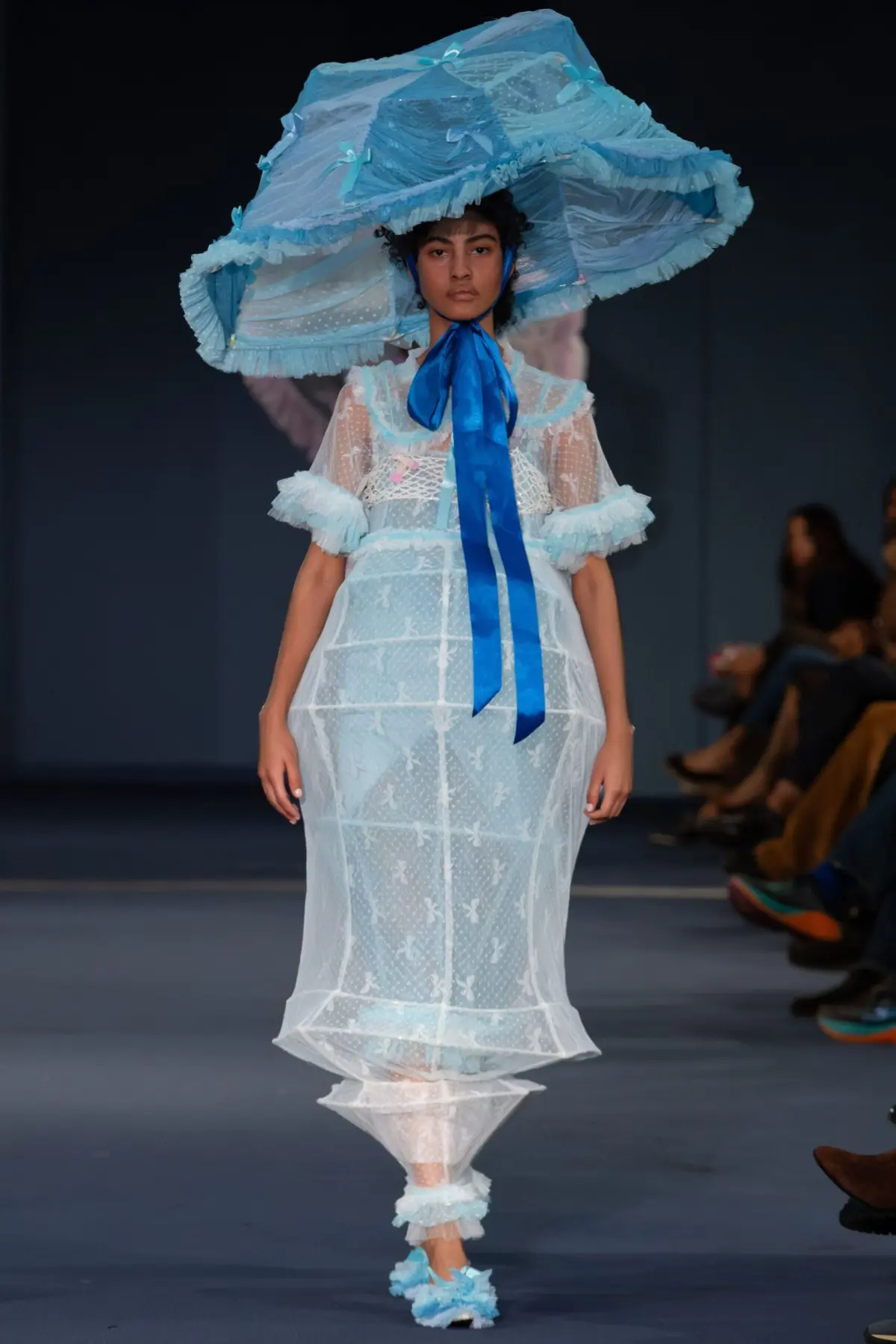
This afternoon, the 41st International Festival of Fashion, Photography, and Accessories in Hyères, France, officially announced its winners, marking a watershed moment for the storied institution and celebrating a new wave of international talent. Shanghai-based designer Yui Chen took home the prestigious Grand Prize for “Food Cover,” a womenswear-leaning unisex lineup that the creator described as a deeply personal way of preserving childhood memories.
Developed in collaboration with Montex, Chen’s winning silhouettes combined everyday staples, such as a striking yellow lingerie dress, with collapsible overlayers, ranging from tent-like structures in transparent lace to intricate cages fashioned from leather bows. During her showroom presentation, Chen detailed her meticulous design process, explaining how she models every piece in miniature at least once before constructing the actual garments. Among her standout creations was an eight-paneled sheath dress crafted from recycled leather that folds completely flat, functioning much like an accordion into eight distinct panels. Discussing her overarching artistic philosophy, Chen noted that fashion represents the most vivid form of theater, sharing her ultimate dream to construct an entire universe and distinct design language comparable to the legendary legacy of Issey Miyake.

As the Grand Prize winner, Chen will receive comprehensive industry support from Chanel, the festival’s long-term Grand Partner, alongside new Grand Partner le19M and its network of ten specialized maisons d’art. Additional grants and professional backing will be provided by sponsors including the Atelier des Matières, Supima, and newcomer Watteau, the visual content hub. Further support will be extended by Les Teintures de France, the Alliance for European Flax-Linen & Hemp, and Richemont’s AZ Academy, among others. Furthermore, all fashion laureates recognized at the festival will be prominently showcased by Première Classe during Paris Fashion Week in March and October 2027.
The celebration at the Villa Noailles captured a palpable sense of renewal, reflecting a broader creative awakening in design studios worldwide. This year’s official motif—a racing flag featuring a star set against a pink-and-green checkered ground—served as a visual signal that the festival is firmly back on track following recent operational hurdles. Organizers characterized this particular edition as a “year of firsts,” not merely because Chen made history as the first Chinese designer to secure the festival’s top honor, but also due to a deliberate structural shift spearheaded by Hugo Luccino, the festival’s managing director. Luccino placed women at the helm of every primary jury panel: Chloé creative director Chemena Kamali led the fashion jury, photographer Camille Vivier oversaw the photography evaluation, and Danish fashion designer Cecilie Bahnsen directed the accessories judging panel.
These leadership appointments mirrored a broader empowerment of women across local governance and festival administration. During her official welcome address, Josée Massi—the mayor of Toulon, who earlier this spring made history as the first woman president of the Métropole Toulon Provence Méditerranée—offered encouraging words to the 30 international finalists, reminding them that their presence and talent transcend any single award. Shortly thereafter, Hyères’s newly elected mayor, Véronique Bernardini, who is the first woman to hold the post since its creation in 1677, opened the festivities with a modern spin on a famous Gabrielle Chanel aphorism: trends pass, but style remains, and in Hyères, audacity is never out of style.

At the subsequent opening reception, Mayor Massi praised the strategic decision to host the main fashion show at the Forum du Casino, situated directly in the heart of Hyères, describing the move as a cultural renaissance. Emphasizing that culture should never be treated as an elitist pursuit, she stressed the importance of bringing artistic expression closer to the public, particularly the youngest generation. Elaborating on this community-focused vision, Massi noted that she frequently observes how the future stands less than a meter tall, underscoring the municipal responsibility to actively engage youth. She also outlined a vision for Hyères and Toulon to function as twin hubs for fashion and design, pointing out that Toulon already hosts a satellite campus of the École Camondo interior architecture and design school, with plans for the Design Parade to potentially relocate to its Porte d’Italie district as early as next year.
Valérie Duport, who assumed the presidency of the Villa Noailles in July, also celebrated a personal milestone within the organization, remarking that she was the one who raised her hand to step into the leadership role. Duport paid tribute to the enduring legacy of France’s foundational fashion festival, emphasizing that longevity remains a rare achievement in an unpredictable industry. Discussing the future of the venue, she described the Villa Noailles as an inherently living place designed to warmly welcome visitors. Speaking candidly about financial stewardship and the roadmap ahead, Duport confirmed that a comprehensive restructuring plan is already in place to systematically pay off approximately €1.3 million in legacy debt over the next two years, clearing the path for a fresh start.
The festival’s installations and exhibitions successfully brought together a dynamic mix of familiar alumni and rising stars. Lucas Emilio Brunner, who captured last year’s Grand Prize with a whimsical collection inspired by inflatables, returned to the festival with Standards, a rigorously executed lineup inspired by sports flags and 1960s Ivy League style, created in collaboration with the Ateliers de Verneuil. Among his collection’s standout pieces were draped striped poplin shirts, polo shirts featuring contrasting trim, and a sophisticated coat constructed through intricate leather marquetry.

Other notable fashion winners included London-based artist and designer Dieter Vlasich Obermann, representing Mexico and Germany, who secured the 19M Métiers d’Art Prize for a collection inspired by tiliches—the traditional Mexican concept of "junk"—and the hidden craftsmanship they can conceal. Paris-based designer Rachel Luurssen from the Netherlands claimed the Ateliers des Matières Prize for a womenswear collection that synthesized Hollywood glamour and coquette aesthetics with darker ruminations on fading beauty and body dysmorphia. Meanwhile, Paris-based Chinese designer Xiao Xu was awarded the Supima Prize for a menswear collection titled Uncanny, which drew heavily on latex, 1970s fetish culture, traditional embroidery, and innovative knitwear. Earning both a special mention and the Public Prize, Spanish designer Brais Albor Rodriguez presented an improbable yet witty collection that humorously juxtaposed the imagery of squirrels—constructed using shearling sourced via the secondhand platform Vinted—with themes of masculine bravado. Additional Grand Prizes were awarded to Sassa Ann van Wyk for Accessories and Motoki Nakatani for Photography.
The exhibition roster further highlighted collaborative mastery through special presentations. Emma Bruschi, winner of the 2020 le19M Métiers d’Art Prize, spearheaded an interactive straw-weaving workshop alongside Galerie 19M. Amaury Darras, the 2025 Accessories Grand Prize laureate, presented Keratina Medusa, a striking Art Nouveau-inspired corset developed in partnership with Goossens that seamlessly bridges fine cabinetry and jewelry-making. Adrien Michel, winner of the 2025 le19M Métiers d’Art Prize, introduced a conceptual capsule inspired by Marcel Breuer’s iconic Cesca B34 chair, anchored by an ingenious shirt designed to fold directly out of a leather case manufactured with Studio MTX. Furthermore, Sébastien Meunier—who launched his eponymous label following his Grand Prize victory at Hyères in 1998—returned with Re-Authored, a retrospective re-examination of his own creative legacy.
Looking ahead, managing director Hugo Luccino explained that as part of this new era, the doors of the Villa Noailles will remain open for extended periods throughout the year. Expanded institutional programming will build upon the foundational fashion and design festivals by introducing museum-caliber exhibitions, alongside the official revival of the venue’s renowned artistic residency program.

Describing the enduring spirit of the event, Luccino emphasized that the institution remains a festival of true creativity and a dedicated platform for young talents to express their visions without restriction. He noted that these emerging creators are the ones asking the difficult questions and, most importantly, imagining and inhabiting the world of tomorrow. Acknowledging that creative exploration does not always yield simple answers, he reflected that art often generates more questions than resolutions, yet these are the subjects that will endure, with their earliest artistic intuitions invariably taking root in Hyères.
The exhibitions and programming for the 41st International Festival of Fashion, Photography, and Accessories in Hyères will remain open to the public through February 28, 2027. The venue operates Wednesday through Sunday from 1:00 PM to 6:00 PM.