




Right now, art lovers and collectors alike could use a thoughtful treat, and there is few better ways to indulge than by acquiring a terrific piece of art jewelry while simultaneously celebrating and supporting the independent artists and specialized galleries that bring their visions to the public. Through its ongoing international network of gallery supporters, the Art Jewelry Forum (AJF) continues to champion the dynamic field of contemporary art jewelry through its bi-monthly curated series, On Offer.
Designed to connect collectors with an extensive international network, the On Offer series allows participating galleries to showcase extraordinary pieces personally selected to tempt and inspire viewers. Ranging from conceptual brooches challenging traditional notions of material wealth to delicate, labor-intensive rings and sculptural necklaces, the September 2026 selection demonstrates the astonishing breadth of contemporary studio practice across the globe. AJF encourages prospective buyers to contact the respective galleries directly for inquiries and purchases, ensuring a direct link between the collector, the gallerist, and the maker.
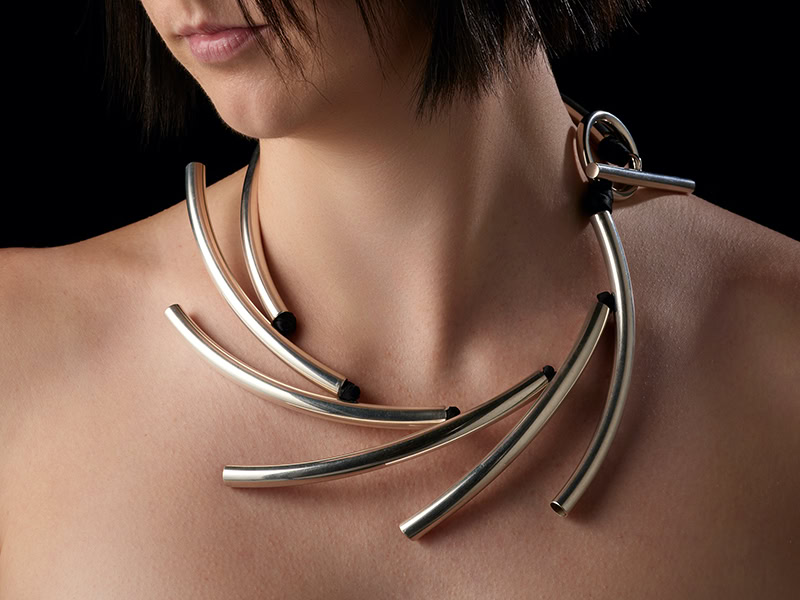
Among the standout works featured in this edition is a piece by Linda van Niekerk, presented by Zu design in Adelaide, Australia. Priced at AU$1,750, van Niekerk’s neckpiece Silver Cloud Burst (2025) is crafted from sterling silver and silk, measuring 19 inches long with a chenier 5/16 inches in diameter. Photographed by Peter Whyte, the piece stems from the artist’s Clouds series, which draws deep inspiration from the vast, cinematic Tasmanian skies. The work thoughtfully captures not only the physical shapes of clouds but also their constantly shifting, evolving forms over the horizon.
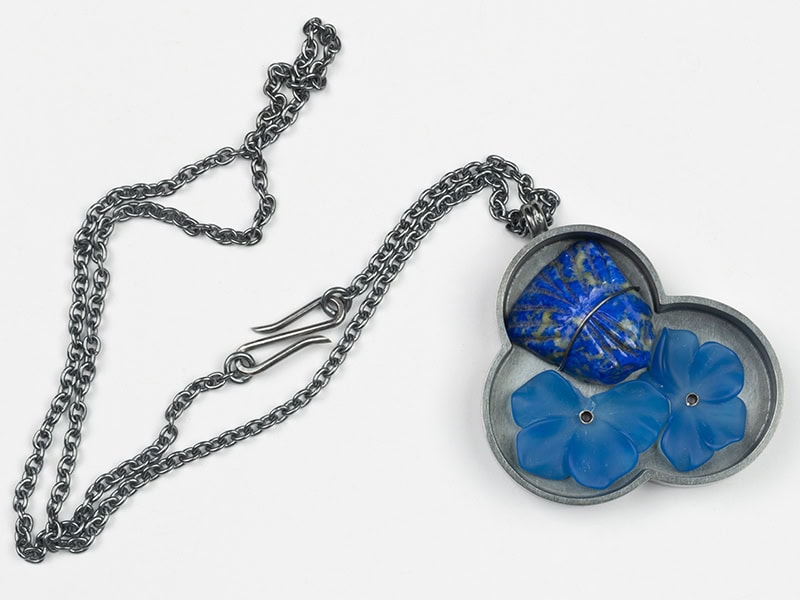
Traveling to Lisbon, Portugal, Galeria Tereza Seabra presents a captivating pendant by Catarina Silva simply titled Untitled (2026). Priced at 750€ plus shipping, the brooch measures 2 x 2 x 5/16 inches with a 9 7/8-inch chain and is crafted from oxidized silver, lapis lazuli, and tinted agate, with photography by Pedro Tropa. This recent work was created for Silva’s solo exhibition Jardin d’agrément, which forms part of the official program of the third Lisbon Jewellery Biennial. The exhibition imagines a lush, utopian garden inspired by paradise gardens and mythological gardens of the gods found across diverse cultures. In this envisioned space, humans, animals, and plants coexist beyond traditional hierarchies within a shared ecology of reciprocity and wonder. Here, jewelry functions as a living constellation of symbols—including apples, unicorns, flowers, birds, and Marian imagery—evoking knowledge, care, fertility, and transformation. Notably, at the heart of the exhibition, the snake emerges as a guardian rather than a tempter, symbolizing wisdom, regeneration, and the continuous cycle of life. Rather than lamenting a lost Eden, Silva’s work offers a poetic fiction that invites viewers to imagine new ways of inhabiting the world, where coexistence is practiced as a living reality.
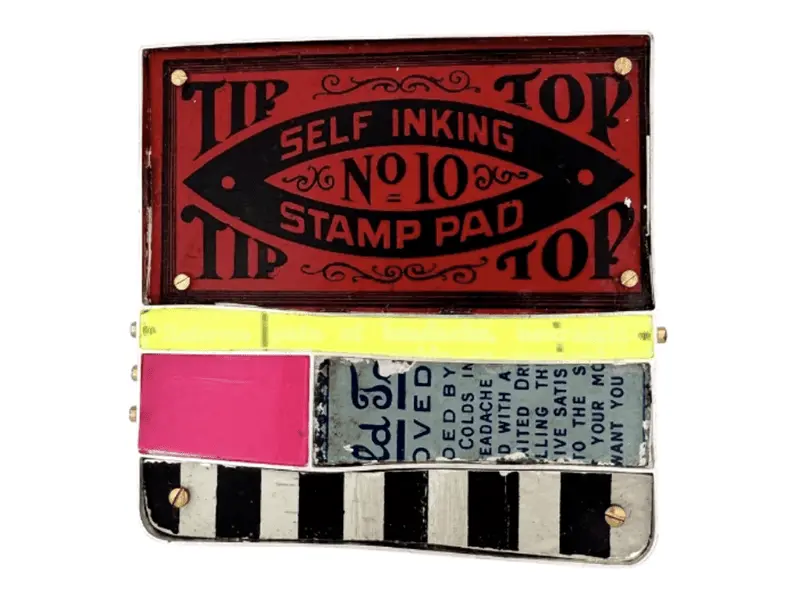
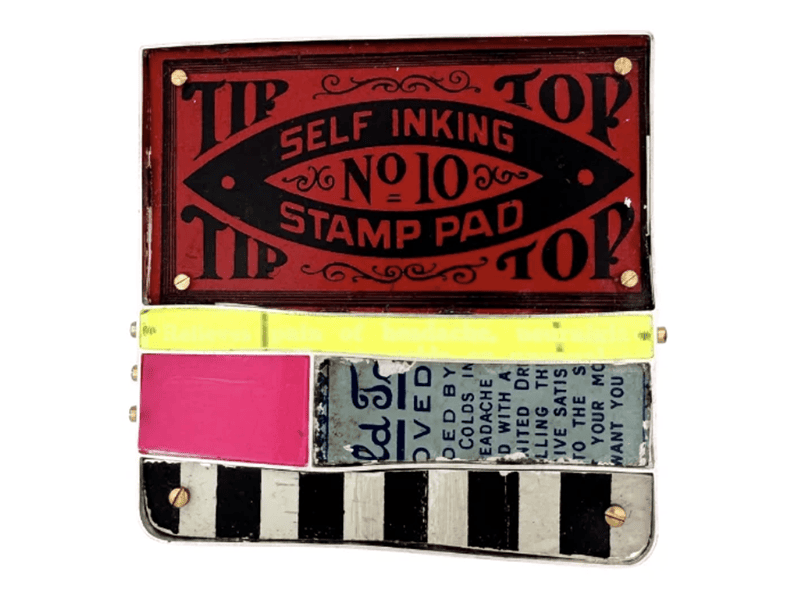
In Lewes, Delaware, Heidi Lowe Gallery showcases the work of Carin Jones through the brooch On Whim Tattoo (2026), priced at US$350. Photographed by Kassadi Williams, the piece measures 2 1/2 x 2 1/4 inches and is constructed from vintage tin, sterling silver, acrylic, and signature bolts in brass and stainless steel. Jones’s artistic focus centers heavily on historical specimens, such as vintage tins, effectively replacing traditional gemstones with found objects set within finely crafted precious metals. This deliberate juxtaposition challenges conventional societal notions of value and grandeur, prompting viewers to reconsider the often arbitrary relationship between material worth and artistic merit.
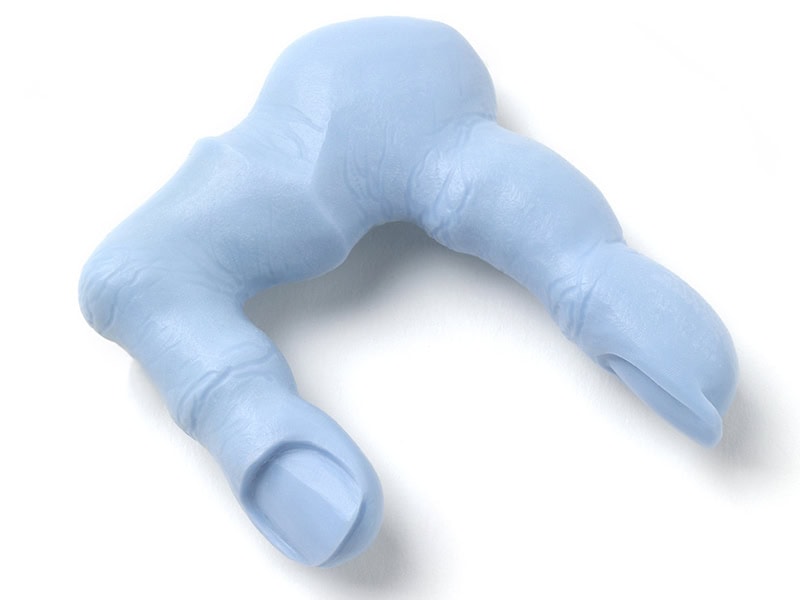
Meanwhile, at Four Gallery in Umeå, Sweden, gallerist Karin Roy Andersson presents Alexander Blank’s brooch Bones & All (2025). Priced at 460€ excluding VAT, the piece measures 2 3/8 x 2 x 1/2 inches and is made from Corian and silver, with photography by Mirei Takeuchi. Blank’s work engages with a provocative speculative narrative concerning the human hand. Hands are our primary tools for interacting with the physical world—they cook, build, clap rhythms, make fires, inflict harm, heal, and, in contemporary times, incessantly swipe and press digital buttons. Society generally views hands as subservient instruments carrying out the predetermined plans of the brain. However, Blank’s latest series asks a subversive question: What if the hands had enough? What if they wanted to break free and create an entirely autonomous reality? In this collection, hands and fingers step into a speculative evolutionary path where they become independent, free, and fully realized as themselves.
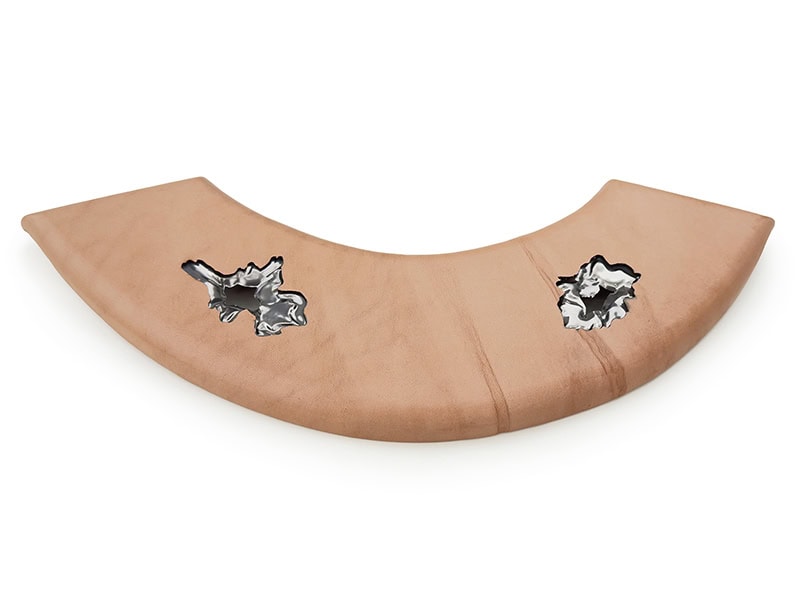
Addressing themes of security and trauma, In the Gallery at Brooklyn Metal Works in Brooklyn, New York, features Kerianne Quick’s brooch .223 Remington (Oh Well) (2025). Priced at US$1,750 and photographed by the artist, the piece is fabricated from titanium, vegetable-tanned leather, and cotton, spanning 6 1/2 x 17 x 1 inches. Oh Well is a broader collection of leather and titanium necklaces and brooches drawing directly from historical and contemporary forms of body armor, including protective bibs, utility wear, aprons, and tactical vests. By utilizing titanium "wound" inserts informed by slow-motion projectile testing and forensic imagery of high-caliber bullet wounds, Quick transforms stark evidence of bodily trauma into striking objects of adornment, interrogating society’s obsession with manufactured protection and the illusion of a false sense of security.
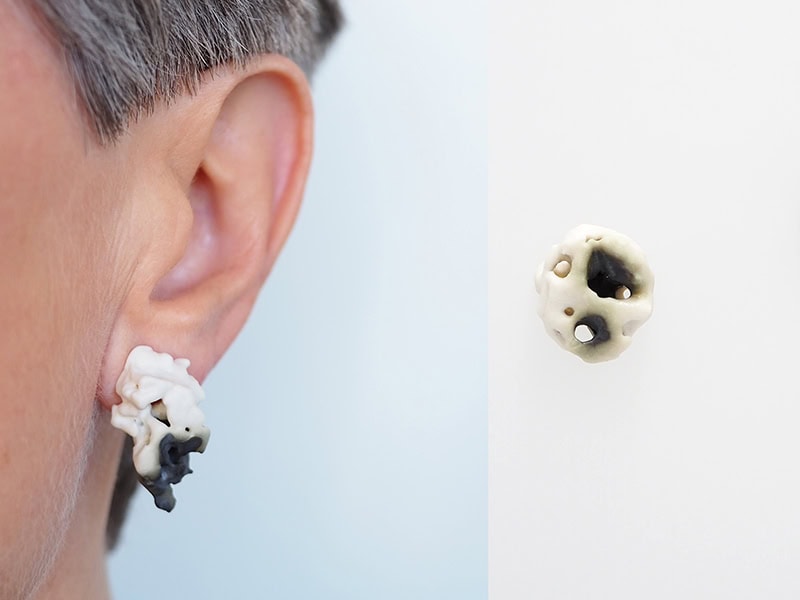
In London, United Kingdom, Objects Beautiful highlights an ear stud by Gitte Nygaard, priced at £270 GBP excluding tax and crafted from silver, bronze, sponge, and porcelain. Nygaard, recognized as one of the most important European art jewelers working today, uses porcelain to explore porosity as both a physical form and a conceptual meaning. Porosity becomes a permeable, changeable state—an imprint of relations locked in constant transformation. Through her making process, inner structures surface sensuously, shaped entirely by the materials’ inherent capacities to absorb, resist, and release. For Nygaard, porosity functions simultaneously as a methodology of making and a way of thinking, reflecting a cautious hope that jewelry can echo the fragile, ongoing creation of the world itself.
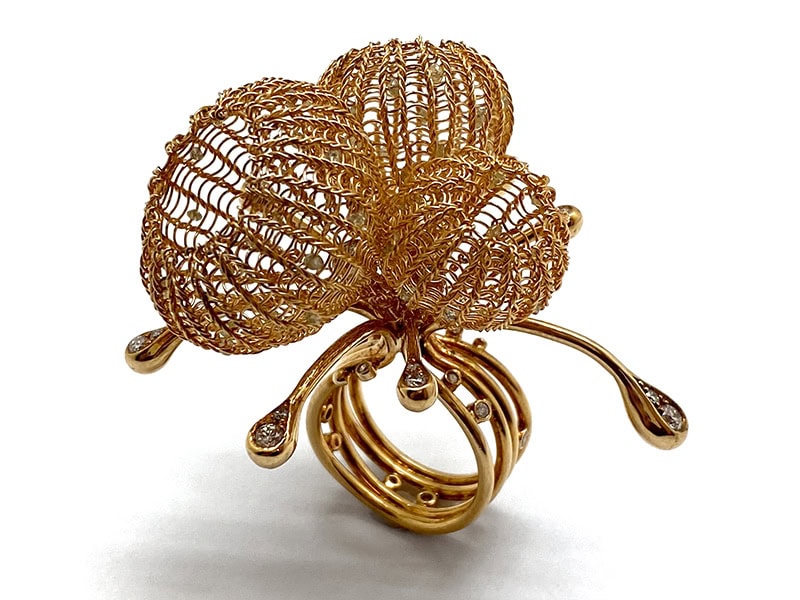
Pistachios Contemporary Art Jewelry in Chicago, Illinois, presents an extraordinary statement ring by Sowon Joo, priced at US$16,795. Photographed by Pistachios, the ring is cast in solid 18-karat gold, intricately crocheted by the artist’s hand, and adorned throughout with brilliant diamonds. Joo’s overarching artistic practice centers on the profound rites of passage experienced by all living creatures—birth, death, and the crucial growth and development that occurs between these milestones—using the natural world as a rich metaphorical language to describe these universal human transitions.
Galeria Reverso in Lisbon, Portugal, features the work of Gésine Hackenberg through her Kitchen Glass Brooches, part of her ongoing Still-lives Collection. Priced at €940, the featured piece, Precious Fluids #1 (2012), is crafted from silver-plated glass and red brass, with photography provided by the artist. Explaining the conceptual foundation of the series, Hackenberg notes that the collection serves as a contemporary interpretation of 17th- and 18th-century Dutch still-life paintings. While those historical paintings typically depicted everyday items holding deep economic and emotional significance for people of that era, Hackenberg physically cuts vintage glassware and rearranges the shards into fresh, contemporary compositions. This process acts as a direct translation from three-dimensional objects to two-dimensional shapes, elevating down-to-earth glasses and bowls into precious jewelry where the wearer’s body temporarily assumes the role of a traditional canvas. Furthermore, the collection pays intentional homage to the rich history of European glass manufacture and its designers, particularly those rooted in the Netherlands, Germany, and Scandinavia.
Zero waste, resourcefulness, and historical reclamation define the practice of Marty Ornish, whose work is presented by the Wearable Art Museum under the direction of Lisa M. Berman. Priced at $1,200, the collar Fringe Benefits hails from Ornish’s On the Fringe collection and is constructed from a historical 100-year-old cotton quilt, batting, letterpress ink, and fringe, measuring 24 x 20 x 22 inches with photography by Steve Ornish. Operating under daily studio mantras such as "zero waste," "loved to death," and "nothing is new," Ornish—widely known as MartyO—creates politically charged, thought-provoking museum pieces using fabric as a primary material and meaning as her core substance. Her works serve as tangible examples of taking society’s material waste and repurposing it into sophisticated wearable sculpture. This collar series forms part of the California Fibers exhibition The Languages of Fiber, hosted at the Huntington Beach Art Center in California.
Fingers Gallery in Auckland, New Zealand, showcases the work of Aaron Brown through his Huia ring (2025), priced at NZ$2,370. Crafted in 9-karat yellow gold in a size R and photographed by Michael Couper, the piece reflects Brown’s upbringing in a creative, entrepreneurial household where he internalized the empowering belief that "you can do anything." This fearless curiosity continues to fuel his evolving craft across various mediums, from delicate gold rings to bold bronze sculptures. Celebrating the distinct natural heritage of Aotearoa, Brown transforms native flora and fauna into refined wearable art, ranging from his Kowhai ring to graceful fantail designs. Expressing his artistic philosophy, Brown notes his deep appreciation for the technical challenges of representational carving and his overarching goal to capture a genuine slice of his subject’s personality.
In Baltimore, Maryland, the Baltimore Jewelry Center highlights the work of Cindy Cheng, a local jeweler and sculptor whose single sterling silver earring Best Bud (2022) is offered at US$150. Measuring 1 1/2 x 3/4 x 1/2 inches with photography by J Diamond, Cheng brings an extensive background in fine arts to her studio practice. Before dedicating herself fully to jewelry, she served as a faculty member at the Maryland Institute College of Art (MICA), teaching in the Drawing and General Fine Arts departments. Having completed notable residencies at the Joan Mitchell Center in New Orleans, Anderson Ranch, the Arrowmont School of Art’s Pentaculum, and most recently at the Baltimore Jewelry Center itself, Cheng is driven by an insatiable thirst for acquiring new skills and mastering diverse techniques.
Galerie Noel Guyomarc’h in Montreal, Canada, presents Carina Shoshtary’s brooch Suspended Gravity (2026), priced at 3,000€. Measuring 7 5/16 x 4 3/4 x 2 5/16 inches, the brooch incorporates snail shells, hinoki splints gifted by traditional Japanese mask maker Hideta Kitazawa, seeds of the Japanese anemone, PLA, silver, stainless steel, and lacquer, with photography by the artist. Shoshtary’s latest series, Forms of Holding, incorporates organic natural elements that are physically wrapped and bound using a 3D pen, a technique that acts conceptually as a modern form of protective architecture.
In Stockholm, Sweden, Platina gallery features Ameli Dévé’s brooch Braid (2024), priced at US$550. Photographed by Sofia Björkman, the oxidized silver brooch measures 7 7/8 x 3/4 x 3/8 inches. Dévé frequently draws upon universal cultural symbolism and familiar domestic forms, utilizing pure fine silver whose unique softness allows her to manipulate the metal into configurations that would otherwise remain unachievable. By stretching and pushing the material directly to its limits, her creations reference traditional craftsmanship while simultaneously subverting its classic structures. Born in northern Sweden and currently based in Gothenburg, Dévé completed a rigorous three-year apprenticeship in Tibet learning traditional Tibetan jewelry-making techniques before pursuing further studies in Sweden, New Zealand, and France, ultimately earning an MFA in jewelry art from the Academy of Design and Crafts.
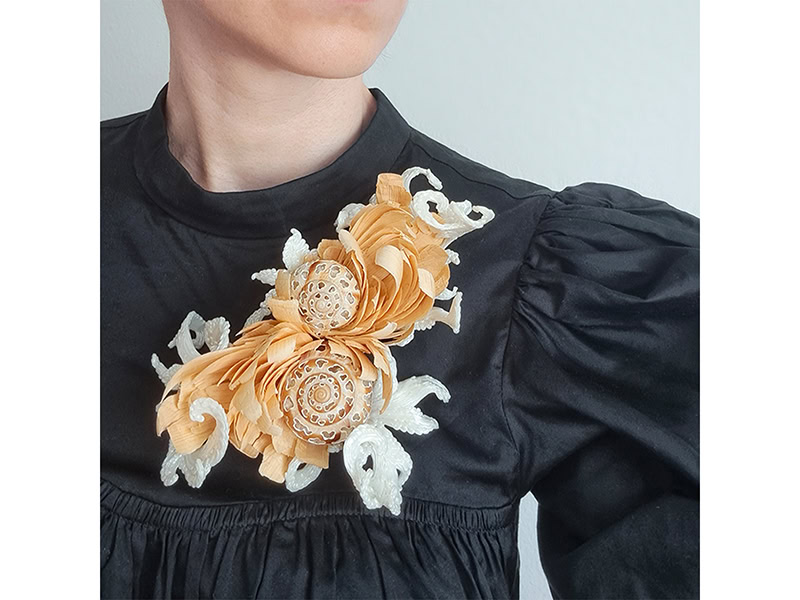
Finally, Gravers Lane Gallery in Philadelphia, Pennsylvania, presents Teresa Shields’s Green Pod Necklace (2021), priced at US$5,800. Fabricated from felted wool and wool roving with a hidden magnetic clasp, the necklace measures 6 x 25 1/2 x 1 inches, with photography courtesy of the artist. Shields’s textile pods are loosely based on the architecture of the maple seed, though she intentionally avoids direct replication in favor of capturing the organic essence of the specimen. Viewed from a distance, the piece reads as a repeating mass of identical organic shapes fanned into a graceful collar, yet up close, no two pods are alike. Each element is individually hand-formed through a complex felting process Shields mastered during an intensive at Penland in 2016, wherein she reverse-engineers her sculptural visions by calculating wool shrinkage to deliberately build forms backward toward her desired outcome.
AJF’s September 2026 On Offer showcase remains active through its participating international galleries, offering collectors an accessible entryway into the vibrant and thought-provoking world of contemporary art jewelry.