






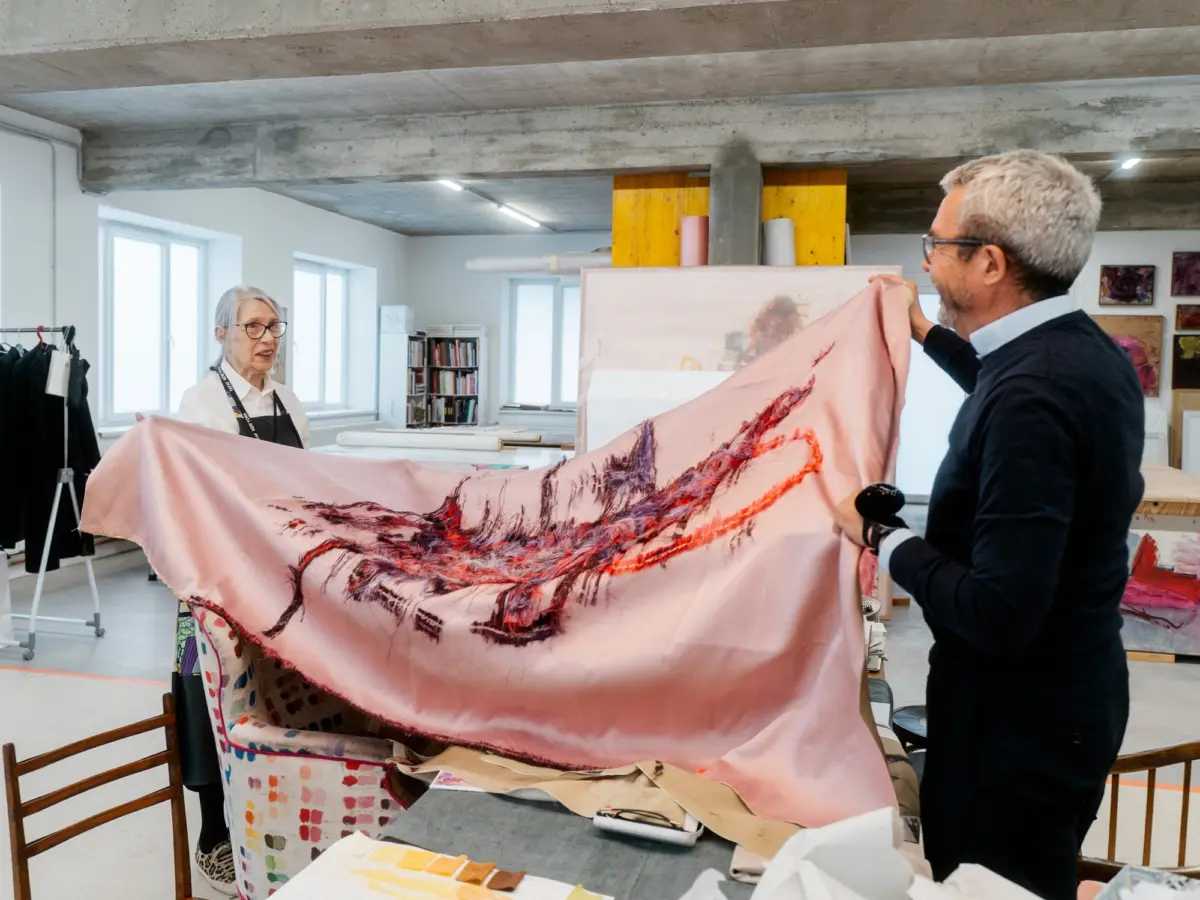
For Albert Kriemler, the creative director of the Swiss luxury house Akris, the worlds of fashion and fine art have never been mutually exclusive. Growing up as a teenager in St. Gallen, Switzerland, Kriemler’s early life was intimately tied to the family business founded by his grandparents. Trips to fabric fairs were routine, but young Kriemler was also afforded experiences that would permanently shape his aesthetic sensibility, such as occasionally attending the legendary runway shows of Yves Saint Laurent. Those unforgettable presentations brought masterworks by artists like Vincent van Gogh, Georges Braque, and Piet Mondrian to life on the catwalk, seamlessly merging textile craftsmanship with museum-grade inspiration.
Given that foundational background, it is hardly surprising that Kriemler, who has steered the creative direction of Akris since 1980, frequently turns to the art world to nurture his creativity. Over more than four decades at the helm of the brand, he has transformed these artistic dialogues from subtle nods into the core lifeblood of his collections.
Consider his zesty fall 2026 Akris collection, which served as the vivid fruit of a close collaboration with Colombian artist Olga de Amaral. Known for her large-scale textile installations frequently covered in shimmering gold or silver leaf, de Amaral emboldened Kriemler to stretch far beyond his usual comfort zone of luxurious understatement. Inspired by her mastery, he embraced an aesthetic defined by uninhibited shine, vibrant color, and rich, tactile texture.
Kriemler first drew a direct, unmistakable line between his ready-to-wear fashions and contemporary art during the brand’s milestone debut Paris runway show in 2004, which drew its soulful palette and mood from the colors of Swiss-French painter Félix Vallotton. In the years that followed, collecting art, building friendships with creators, and occasionally lobbying visionaries to partner with him on a capsule or full collection became second nature. He began open-sourcing his creative methods with them, inviting painters, sculptors, and photographers into the inner sanctum of fashion production.
His partnership with de Amaral was a textbook example of this immersive process. Kriemler traveled to Bogotá, spending several days at the home and studio of the then-94-year-old artist, deeply soaking up her hard-earned wisdom about her craft, her materials, and her philosophy.

A Broader Base of Inspiration
"I found out that when you get involved in an artist’s work and how she does art, that you get a much broader base for inspiration," Kriemler reflects. "You learn how she thinks about color, how she thinks about light, how she thinks about proportion."
Such deep, symbiotic tie-ups have repeatedly unlocked Kriemler’s most experimental tendencies. Perhaps the most dramatic manifestation of this occurred during his fall 2014 collection, which featured striking LED-equipped dresses and tailored garments directly evoking the "Stars" series by acclaimed German photo artist Thomas Ruff.
Kriemler recalls with fresh excitement the moment he discovered that Forster Rohner, an innovative fabric house based right in Akris’ hometown of St. Gallen, was incubating a burgeoning practice in electronic-enabled embroideries. The technological breakthrough offered a tantalizing new frontier for the luxury house.
"It’s always interesting when you can infuse new technologies into the workmanship process, because you create a new appearance," Kriemler notes. "It’s like a new playground."
While major global fashion houses routinely partner with established, blue-chip artists for high-profile marketing campaigns, Kriemler possesses a rare, intuitive knack for unearthing under-the-radar or on-the-cusp talents, consistently trusting his own discerning eye. Rather than treating art as a mere surface application, he allows the works to genuinely contribute to the underlying structure, architectural proportions, precise coloration, and overarching spirit of his designs.

Over the years, he has brilliantly spotlighted Reinhard Voigt’s mesmerizing pixelated oil paintings, Cuban-American artist Carmen Herrera’s rigorous abstract color planes, and Rodney Graham’s witty multimedia hijinks. Interestingly, his initial artistic attraction to Olga de Amaral stemmed from her signature use of horsehair—a critical linchpin material traditionally utilized for Akris handbags and occasionally incorporated into structured jackets.
Similarly, Martha Jungwirth, the celebrated Austrian artist who heavily inspired the Akris spring 2027 collection, initially captured his attention through her intensely expressive painting style and idiosyncratic approach to color.
"But what I loved always is that she works not on white canvas like a lot of artists. She uses a natural linen canvas always, and that’s always part of her work," he enthuses.
Kriemler first discovered Jungwirth’s paintings at the Thaddaeus Ropac gallery roughly five years ago, demonstrating his dedication by traveling expressly to Bilbao, Spain, two years ago just to experience the massive Jungwirth retrospective at the Guggenheim Museum there.
Enjoying the Unexpected
For Kriemler, keeping his creative pulse alive means visiting galleries and art museums whenever his demanding travel schedule permits. He often strategically times his visits for one hour before closing time to avoid long queues, perfectly positioning himself to relish unexpected, serendipitous discoveries. Among his cherished memories is stumbling upon a mesmerizing Vilhelm Hammershøi exhibition in 2019 at the Musée Jacquemart-André in Paris.

"I’ll never forget that moment: An artist I’d never heard about before, and then you get to see such an exquisite work," he says.
While his journeys introduce him to hidden gems across the globe, he naturally maintains his own trusted haunts and cultural touchstones during his creative process, drawing enduring energy from the intersection where contemporary tailoring meets the timeless integrity of the visual arts.