





Organizers of the mobilization estimated that approximately 200,000 participants turned out for the high-profile "Red Line" rally. This marked the fourth major demonstration of its kind in the Dutch capital since the outbreak of hostilities, which were triggered by the devastating attacks led by Hamas against Israel in October 2023, followed swiftly by the launch of an intensive Israeli bombing campaign and ground offensive in the enclave.
The Prime Minister’s absence has drawn considerable scrutiny, largely due to his past participation in similar movements. In October of the previous year, Jetten actively took part in a comparable Amsterdam demonstration while serving as the leader of the D66 political party, which was positioned in opposition at the time. However, addressing reporters this week, Jetten argued that stepping into the crowds as the sitting head of government would cross a distinct boundary, asserting that it was "not his place" to join the protest in his current official capacity. Furthermore, he declined to label the ongoing Israeli military offensive as a genocide, shifting away from language he had utilized a year prior.
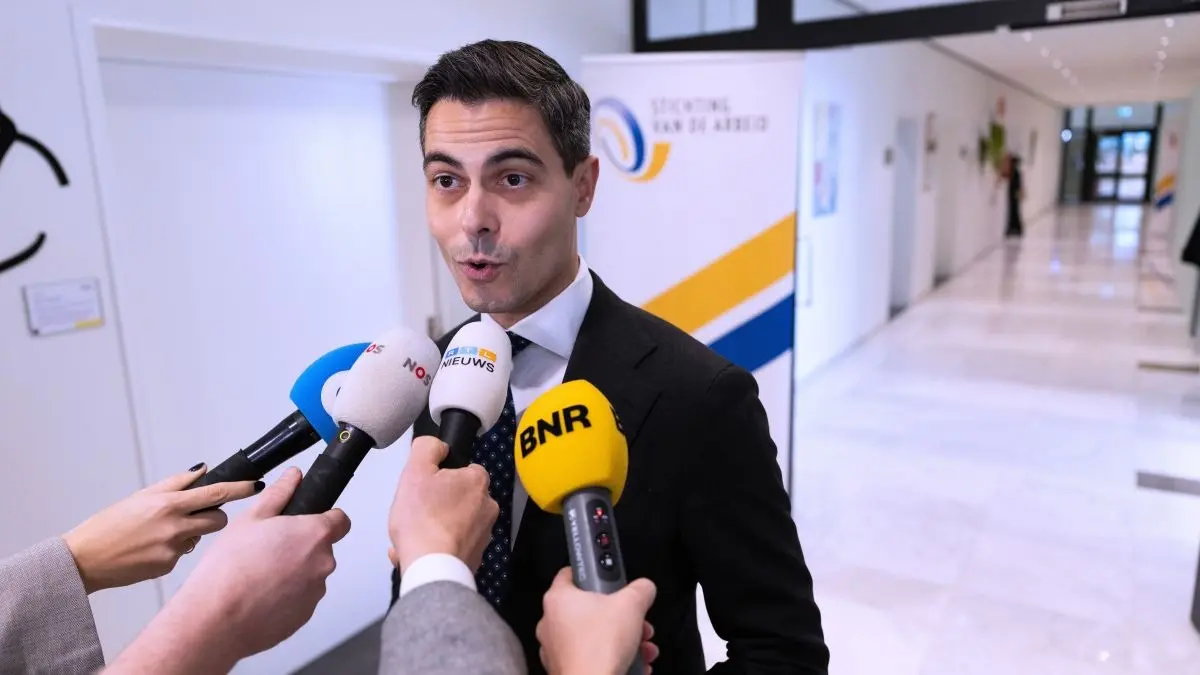
Elaborating on his stance during his weekly press conference on Friday, Jetten acknowledged the immense public concern driving the demonstrations. He noted that hundreds of thousands of citizens across the Netherlands felt compelled to take to the streets because of profound distress regarding the worsening humanitarian crisis affecting the Palestinian population. He pointed out that this widespread public anxiety is precisely why his cabinet has maintained a commitment, dating back to the earliest stages of the conflict, to increase humanitarian assistance and exert diplomatic pressure on Israel.
Despite these assurances, Jetten maintained a firm boundary regarding his physical presence at the protest site. He explained that while the public has every right to demonstrate, show how deeply they are moved by the suffering of millions of Palestinians, and urge the cabinet to take decisive action, his role as Prime Minister requires a different kind of engagement. He stated that he does not believe it is appropriate for the head of government to participate in such partisan or activist demonstrations, emphasizing that governance demands managing complex diplomatic realities rather than marching alongside protesters.
VVD Blockade and Political Friction
The Prime Minister’s balancing act has placed him directly in the crosshairs of human rights organizations and political critics alike. Activists have continually pressured the government to take a much harder line against Israel’s military actions. Yet, Jetten’s governing coalition complicates any unified hardline stance. The administration includes the right-wing liberal VVD party, whose leadership has maintained a staunchly pro-Israeli posture throughout the conflict, creating an internal legislative and ideological barrier to sweeping policy shifts.
During his weekly briefing, Jetten insisted that the Dutch government has consistently communicated its deep concerns through direct bilateral talks with Israeli authorities. He maintained that officials have explicitly stated that the deteriorating conditions in Gaza, the West Bank, and broader regional flashpoints like Jordan and Syria are entirely unacceptable.
Even so, Jetten flatly ruled out implementing harsher punitive measures demanded by the protest organizers, such as enforcing a comprehensive arms embargo or formally declaring that Israel is committing genocide and ethnic cleansing against Palestinians. This cautious diplomatic approach has alienated critics from across the political spectrum, including senior establishment figures. Among the most vocal critics of Jetten’s leadership on the file is Job Cohen, the former mayor of Amsterdam and a prominent figure from the Labour party (PvdA).
The internal debate within the country’s political elite was thrown into sharp relief over the weekend when Cohen, alongside former VVD foreign affairs minister Jozias van Aartsen, broke ranks to announce they would personally join the Amsterdam demonstration. Both men, who are Jewish, articulated their profound disquiet with current events in interviews with the national newspaper de Volkskrant, signaling a widening rift among traditional political leaders over how to respond to the crisis.
Humanitarian Values and Internal Dissent
Appearing subsequently on the television talk show hosted by Pauw, De Wit, and Moggré, Job Cohen elaborated on his evolution regarding the terminology used to describe the conflict. He admitted that he had previously experienced significant doubts, particularly regarding the application of the term "genocide," finding it extraordinarily difficult to attribute such a label to the state of Israel itself. However, he drew a sharp distinction between the nation and its current administration.
Cohen affirmed his foundational belief in the importance of Israel as a secure haven for Jewish people fleeing persecution, yet he described the policies of the sitting Israeli government as appalling. He stated that it has become nearly impossible to deny that the unfolding situation increasingly bears elements of genocide.
Jozias van Aartsen used his platform to direct sharp criticism toward his own former political home, the VVD, condemning its persistent refusal to advocate for international sanctions against Israel. Van Aartsen argued that a political party historically rooted in liberal principles has a fundamental duty to defend basic values such as universal humanity and international law. Instead, he lamented, the party leadership has chosen to stand by and watch while the humanitarian crisis deepens.