




As artificial intelligence workloads drive power densities to unprecedented heights, data center architecture is approaching a hard physical ceiling. Traditional cooling strategies that rely on a hybrid approach of liquid and air are no longer sufficient for modern server racks pushing beyond the 250-kilowatt threshold. At these extreme densities, even a conventional 70/30 liquid-to-air cooling split leaves an unmanageable 75 kilowatts of air load trapped inside a single enclosure. The supplementary air-handling systems required to move that massive volume of heat introduce operational costs, spatial footprints, and engineering complexities that few operators are willing to accept.
The emerging industry consensus points to a definitive answer: near-total heat capture. By routing liquid loops to absorb effectively all thermal energy, the remaining air load drops to less than one percent of the total system requirement. This paradigm shift enables the deployment of completely fanless AI servers, stripping away the mechanical points of failure, noise, and massive energy consumption traditionally associated with forced-air cooling. Companies like CoolIT, an Ecolab Company, are actively deploying these loops today, utilizing modular coldplate blocks that have been refined across six generations of fanless designs. Yet, as processor thermal design power continues to climb generation over generation, this relentless heat load is cascading outward, putting pressure on memory, networking, storage, and power components that once ran comfortably on ambient air alone.
For years, the thermal management narrative in high-performance computing and enterprise data centers remained relatively simple. Engineers focused intensely on cooling the primary processor—whether a central processing unit or a graphics processing unit—and relied on chassis fans and ambient air movement to handle the rest of the supporting architecture. That historical balance has now fundamentally shifted. As processor TDP climbs higher with every new silicon generation, heat spreads outward from the central compute engines and cascades rapidly into the surrounding components.
Memory modules, high-speed networking gear, local storage drives, and power conversion units now operate at temperatures high enough to demand dedicated liquid cooling of their own. Engineers designing the next generation of artificial intelligence servers face a densely populated motherboard where the requirement for direct heat capture rises with every commercial hardware launch. Beyond the 250-kilowatt-per-rack threshold, traditional air cooling transitions from an auxiliary method into a severe system bottleneck. Near-total liquid heat capture removes this physical barrier, enabling fanless AI server architectures that are explicitly engineered for the demands of next-generation computing.
Designing cooling systems for these peripheral components introduces entirely new challenges for thermal engineers. Unlike flagship processors, which are typically manufactured as flat, uniform rectangular packages with predictable thermal profiles, platform peripherals arrive in a remarkably diverse array of shapes, sizes, and board-mounting configurations. Each of these components comes with its own strict thermal limits. Some peripheral parts actually run significantly cooler than a processor case temperature, while others generate concentrated hotspots that make them highly sensitive to a thermal architecture tuned exclusively for CPUs and GPUs. Data center operators require purpose-built solutions for these peripheral components, matching the cooling mechanism precisely to the part rather than attempting to stretch a generalized cooling strategy across the entire board.
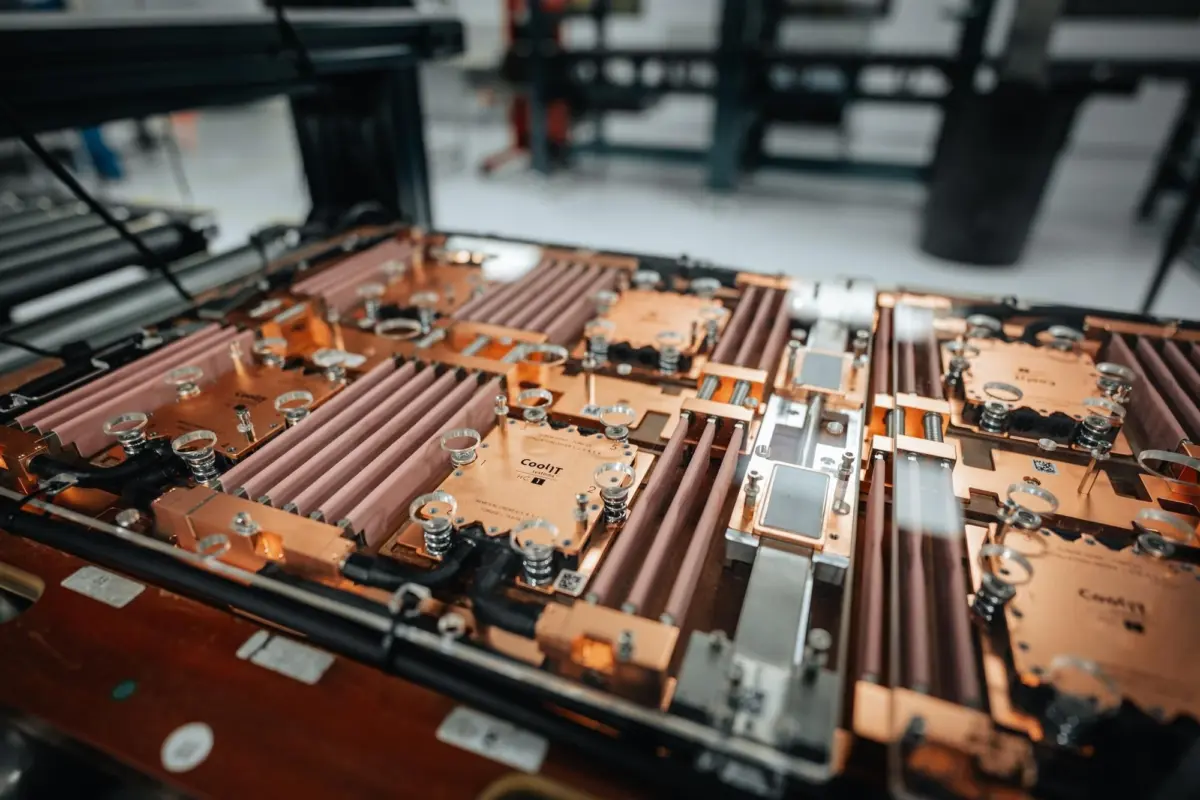
CoolIT engineering teams meet this complex challenge with a deep and versatile technical toolkit. Conductive plates, advanced vapor chambers, specialized heat pipes, and custom thermal transfer plates work in concert to efficiently move heat away from peripheral components and toward the primary liquid cooling path. Riding coldplates further enable the integration of pluggable components without sacrificing thermal performance. Each individual solution remains carefully tailored to the specific component it serves, ensuring optimal heat transfer without compromising the physical modularity of the server design.
Successfully cooling individual components is only the first part of the equation; uniting them into a cohesive, reliable system represents the true engineering hurdle. Achieving full heat capture requires folding every one of these disparate thermal solutions into a single, unified server loop that distributes coolant efficiently while maintaining ease of installation and maintenance. Connection reliability, intricate coolant routing pathways, and the total time required to assemble the loop during rack integration ultimately determine whether a thermal design thrives in demanding production environments or stalls during bench testing. CoolIT constructs these comprehensive loops from proven modular blocks, allowing data center operators to achieve maximum thermal performance and accelerated deployment speeds within the same integrated solution.
As enterprise demands push rack power capacities steadily upward toward the one-megawatt mark, the economic and operational case for comprehensive liquid cooling grows stronger at every incremental step. A traditional 70/30 split between liquid and air cooling holds up comfortably at lower power densities. However, once a rack crosses the approximate 250-kilowatt threshold, that traditional model ceases to function effectively. The remaining 30 percent of the thermal load left for air cooling balloons into a punishing 75-kilowatt load trapped inside a single enclosure. Moving that sheer volume of heat demands a massive parallel air infrastructure whose ongoing financial cost and spatial footprint few facility operators are willing to accept. Adding further compute density to the rack only widens the gap, making hybrid cooling untenable for flagship AI deployments.
Industry modeling places full heat capture as the definitive standard server design for flagship rack-scale products through 2028. While achieving true 100 percent heat capture remains practically impossible in the strictest scientific sense, the honest and entirely achievable target is near-total capture. That subtle technical distinction matters deeply to hardware engineers who value absolute precision, but the strategic direction of the industry remains clear regardless of nomenclature. Full heat capture is actively transitioning from an expensive, premium option into a mainstream operational requirement as rack densities continue their inevitable climb.
CoolIT scales heat capture to near-total levels by leveraging modular coldplate building blocks that have been rigorously proven across six generations of fanless server deployments. Engineering teams across the sector are already deeply engaged in designing thermal architectures for the maximum-density racks slated for release in the near future. As the thermal cascade continues to spread across modern motherboards and server racks grow increasingly dense, near-total heat capture is rapidly becoming the foundational design philosophy that keeps high-performance artificial intelligence infrastructure running reliably at scale.