





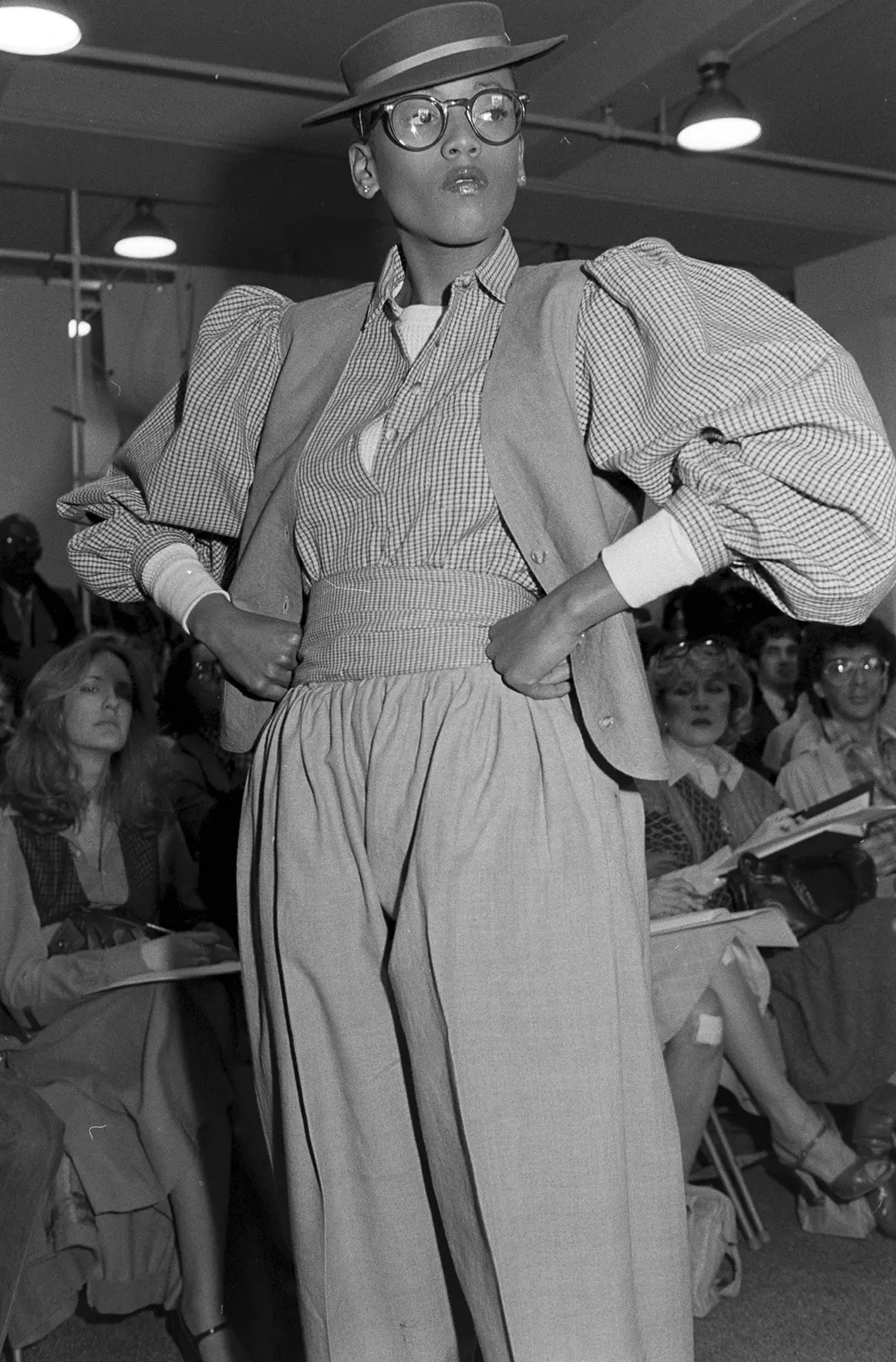
Doris “Toukie” Smith, the trailblazing model, actress, and cultural icon whose magnetic presence, distinct personal style, and larger-than-life personality helped broaden fashion’s vision of beauty, has died at the age of 74 following a long and courageous battle with multiple sclerosis. Her lasting influence on the international runway—and on the generations of creatives who followed in her footsteps—remains an indelible and celebrated chapter of fashion history.
A proud Philadelphia native, Smith was deeply rooted in a creative lineage. She was the sister of the legendary American designer Willi Smith, whose pioneering contributions to the cultural zeitgeist profoundly impacted the direction of fashion’s conversation during the latter half of the 20th century. "Toukie," as she was universally known throughout the industry, arrived in New York City just as her brother’s star began its meteoric rise on the American fashion scene, setting the stage for a collaborative family legacy that would leave an enduring mark on Seventh Avenue and beyond.
According to industry trailblazer Bethann Hardison, it was Willi Smith’s early introduction of his sister in his runway shows that helped catapult her modeling career into the national spotlight during the vibrant decades of the 1970s and 1980s. Reflecting on those formative years, Hardison shared insights with WWD about Smith’s unique entry into the high-stakes world of fashion.
"She was his nagging little sister, but as Willi began to use her in his shows, she began to get more exposure," Hardison recalled. "No, she wasn’t the tallest model, but she was beautiful. She had a larger-than-life personality and a great spirit. It was the 1970s, a great time for us all. Back then, becoming a model was different than today. She [Toukie] was more of a personality model and was admired by many of the great fashion designers. And it worked for her."

Although she may not have conformed to the rigid industry standards for a model’s height or traditional body type during that era, her arrival alongside other Black models—both men and women—ignited a much-needed, long-overdue conversation about diversity, representation, and the broadening definition of beauty within the fashion establishment. When asked to evaluate her lasting influence, model, chef, and businesswoman Norma Jean Darden noted that Smith helped reshape how the industry viewed the female form.
"Toukie helped fashion reenvision the female form. She was voluptuous for a model. But the designers loved her," Darden said, adding, "When I met her and Willi, they were embarking on a journey. It was a family affair always."
Willi Smith famously stood as one of the "big four" Black designers of his generation—alongside Jon Haggins, Scott Barrie, and Stephen Burrows—who fiercely championed diversity on Seventh Avenue and across the global fashion stage beginning in the 1960s. Among that influential quartet, he would ultimately emerge as one of the most commercially successful and culturally resonant figures. Darden fondly recalled participating in a major milestone alongside the siblings: "I walked in Willi’s grand gala at Wanamaker’s in Philadelphia, where his mother and aunt were seamstresses for a long time. When he returned to New York as the star of Seventh Avenue, Toukie was right there with him."
When Women’s Wear Daily turned its editorial lens onto the burgeoning movement of Black models and designers of the era through its special feature "SA’s 73 Movers," Smith was proudly captured among those now-iconic faces. Highlighting her unconventional and natural path to success, fellow luminary Naomi Sims remarked at the time, "Some of the best Black models have never gone to modeling school. Willi Smith’s sister, Doris, spotlights many shows."

Darden also pointed to Smith’s unwavering commitment to her own authentic image as a defining characteristic of her career. Her close-cropped natural hairstyle, worn boldly long before many other models would dare to adopt the look, perfectly captured the revolutionary spirit of the era and served as a living reflection of the "Black is beautiful" mantra sweeping the nation.
"Smith’s understanding of her own beauty was an affirmation, a voice that remains impactful in paving the way for the inclusivity we continue to fight for today," Darden emphasized.
As WWD continued to broaden its editorial coverage to champion inclusive beauty, Smith and her contemporaries fundamentally altered the discourse surrounding diversity, injecting fresh excitement, authenticity, and cultural expression directly into the runway experience. The daily publication’s extensive runway archives thoroughly document Smith’s ubiquitous presence as a celebrated face across both American and European fashion capitals.
Her vivacious energy naturally transcended the shows of her brother Willi, leading her to grace the legendary runways of houses such as Chanel, Geoffrey Beene, Valentino, Fernando Sanchez, Kansai Yamamoto, and Issey Miyake. Notably, with Miyake, she participated in the historic and critically acclaimed "East Meets West" fashion show, which memorably featured an all-Black model cast. Her dynamic presence also illuminated Patrick Kelly’s landmark fall 1989 runway presentation.

Sandi Bass, an original member of Hubert de Givenchy’s prestigious all-Black model cabine, recalled Smith’s extraordinary warmth and international camaraderie. "Toukie never met a stranger," Bass reflected. "From Paris, Rome, and Tokyo, we walked the runways together, all of us. Her infectious personality drew you in at ‘hello,’ leaving the receiver under her magic, feeling they just met a ‘forever friend.’"
Veronica Jones, a former buyer at Joseph Magnin Department Stores and a longtime friend, echoed those sentiments, describing Smith as a true creative force. "Toukie had a fantastic spirit; she was a force of life. Loving, kind, and she graced the runway with the same spirit. When traveling for overseas buying trips, she was one of the Black models I loved to see on the runways at Issey Miyake and Kansai Yamamoto and others. She remained herself, a true fashion diva. While she wasn’t the average model, she knew how to work it on the runway, becoming an icon in her timeline."
Beyond the professional sphere of high fashion, Smith was a celebrated and familiar fixture on the vibrant social scene of New York and global creative circles, serving as an enduring muse to many visionary artists. Fellow model Alva Chinn observed, "On the runway, Toukie brought a womanly body and energy as muse to her designer brother, Willi Smith, and she was also a muse to photographer Jean-Paul Goude."
WWD notably interviewed Goude in 1982 following the release of his provocative and controversial art book "Jungle Fever," which prominently featured Smith. Discussing his artistic approach with the publication at the time, Goude explained that he intentionally exaggerated her features through an artistic lens, stating, "Smith was a masterpiece of nature. But I couldn’t help myself. I had to improve on the masterpiece."

Fellow fashion icon Pat Cleveland remembered Smith with immense fondness, capturing the whimsical joy she brought to every environment she entered. "Toukie was pure joy, and she lit up every room she walked into. She seemed to float through it like someone out of a fairy tale. She was particularly tiny and cute like a Betty Boop character. She was playful and had a special sweetness about her that made everyone around her smile. She brought that spirit to everything she did, especially on the runway for her brother, Willi. Toukie was one of a kind."
Away from the blinding lights of the fashion capitals, Smith’s multifaceted life expanded into acting, entrepreneurship, and motherhood. She showcased her comedic and dramatic timing as a recurring cast member on the popular television sitcom "227" from 1989 to 1990, successfully established and operated a popular restaurant and catering business in New York City, and welcomed twin sons with actor Robert De Niro via surrogate during a partnership that spanned approximately eight years. Furthermore, following the tragic death of her brother Willi in 1987, Smith played a pivotal role in establishing Feb. 23 as official Willi Smith Day in New York City, ensuring his monumental achievements in fashion would be permanently honored in conjunction with Black History Month.
Together, the reflections of these industry icons solidify Smith’s rightful place as a central figure in the Black model movement of the 1970s and 1980s. Her legacy remains a testament to an extraordinary era that helped transform diverse representation from a fleeting exception into an essential standard, permanently breaking barriers on the runway and clearing a path for countless generations to follow.