






With its two round eyes and curving, sculptural grin, the Bilibo has spent a quarter of a century looking very much like a character waiting for its story to begin. Designed by Swiss creator Alex Hochstrasser, the iconic hemispherical shell stands as a masterclass in open-ended toy design, easily transforming from a child’s seat or rocking boat into a protective helmet, a drum, a stepping stone, or a snow sled. Twenty-five years after its debut in 2001, the toy remains remarkably unchanged in its core form, serving as a powerful testament to the enduring appeal of a design that leaves almost everything to the boundless realm of a child’s imagination.
To mark this significant silver milestone, Moluk, the Zurich-based design-led toy company run by Hochstrasser alongside his sister, architect Doris Hochstrasser, is expanding the beloved family. The brand is introducing the Bilibo Midi, a more compact shell tailored specifically for toddlers, alongside Bilibo Dots, a versatile set of colorful counters that successfully translate the foundational philosophy of the original design into a completely new, tactile format. Both fresh additions build directly upon the core premise that has propelled Bilibo into homes, progressive classrooms, and prestigious museum permanent collections around the globe—and that continues to anchor the entire catalog of Moluk: offer a thoughtfully pared-back object and leave the rest entirely up to the imagination.

The Toy That Lets Kids Make the Rules
Looking back at the genesis of his most famous creation, Alex Hochstrasser points to the landscape of the toy market at the turn of the millennium. Walking down the aisles of commercial toy stores, he found himself struck by how rigidly mainstream playthings were categorized by strict age ranges and outdated gender norms, effectively granting them an expiration date long before the physical materials ever wore out. At the same time, the market was flooded with heavily licensed merchandise where the narrative was entirely pre-written, leaving little room for creative interpretation or spontaneous engagement.
Seeking an alternative path, Hochstrasser wanted to develop something far more universal, inclusive, and enduring—an object that could genuinely grow alongside children and leave them firmly in charge of their own narrative and play experience. This vision required rigorous firsthand observation of children at play, repeated rounds of physical prototyping, and critical insights drawn from child-development experts. Yet, Hochstrasser always ensured that the final step of the creative process remained outside his direct control. As he frequently explains, the ultimate design phase always belongs to the children themselves, who step in as the true co-inventors to decide what the object actually is and what it can accomplish on any given day.

How Bilibo Took Shape
The iterative journey toward the final Bilibo form drew heavily on archetypal, organic shapes found in nature, such as smooth bird eggs and protective turtle shells. What fascinated the designer most was how the physical behavior of a simple hollow hemisphere could change dramatically simply by turning it upside down. When resting steadily on its wide rim, the object acts as a stable hill to climb, a cozy shelter for toys hidden underneath, or a stable seat. When flipped over onto its smoothly rounded base, however, it instantly transforms into a dynamic, kinetic vessel capable of rocking, spinning, and challenging a child’s sense of balance and coordination.
Furthermore, the shell’s carefully engineered threefold symmetry allows two identical pieces to snap and lock together seamlessly, creating a cheerful, symmetrical sphere. The two distinct openings are read instinctively by children as eyes, instantly lending the inanimate object a friendly personality and a clear sense of direction. At the same time, these openings serve highly functional purposes: they act as convenient peepholes, sturdy anchor points for threading a pull rope, and practical spouts for pouring water or sand during tactile sensory play.

Every single detail was intentionally calibrated to contribute simultaneously to the object’s engaging character and its vast possibilities for physical and imaginative play. Hochstrasser sought to craft a form that felt immediately friendly and familiar to a young child, yet distinct and slightly unusual enough to spark genuine curiosity and exploratory behavior.
This deceptively simple industrial design quickly attracted critical acclaim far beyond the traditional boundaries of the toy industry. It earned a coveted Design Distinction recognition in I.D. Magazine’s Annual Design Review in 2002, sharing the spotlight the very same year with the debut of the original Apple iPod. Years later, Bilibo earned a place in the Museum of Modern Art’s landmark 2012 exhibition, Century of the Child: Growing by Design, 1900–2000, before securing permanent spots in prestigious design and modern art museum collections across Zurich, Brussels, and Paris.

25 Years Later, the Play Continues
As the brand celebrates its quarter-century milestone, the introduction of the Bilibo Midi addresses the needs of a slightly younger demographic. Bringing a lighter, more compact shell to toddlers, the Midi provides ample room for a two- or three-year-old child to comfortably sit, rock, and spin. Its scaled-down dimensions also make it exceptionally easy for small hands to carry independently, even when it is loaded up with backyard sand or water.
A modest change in physical scale can make a profound difference in how independently young children interact with an object. During the testing phase for the Midi, the design team was struck by how naturally toddlers picked up the smaller shells or arranged them across the floor to use as independent stepping stones without needing any adult intervention or instruction.

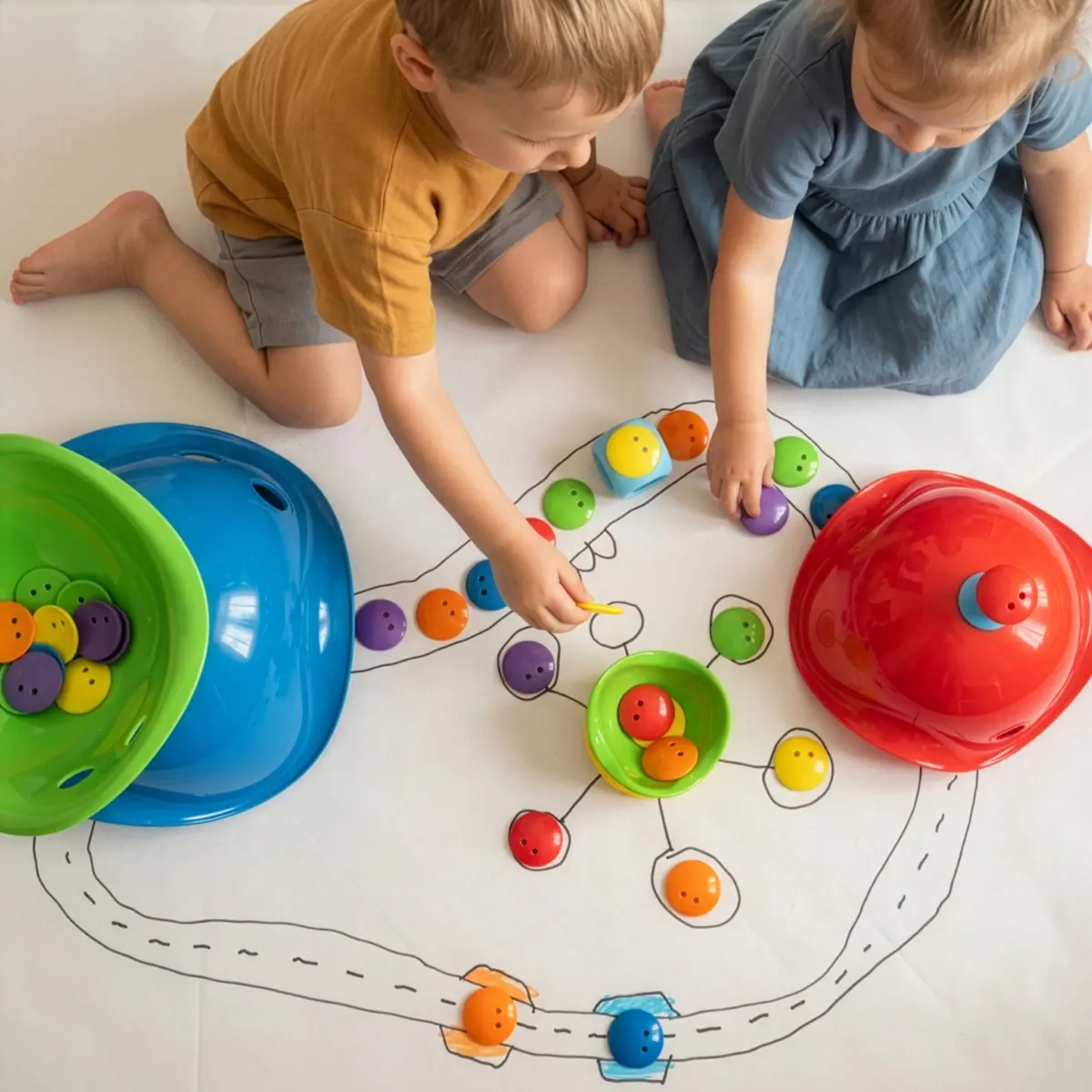
Simultaneously, Moluk is rolling out Bilibo Dots, a curated set of 36 miniature counters that echo the original shell’s distinctive curved profile and dual-eye motif in a small format. These versatile tokens can be sorted, stacked, counted, threaded onto strings, or tossed directly inside a classic Bilibo shell to rattle around and create auditory feedback. Hochstrasser views all Moluk creations as an interconnected family of building blocks for play, engineered to work harmoniously together so that each new addition unlocks fresh possibilities for the existing pieces. Placing a handful of colorful Dots inside a Midi shell, for instance, instantly turns it into a magical treasure chest.
To honor the anniversary, the classic full-sized Bilibo is also being released in a series of special-edition colors for 2026 and 2027, featuring rich tones of amber, emerald, graphite, and coral. Aside from these vibrant new hues and a structural retooling in 2021 that made the injection-molded plastic even lighter and stronger, the original design has remained virtually untouched for twenty-five years. Today, adults who spent their early childhoods rocking and spinning inside Bilibo shells are watching a brand-new generation discover the very same open-ended joys.

Ultimately, the enduring longevity of the design relies equally on the physical durability of the object and the ability of children to continuously invent fresh applications for it. With no digital screens to update, no delicate mechanisms to break, and no batteries to replace, the Bilibo endures as a pure study in geometric simplicity. By shifting its orientation or changing how it is viewed, its character transforms entirely, inviting rough-and-tumble physical mastery like balancing and spinning, while smoothly adapting to become a drum, a boat, or a cradle within the narrative of a child’s imagination. The physical object remains constant, but the world of play it unlocks keeps evolving as the child grows.