





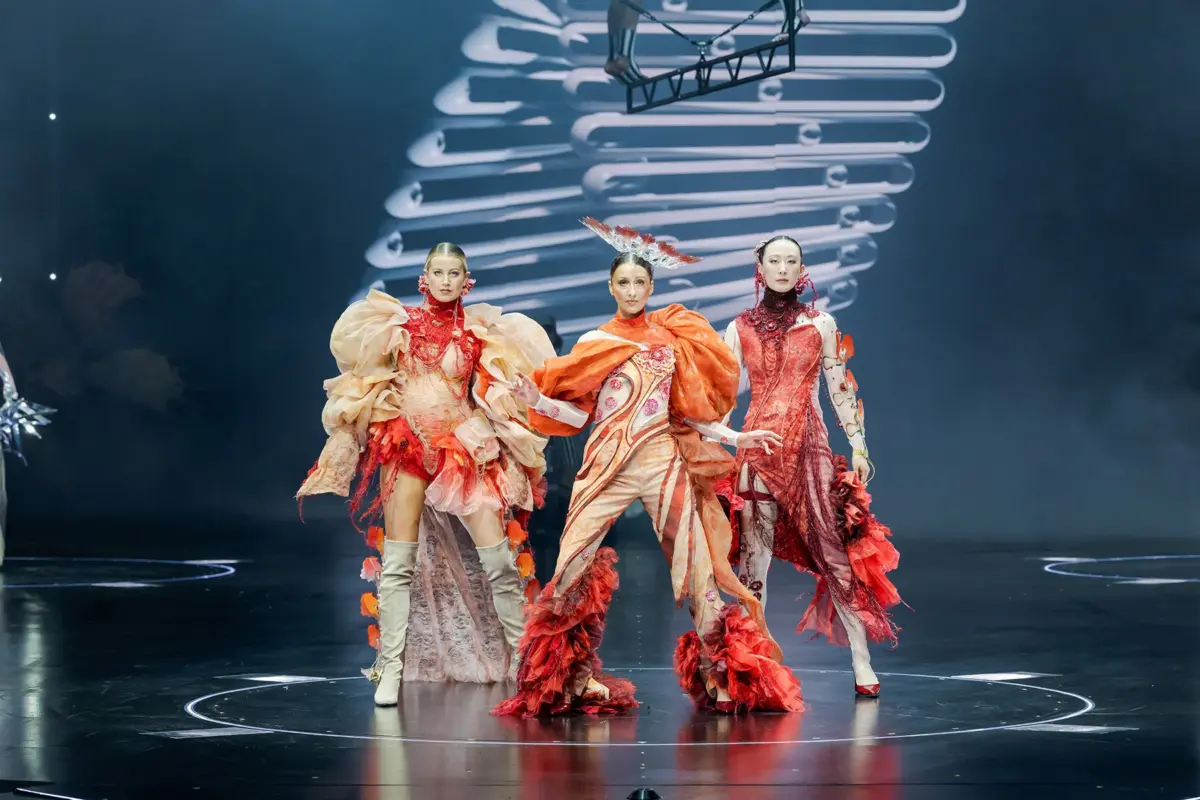
The World of WearableArt (WOW) begins with a singular object, but its ultimate competition is structured entirely around what happens after that object reaches a human body. Set against the vast expanse of Wellington’s TSB Arena, finalist garments enter a high-stakes environment where distance and movement immediately become rigid design constraints. Here, dynamic stage lighting radically transforms what remains visible from a viewer’s seat, testing the limits of craftsmanship, engineering, and artistic expression.
The 2026 edition of the international competition, aptly titled GLO!, brings together 108 finalist works crafted by 134 visionary designers hailing from 18 different countries. As these breathtaking creations take over the arena, they invite a critical question at the very core of the format: what happens to an artwork when it is forced to perform live for a massive audience?
This ambitious production originated on a much smaller scale nearly four decades ago. Founder Suzie Moncrieff staged the inaugural WOW show at Nelson’s William Higgins Gallery in 1987, issuing a creative challenge to designers to "take art off the wall and adorn the body." Approximately 200 people gathered for that initial showcase. Today, the modern Wellington production reaches more than 60,000 spectators across its extensive seasonal run. As the physical footprint and audience of the event expanded exponentially, the viewing conditions shifted in tandem. A garment that once moved gracefully through an intimate, gallery-scale setting must now be completely legible across an entire arena.
Designed for the Back Row
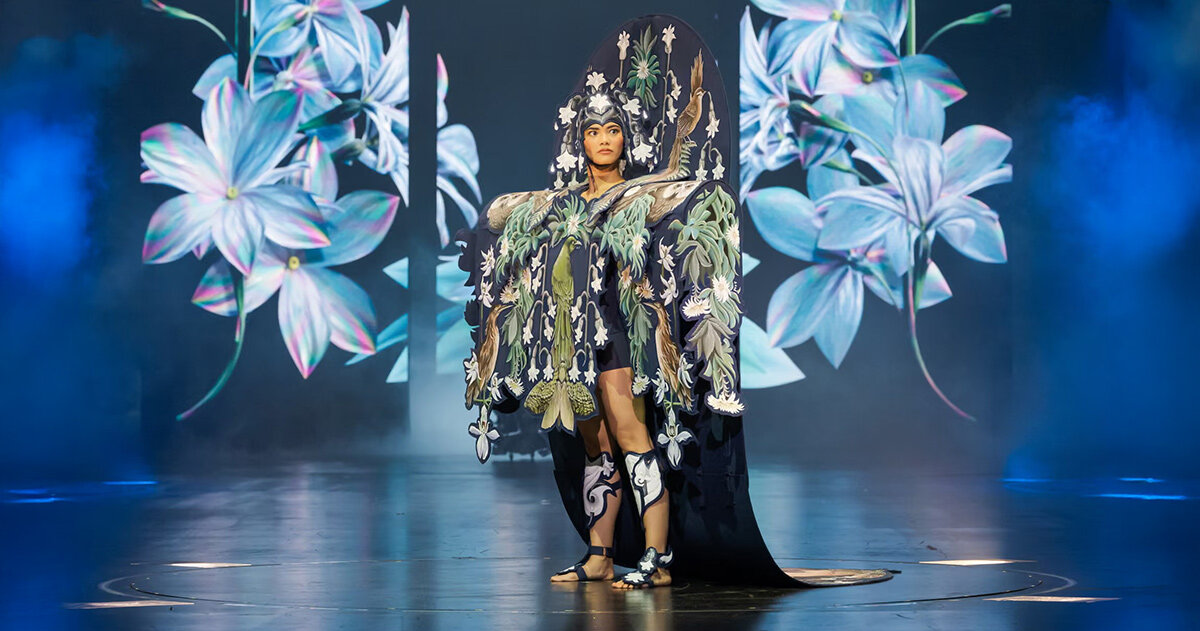
The World of WearableArt explicitly bakes this demanding requirement into its framework. Official judging criteria mandate that every competing garment must "look as good up close, as it does from a distance," while retaining a structural integrity robust enough to handle complex choreography. Judges evaluate the finalists under full show lighting, accompanied by immersive music and a full cast of performers. The judging process deliberately treats visibility as a core component of the initial design brief. While intricate surface details still count immensely, silhouette and structural posture are equally critical. Movement can fundamentally alter the perceived shape of an object, and distance ruthlessly decides which subtle gestures survive the journey across the room.
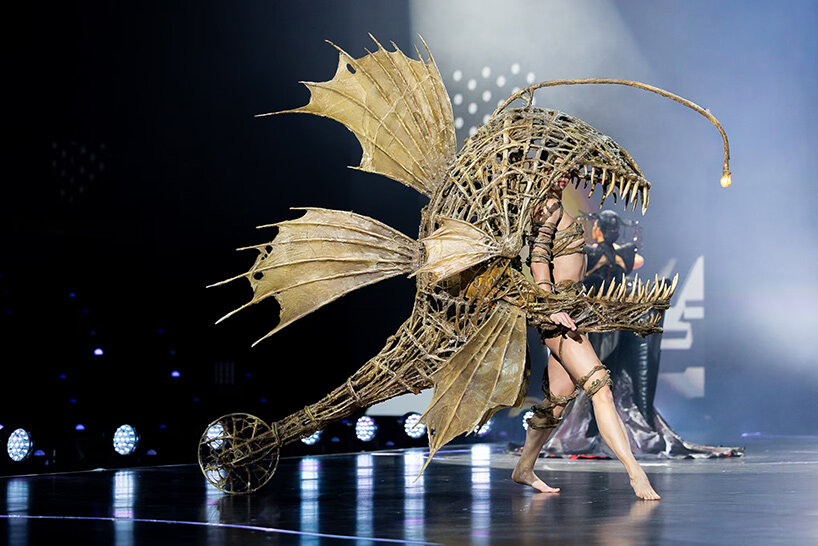
The diverse works featured in the 2026 edition make this intense pressure instantly visible to the naked eye. Joe Blanck’s creation, Lophii, entirely swallows the wearer inside the massive silhouette of a deep-sea anglerfish, complete with an illuminated lure that projects dramatically beyond the human body. Meanwhile, Cecilio Castrillo’s Artemis stretches outward through a pale, winged architectural structure that reads almost diagrammatically against the deep shadows of the stage.
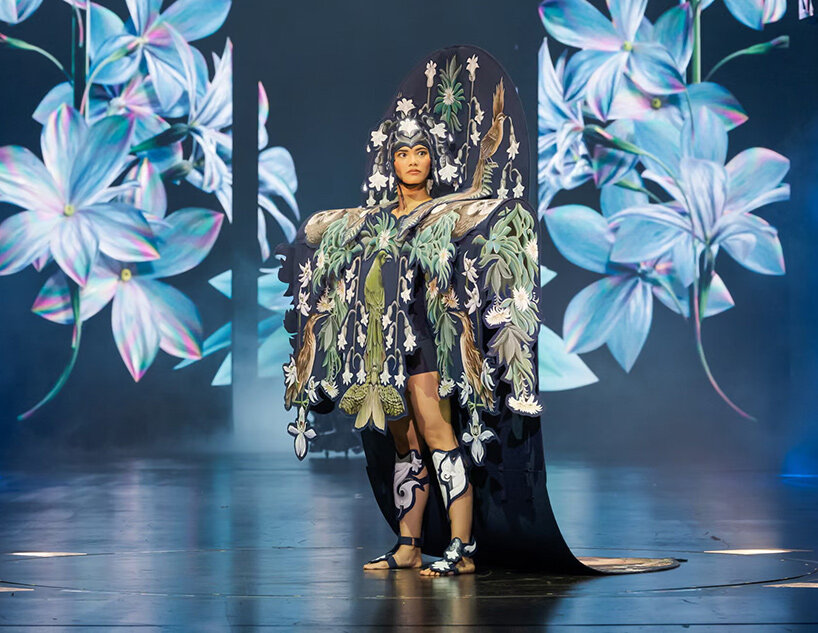
Kayla Christensen’s Sacred Nightfall, which claimed the prestigious title of winner of the 2026 Supreme WOW Award, operates through an entirely different kind of physical scale. An intricately stitched, masterfully detailed tapestry transforms into a striking figurative presence once it is wrapped around and inhabited by the performer. Through these transformations, the human body turns each inanimate construction into a living image capable of traveling across the vast room and capturing the collective gaze of the audience.
Approaching the Condition of Theatre
Prominent modernist art critic and historian Michael Fried famously supplied one of the twentieth century’s most severe warnings regarding art becoming overly dependent on its viewer and immediate physical surroundings. In his influential 1967 essay Art and Objecthood, he wrote: "Art degenerates as it approaches the condition of theatre." Fried was arguing passionately against an art form whose meaning relied too heavily on duration, spectacle, and the beholder’s physical, theatrical encounter within a shared space.
The World of WearableArt embraces almost the exact opposite position. Within this arena, complete dependence on the stage, the lighting, and the theatrical production is deliberately built into the very DNA of the competition. A WOW garment is fundamentally expected to change, morph, and come alive the moment somebody steps inside it and activates its form.
Renowned performance theorist Erika Fischer-Lichte offers another vital perspective to help understand this profound shift. She argued that "a performance comes into being through the bodily co-presence of actors and spectators." A wearable artwork complicates this traditional relationship even further because the artistic object sits directly on the living performer, the human body provides its primary scale and fluid motion, and the audience supplies yet another critical condition through which it is interpreted. At WOW, every garment successfully bridges the gap between static sculpture and ephemeral live event, with its ultimate, true form emerging only through active use.
What Survives the Photograph
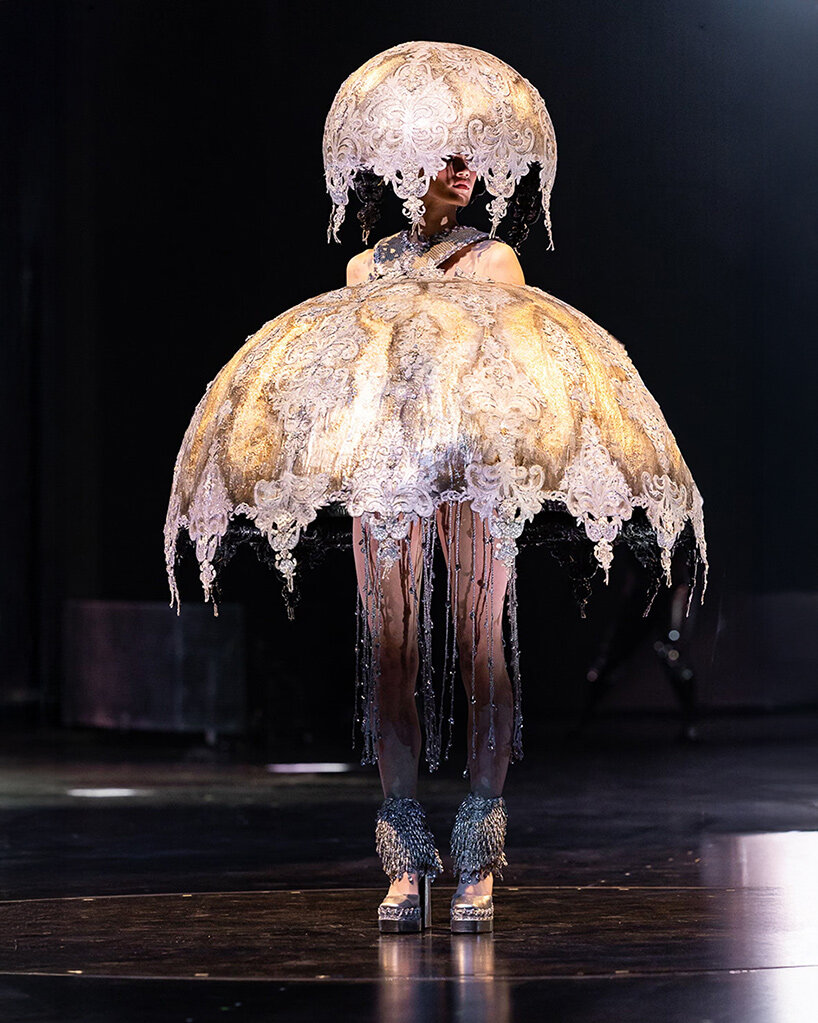
Beyond the immediate confines of the arena, another vast and influential audience is waiting in the digital realm. Fashion scholar Caroline Evans, writing extensively about the consumption of fashion in the wake of digital media’s exponential rise, observes that "we now consume fashion as image as much as we experience it as material object." The striking photographs emerging from Wellington demonstrate this contemporary reality in real-time. Viewed purely as a still image, the accompanying music disappears entirely, and complex choreography is frozen into a single, permanent pose. Movement can no longer be directly witnessed; instead, it has to be cleverly suggested by the dramatic position of a limb or the sweeping arc of a fabric caught mid-motion.
Consequently, the very same garment must successfully operate through two entirely different kinds of viewing experiences. On the live stage, its appearance shifts continuously from one second to the next as the performer moves fluidly through changing light and space. In photographs, all of that dynamic complexity is compressed into a single frame that ultimately reaches far more viewers than the live production itself. Large, expressive silhouettes and forms that can be understood almost immediately tend to survive this digital transition exceptionally well. The exact same qualities that make these intricate works readable from the very back of a crowded arena also make them remarkably easy to carry onto a glowing screen.
The Audience Enters the Design
Spectatorship is inherently an active cognitive process during which viewers select, process, and interpret what they see, connecting those visual stimuli to their own personal experiences. WOW provides its audiences with unusually direct and provocative material to work with. The imaginative designs frequently begin with recognizable, everyday forms, which are then enlarged, distorted, or abstracted until the very act of recognition becomes a central part of the artistic encounter.
Shing Hei’s My Ugly Duckling cleverly places the avian form directly around the human body, while Rachel Poole and John Fitzgerald’s Ripe for the Pecking transforms familiar fruit into exaggerated, sculptural wearable volume. These playful and profound references arrive instantly from across the room, establishing an immediate connection with the onlookers.
The most compelling critical inquiry surrounding the World of WearableArt concerns the immense pressure that spectatorship places on physical form. Its garments are meticulously built to reach someone sitting far away from the stage as well as a camera positioned much closer, before continuing their journey onward as captured digital images. That demanding sequence naturally favors bold scale and instant visual legibility, while live movement supplies an entirely new layer of meaning once the wearer enters the space. It also thoroughly explains why the human body remains so resolutely central to the event. Once art leaves the traditional gallery wall here, the viewer effectively enters the design brief right alongside it.