




Books usually remain still until someone picks them up and brings them to life through reading. But in the visionary world of artist and stage designer Es Devlin, books are dynamic, moving participants in an overarching choreography. This interplay of literature, light, sound, and motion is the central premise of Es Devlin: Other Worlds, a sweeping new exhibition that marks the artist’s first European retrospective, currently on view at London’s Design Museum.
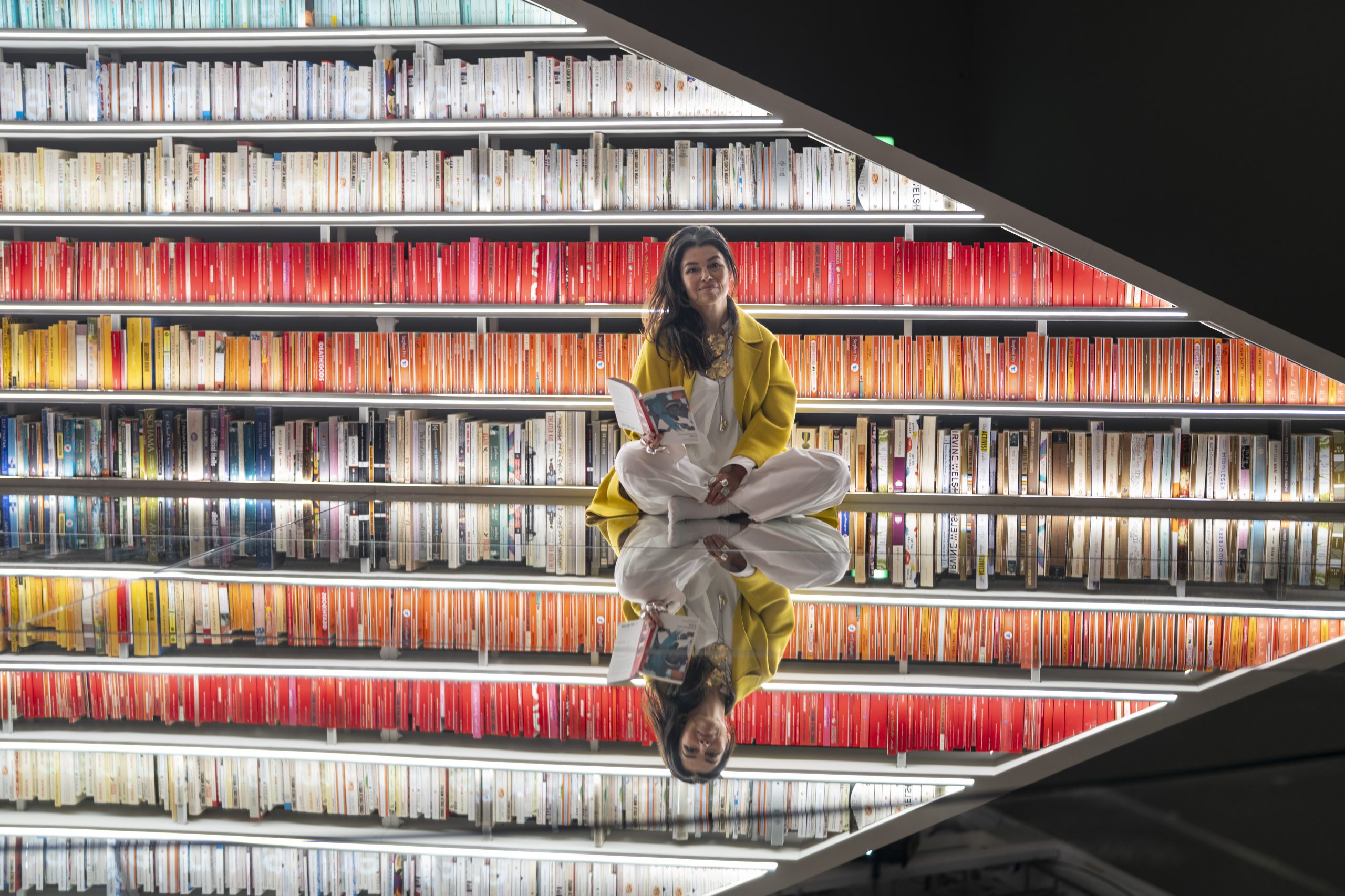
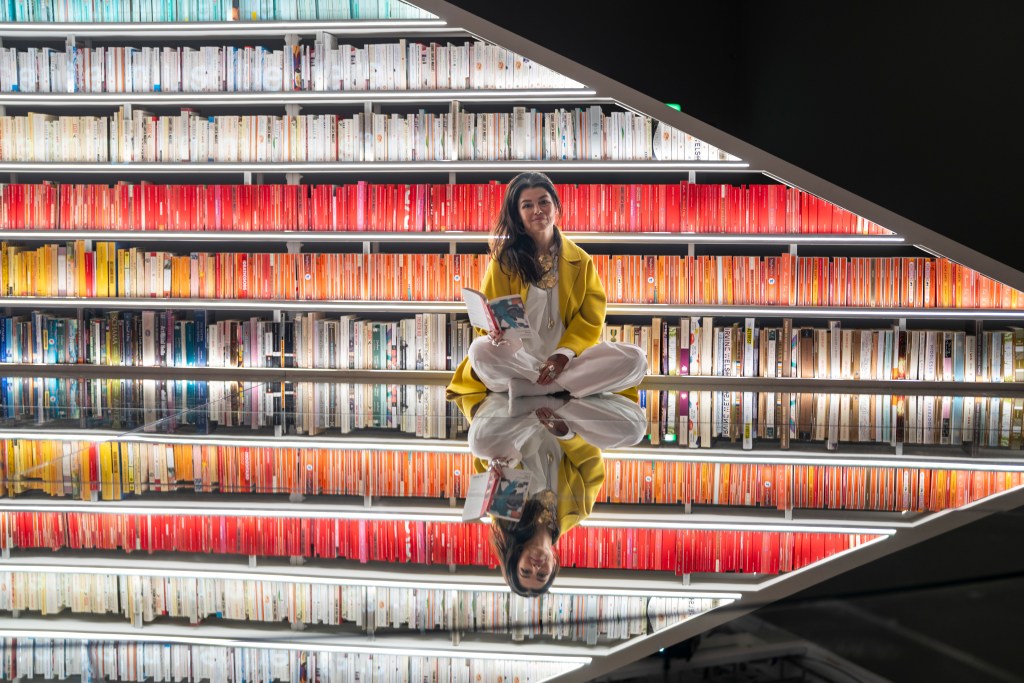
Visitors to the museum encounter installations that feel both familiar and entirely unprecedented. The exhibition features revolving bookcases of varying shapes and configurations that turn in front of and around the viewer—echoing past iterations of Devlin’s work such as Library of Light at the Pinacoteca di Brera during Milan Design Week, Library of Us on Faena Beach for Miami Art Week, and Library of the Four Winds at Castle Howard. For this landmark London retrospective, however, Devlin has unveiled Infinite Library, a monumental triangular structure housing 2,000 books that continuously rotates while reflecting infinitely in a vast circular mirror.
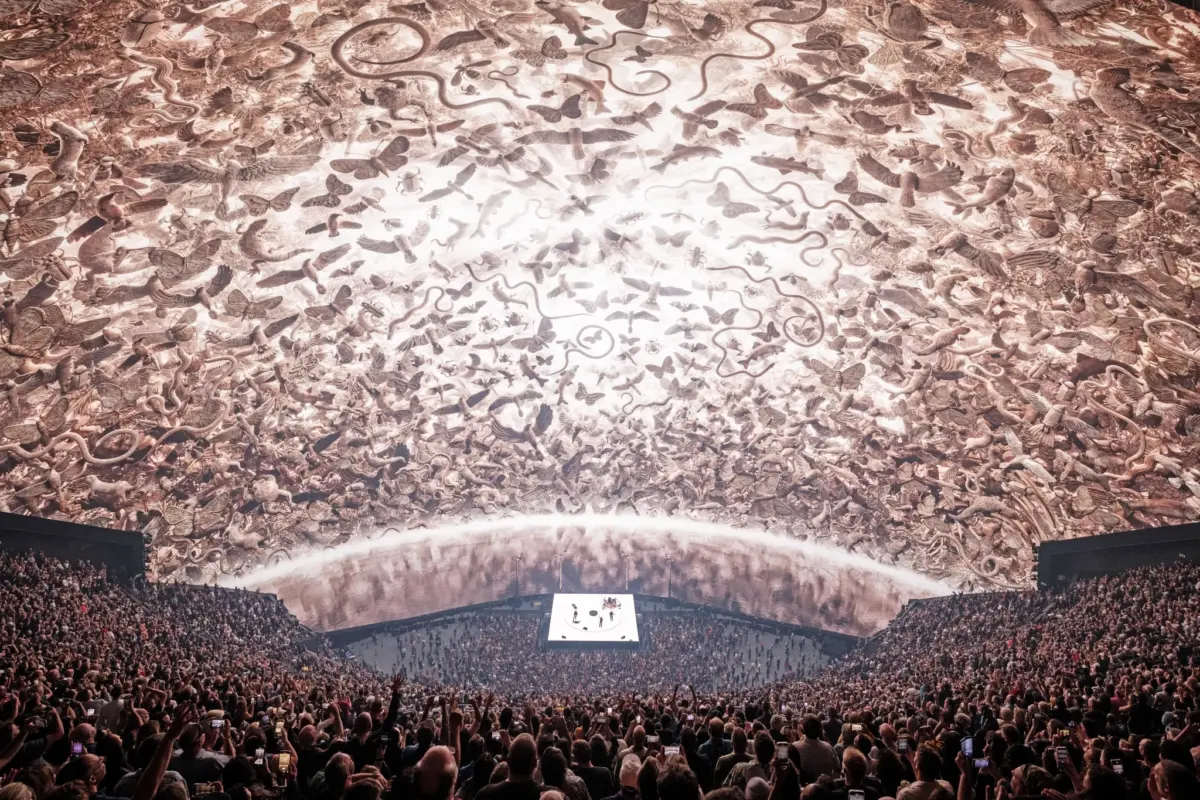
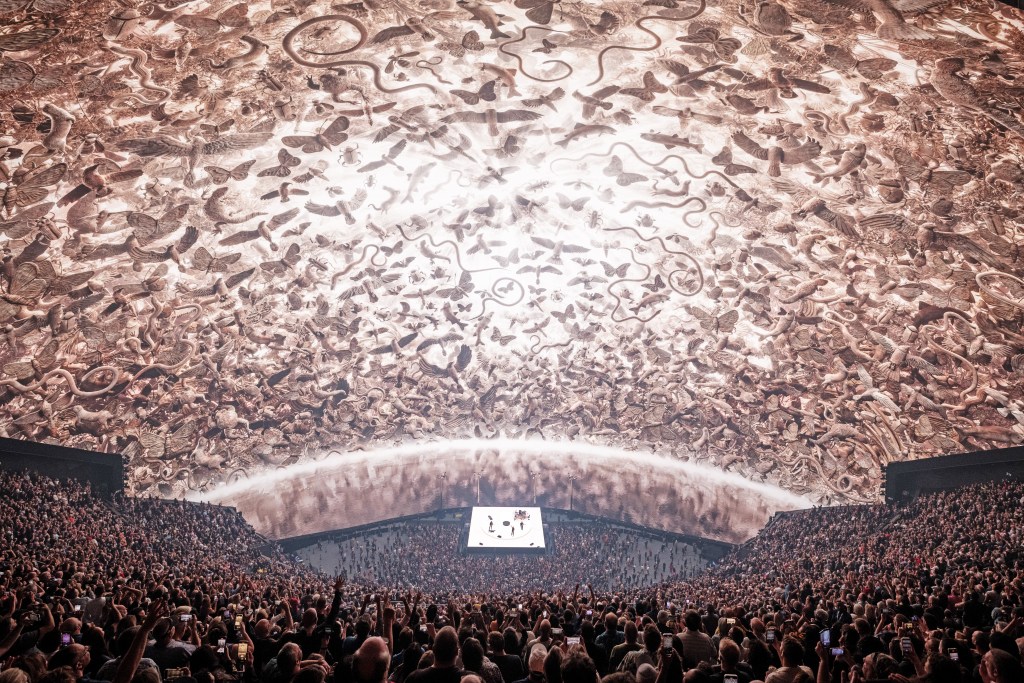
Describing Devlin with a single job title has always proven impossible. Operating across theater, stadium tours, opera houses, and contemporary art institutions, she defies categorization as a stage designer, painter, sculptor, or installation artist. Over a prolific career, she has collaborated with an extraordinary roster of music icons including Kanye West, Lady Gaga, Billie Eilish, U2, Beyoncé, and Mika. She has designed striking sets for the Metropolitan Opera in New York, the National Theatre in London, and the Bregenzer Festspiele in Austria; created immersive public installations for the V&A and Tate Modern; contributed to the inaugural performance at The Sphere in Las Vegas; designed show sets for Louis Vuitton; and been the subject of An Atlas of Es Devlin at the Cooper Hewitt, Smithsonian Design Museum in New York. Most recently, she served as the artistic director of Homo Faber, the celebrated craft biennial held in Venice.
Reflecting on her eclectic career during the exhibition’s press preview, Tim Marlow, director of the Design Museum, noted her unique position in the contemporary cultural landscape. “Es is such a multi-hyphenate. There’s so many things that Es does and is, but ultimately she’s Es Devlin,” Marlow remarked.
When asked about the traditional boundaries separating different artistic disciplines, Devlin offered a perspective rooted in the changing nature of human creation. Pointing to her recent work with artisanal objects in Venice, she observed that distinctions between traditional genres are becoming increasingly less urgent in an era dominated by collective artificial intelligence. Instead, she believes future emphasis will shift away from technical specialisms toward the fundamental recognition of what is made by the human hand and embodied consciousness.
Having spent decades defining her practice through theater, dance, and live music, Devlin has shifted her primary focus over the past decade toward large-scale museum art installations. She notes that she has created 37 such works in the last ten years alone. What she brings to the museum space, however, are the exact terms of engagement she mastered in the performing arts. For Devlin, the visitor’s arrival and initial moments within a space are critical; she curates how people gather and offers them the intimate experience of sharing space as a small audience.
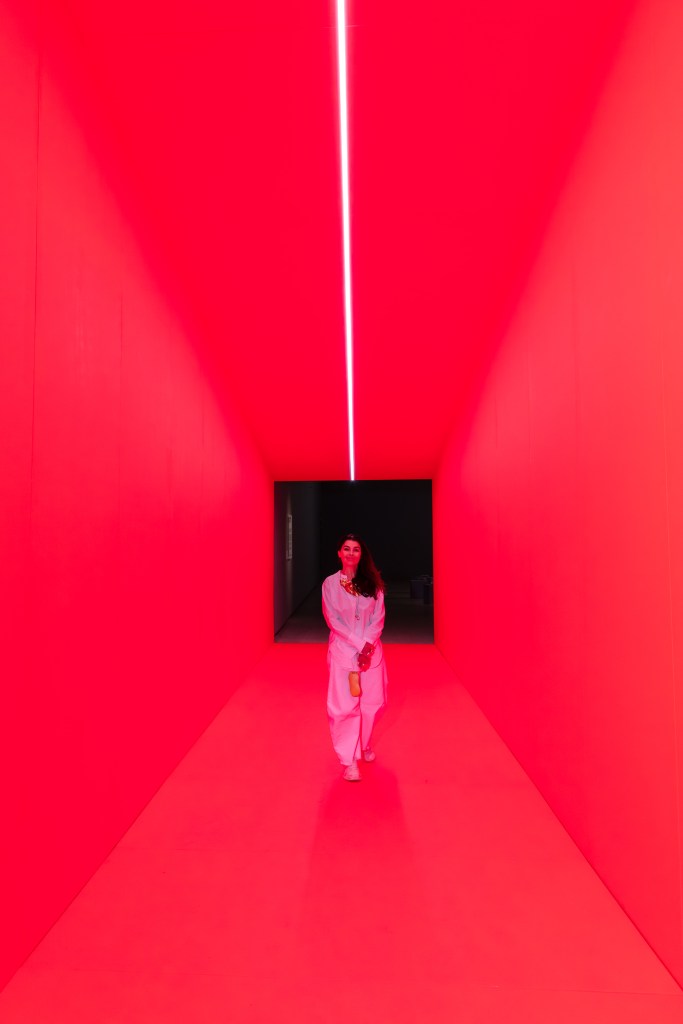
This philosophy is immediately evident upon entering the London exhibition. Visitors first gather in groups of 50 inside a dramatic red room before stepping into an almost exact reproduction of Devlin’s personal studio. After a few minutes of browsing and capturing photographs, the space transforms through sound, lighting effects, and a moving video chronicling the artist’s life, culminating in a carefully orchestrated scenographic twist. From there, the journey continues through a more traditional gallery layout, but the foundational lens of temporary community and shared performance established in the opening moments remains active throughout the experience.
Throughout the retrospective, recurring visual motifs emerge from thousands of displayed objects. Devlin points to fundamental geometries—a line of light, a revolving cube, a circle—as universal shapes that existed long before her birth and will endure long after. While her work is deeply personal and springs directly from her own archive, her ultimate goal is to construct open worlds that invite every visitor to find their own connection, infused with the collective experiences of others across time.
At the heart of the exhibition lies a massive display of drawings, sketches, and models spanning hundreds of projects. Curator Johanna Agerman Ross, working alongside Danielle Thom and Margherita Dosi Delfini, spent intensive days reviewing thousands of artifacts, ultimately selecting 5,000 items and organizing them in close collaboration with Devlin’s studio team.
The survival of this extensive archive is largely a matter of serendipity. Devlin recounts leaving a long-term relationship at the age of 28 with just a single suitcase. Years later, her ex-boyfriend informed her that he was selling the house and had discovered eight bin bags in the attic. Those bags contained the early works that now line the exhibition walls. What began as uncalculated storage evolved into a recognized, invaluable record of an evolving creative process.
The exhibition is equally a testament to collective studio labor rather than solitary genius. Devlin emphasizes that her team of designers—consisting of eight women and one man—is deeply involved in every facet of the work. From taking preliminary drawings and translating them into technical blueprints to constructing recent models and meticulously filing decades of material, the studio functions as an integrated collaborative unit that has preserved her working history since 1996.
Devlin’s current slate of projects reflects the sheer breadth of her ongoing output. She recently completed The Everythingists at the V&A East Storehouse—a title borrowed from Russian avant-garde artist Natalia Goncharova, who rejected creative limitations across stage design, fashion, portraiture, and painting in favor of a renaissance approach to multi-modal expression. Alongside museum exhibitions, Devlin maintains an active schedule across popular culture and classical performance, having collaborated with Hussein Chalayan on Olivia Rodrigo’s tour and contributed design work to productions like Don Giovanni at the opera house.
The retrospective culminates in a final room dominated by the giant rotating library. Containing 2,000 books provided by Penguin Random House UK and arranged in a vibrant rainbow spectrum, the space invites visitors to sit and read from the foundational titles that shaped Devlin’s creative ethos. Among the volumes featured are James Gleick’s Chaos, David Abram’s The Spell of the Sensuous, Toni Morrison’s Beloved, and Margaret Atwood’s Oryx and Crake—the very texts that opened the portals through which Devlin entered the other worlds she now constructs for audiences worldwide.
Es Devlin: Other Worlds runs from October 2, 2026, through April 4, 2027, at the Design Museum in London.